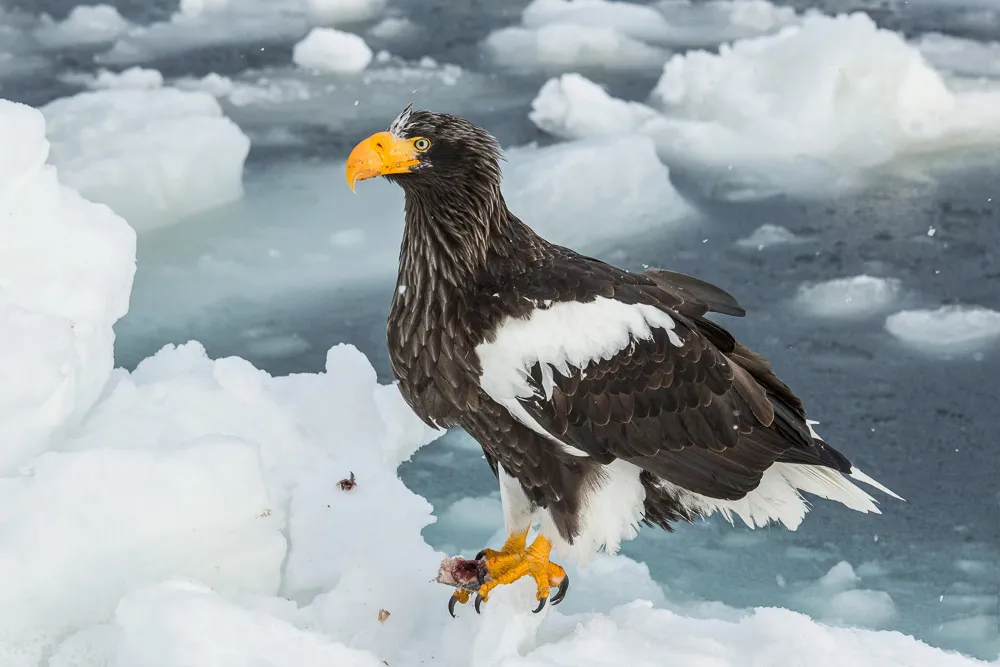
Bald Eagle
Haliaeetus leucocephalus
Also known as North American Bald Eagle, Northern Bald Eagle
- Where to see one
- 102 U.S. zoos in our directory hold bald eagle, confirmed against each zoo's own animal list.
- Native range
- Most of Canada and Alaska, the contiguous United States, and northern Mexico
- Size
- Body length 70–102 cm (28–40 in); wingspan 1.8–2.3 m (5 ft 11 in–7 ft 7 in); mass typically 3–6.3 kg (6.6–13.9 lb)
- Lifespan
- Around 20 years on average in the wild; oldest confirmed bird 38 years
Conservation status
Least Concernassessed 2024
IUCN Red List category LC — step 1 of 7.
Least Concern (LC), assessed 2024; recovered and increasing
About the bald eagle
The bald eagle is a bird of prey found across North America, including most of Canada and Alaska, the entire contiguous United States, and northern Mexico. As a sea eagle in the genus Haliaeetus, it forms a species pair with the white-tailed eagle of Eurasia, which fills the same ecological role there. The bald eagle is the national bird and national symbol of the United States and appears on its seal.
The name has nothing to do with hairlessness — "bald" comes from an older meaning of "white-headed," describing the adult's white head feathers against dark brown body plumage. Males and females look alike, but females run about 25% larger than males. The beak, feet, and irises are bright yellow, the large hooked bill has a yellow cere, and the legs are bare down to short, powerful, large-taloned toes, with the hind talon especially developed for piercing prey held immobile by the front toes. Immature birds are dark brown with messy white streaking and don't reach the adult's white head and tail until roughly their fifth year. Adults measure 70–102 cm (28–40 in) in body length with a wingspan of 1.8–2.3 m (5 ft 11 in to 7 ft 7 in) and typically weigh 3–6.3 kg (6.6–13.9 lb); size increases with latitude, so Alaska produces the largest birds, with some females exceeding 7 kg (15 lb) and wingspans reaching 2.44 m (8 ft).
In the wild, the bald eagle occurs near seacoasts, rivers, large lakes, marshes, and other big bodies of open water with abundant fish. It nests in old-growth or mature trees taller than 20 m (66 ft), usually within 200 m (660 ft) of water. The species builds the largest nest of any North American bird — the record, found in Florida in 1963, measured 2.9 m (9.5 ft) wide and 6.1 m (20 ft) deep, and some historic nests reportedly weighed as much as a metric ton.
Behavior and diet
Diet
Opportunistic feeder, subsisting mainly on fish
The bald eagle is an opportunistic feeder that relies mainly on fish, which it swoops down to snatch from the water with its talons. It reaches sexual maturity at four to five years of age. Its call is a series of weak, staccato chirping whistles — kleek kik ik ik ik — with a cadence somewhat like a gull's, and young birds tend to sound harsher and shriller than adults.
At minimum population in the 1950s, the bald eagle was largely confined to Alaska, the Aleutian Islands, northern and eastern Canada, and Florida. Banning the hunting of bald eagles and the pesticide DDT slowed that decline, and by 2018 the species nested in every continental U.S. state and Canadian province. Bald eagles also gather seasonally where fish are concentrated — one to two thousand birds winter along the Squamish and Cheakamus Rivers in British Columbia from November to February, drawn by spawning salmon, with similar congregations at open lakes and rivers across the northern United States.
The species is generally sensitive to human disturbance while nesting, typically choosing sites well away from low- and medium-density human activity. Even so, bald eagles occasionally nest within major cities, including a family that took up residence in Harlem, New York City, in 2010. Wintering birds are less particular about disturbance and gather wherever perches and prey are plentiful.
Range and habitat
Habitat
Seacoasts, rivers, large lakes, marshes, and other large bodies of open water with abundant fish and old-growth trees nearby
The bald eagle's natural range spans most of North America — nearly all of Canada, the entire continental United States, and northern Mexico — making it the only sea eagle endemic to the continent. It occupies a wide variety of wetland habitats, from the bayous of Louisiana to the Sonoran Desert and the eastern deciduous forests of Quebec and New England. Northern populations are migratory, while southern birds tend to remain on their breeding territory year-round. In Canada, the largest numbers occur along the British Columbia coast, with substantial populations also in Alberta, Saskatchewan, Manitoba, and Ontario; in March 2024, bald eagles were recorded nesting in Toronto for the first time.
Preferred nesting habitat varies regionally: mangrove swamps, shorelines, and open prairie with scattered tall trees in Florida; cottonwood and pine groves along streams in Wyoming; and Sitka spruce, which supplies most nest trees, in Southeast Alaska. Eagles increasingly nest near human-made reservoirs stocked with fish, and the species has occurred rarely as a vagrant in Ireland and the United Kingdom.
Conservation status
The bald eagle is listed as Least Concern on the IUCN Red List, based on a 2024 BirdLife International assessment. That status reflects a dramatic recovery: in the late 20th century the species stood on the brink of extirpation from the contiguous United States.
Protection came in stages. The 1918 Migratory Bird Treaty first protected the species in the U.S. and Canada, and the Bald and Golden Eagle Protection Act of 1940 banned commercial trapping and killing of the birds and collecting their eggs. The bald eagle was declared an endangered species in the U.S. in 1967, and perhaps the most important step came in 1972, when the pesticide DDT, which interfered with the birds' reproduction, was banned in the United States.
Numbers rebounded between 1966 and 2015, enough that the bird's federal status moved from endangered to threatened in 1995 and it was delisted altogether in 2007. The species now nests in every continental U.S. state and Canadian province.
Where to see bald eagle in the U.S.
102 zoos across 38 states
Find the closest one
Rank the 98 zoos holding bald eagle by how far they are from you. Your location is used in your browser to sort this list and is never sent to us.
4 more zoos hold bald eagle but have no coordinates on file yet, so they aren't ranked here. They're in the full list below.
Alabama· 1
Alaska· 1
Arizona· 1
California· 12
- Big Bear Alpine ZooBig Bear Lake$17
- California Living MuseumBakersfield$12
- Conservation Ambassadors – Zoo To YouPaso Robles—
- Fresno Chaffee ZooFresno$25.95–$28.95AZA
- Los Angeles ZooLos Angeles$27AZA
- Monterey ZooSalinas$37.75
- Oakland ZooOakland$17–$28AZA
- Orange County ZooOrange$2
- Palo Alto Junior Museum and ZooPalo Alto$12–$16AZA
- San Diego ZooSan Diego$73–$78AZA
- Sequoia Park ZooEureka$27AZA
- Wildlife Learning CenterSylmar$16
Colorado· 2
Connecticut· 1
District of Columbia· 1
Florida· 8
- Brevard ZooMelbourne$34.95–$36.95AZA
- Central Florida Zoo and Botanical GardensSanford$21.95–$28.95AZA
- Flamingo GardensFort Lauderdale$24
- Jacksonville Zoo and GardensJacksonville$45.95–$51.95AZA
- Palm Beach ZooWest Palm Beachfrom $29.95AZA
- Santa Fe College Teaching ZooGainesville$10AZA
- Tallahassee MuseumTallahassee$17.50
- ZooTampa at Lowry ParkTampa—AZA
Georgia· 1
Illinois· 4
Indiana· 2
Iowa· 1
Kansas· 3
Kentucky· 3
Louisiana· 3
Maryland· 2
Massachusetts· 5
Michigan· 5
Minnesota· 2
Missouri· 1
Montana· 1
Nebraska· 1
New Hampshire· 1
New Jersey· 2
New Mexico· 1
New York· 5
Ohio· 3
Oklahoma· 1
Oregon· 3
Pennsylvania· 4
Rhode Island· 1
South Dakota· 1
Tennessee· 1
Texas· 4
Utah· 2
Virginia· 5
West Virginia· 1
Wisconsin· 6
AZAThe Association of Zoos and Aquariums. Accredited members have passed an independent inspection of animal care and welfare, safety, conservation and education, repeated every five years. Many smaller facilities never apply, so “not accredited” isn't a verdict on its own. What accreditation means · How we check this
Built from each zoo's own published animal list.
Bald Eagle: common questions
Is the bald eagle endangered?
No. It is listed as Least Concern on the IUCN Red List (2024 assessment) after a major recovery, and it was removed from the U.S. endangered species list in 2007 following bans on killing the species and on the pesticide DDT.
How big does a bald eagle get?
Body length runs 70–102 cm (28–40 in), wingspan is 1.8–2.3 m (5 ft 11 in to 7 ft 7 in), and mass is typically 3–6.3 kg (6.6–13.9 lb), with females about 25% larger than males and the biggest birds coming from Alaska.
What does a bald eagle eat?
It is an opportunistic feeder that subsists mainly on fish, which it snatches from the water with its talons.
Where do bald eagles live in the wild?
Their range covers most of Canada and Alaska, the continental United States, and northern Mexico, near seacoasts, rivers, large lakes, and marshes with abundant fish.
Which U.S. zoos have bald eagles?
Fifty-two U.S. zoos have bald eagles, including the San Diego Zoo, Cincinnati Zoo and Botanical Garden, and Philadelphia Zoo.