
Birds of prey in U.S. zoos
Birds of prey, or raptors, are meat-eating birds that hunt other vertebrates using keen eyesight, strong feet with sharp talons and curved beaks for tearing flesh. The group includes eagles, hawks, falcons, kites, ospreys, owls and the vultures and condors, which mostly scavenge. In most raptors, females are larger than males.
Most widely held
 Bald EagleHaliaeetus leucocephalusAt 102 zoos · Least Concern
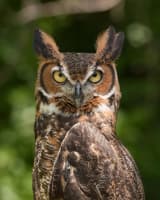 Great Horned OwlBubo virginianusAt 51 zoos · Least Concern
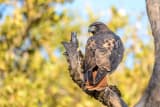 Red-tailed HawkButeo jamaicensisAt 51 zoos · Least Concern
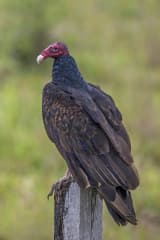 Turkey VultureCathartes auraAt 46 zoos · Least Concern
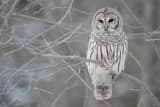 Barred OwlStrix variaAt 36 zoos · Least Concern
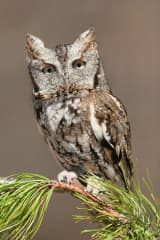 Eastern Screech-OwlMegascops asioAt 30 zoos · Least Concern
 Eurasian Eagle-OwlBubo buboAt 30 zoos · Least Concern
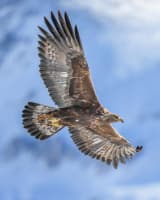 Golden EagleAquila chrysaetosAt 23 zoos · Least Concern
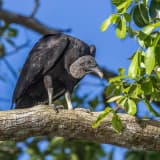 Black VultureCoragyps atratusAt 20 zoos · Least Concern
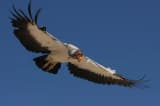 King VultureSarcoramphus papaAt 18 zoos · Least Concern
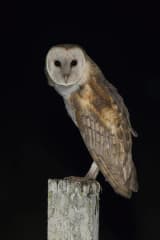 Barn OwlTyto furcataAt 17 zoos · Least Concern
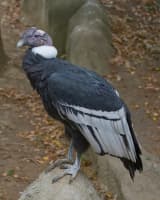 Andean CondorVultur gryphusAt 16 zoos · Vulnerable
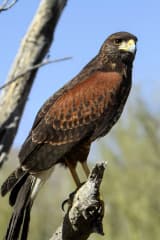 Harris's HawkParabuteo unicinctusAt 15 zoos · Least Concern
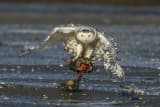 Snowy OwlBubo scandiacusAt 15 zoos · Vulnerable
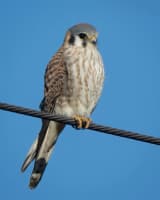 American KestrelFalco sparveriusAt 14 zoos · Least Concern
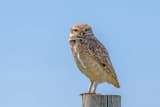 Burrowing OwlAthene cuniculariaAt 14 zoos · Least Concern
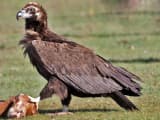 Cinereous VultureAegypius monachusAt 12 zoos · Near Threatened
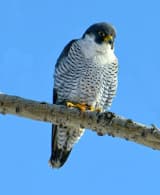 Peregrine FalconFalco peregrinusAt 12 zoos · Least Concern
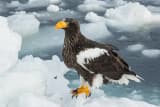 Steller's Sea EagleHaliaeetus pelagicusAt 11 zoos · Vulnerable
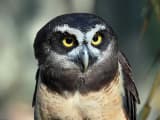 Spectacled OwlPulsatrix perspicillataAt 10 zoos · Least Concern
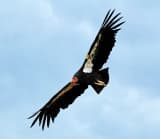 California CondorGymnogyps californianusAt 9 zoos · Critically Endangered
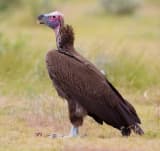 Lappet-faced VultureTorgos tracheliotosAt 7 zoos · Endangered
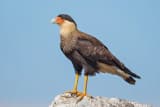 Crested CaracaraCaracara plancusAt 6 zoos · Least Concern
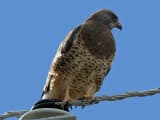 Swainson's HawkButeo swainsoniAt 6 zoos · Least Concern
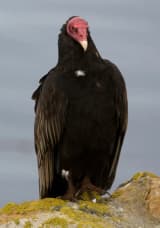 VultureCathartidaeAt 5 zoos
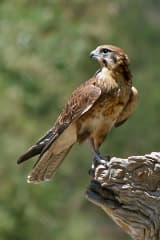 FalconFalconidaeAt 4 zoos
 Ruppell's Griffon VultureGyps rueppelliAt 4 zoos · Critically Endangered
What makes a raptor
Ornithologists define birds of prey as birds that actively hunt other vertebrates and are built for it: keen eyesight to spot prey at a distance, strong feet with sharp talons to grab it, and a curved beak to tear flesh. Storks, herons, gulls and other fish-eaters hunt too, but they are not counted as raptors. Many raptors also scavenge, and vultures and condors live mainly on carrion.
Raptor eyes are large for the skull, and some eagles and Old World vultures have the sharpest vision known in any vertebrate. Watch a perched raptor and you may see it cock its head between three positions while studying something; this is believed to line up the image on the most acute part of its retina. Unusually among birds, females are usually larger than males.
Eagles, hawks, falcons and the rest
The common names describe body plans more than family trees. Eagles are large, with long, broad wings and massive feet. The Steller's sea eagle is typically the heaviest eagle alive, and the bald eagle is the national bird of the United States.
Falcons and kestrels have long, pointed wings and many are swift flyers, but they belong to the family Falconidae, only distantly related to eagles and hawks. The American kestrel is the smallest falcon in the Americas, and the crested caracara is a falcon that walks the ground looking for carrion. In North America, the broad-winged Buteo hawks are what most people call "hawks". The Harris's hawk is unusual for hunting in cooperative groups.
Vultures come from two unrelated families with bare or partly bare heads. Old World vultures live only in the Eastern Hemisphere; New World vultures and condors live only in the Western Hemisphere. The turkey vulture finds carrion by smell, and the Andean condor has a wingspan of up to 3.3 m (10 ft 10 in). Owls, the night hunters of the group, have their own owls collection.
Persecution, poison and recovery
Birds of prey were long killed as threats to game. In one region of Germany, an estimated 624,087 were killed between 1705 and 1800. Many still die of lead poisoning after eating animals shot by hunters.
In the 20th century, the pesticide DDT drove dramatic declines. The peregrine falcon vanished from eastern North America, and the bald eagle came close to disappearing from the lower 48 states. Both recovered after DDT was banned in the early 1970s, and the bald eagle was taken off the federal endangered list in 2007.
The California condor needed more help. By 1987 just 27 birds were left in the wild, and all were taken into captivity. Captive breeding allowed reintroduction to begin in 1991. The species remains Critically Endangered, as is Rüppell's vulture of Africa, whose most serious threat is poisoned livestock carcasses; a single poisoning event has killed as many as 600 vultures.
Common questions
What is a bird of prey?
A bird of prey, or raptor, is a bird that actively hunts and eats other vertebrates, mainly mammals, reptiles and smaller birds. Raptors have keen eyesight, sharp talons and hooked beaks.
Are owls birds of prey?
Yes. Owls are raptors that mostly hunt at night, with very acute hearing, good night vision and feathers that let them fly almost silently.
Are vultures birds of prey?
Yes. Vultures are carrion-eating raptors from two separate families: Old World vultures in the Eastern Hemisphere and New World vultures, including condors, in the Western Hemisphere.
What is the difference between a hawk and a falcon?
Falcons have long, pointed wings and many are very fast flyers; they belong to the family Falconidae, only distantly related to hawks and eagles. Hawks generally have broader wings, and true hawks have long tails for steering through woodland.
Why are female raptors bigger than males?
In most birds males are larger, but in birds of prey the reverse is true. Researchers mostly explain it through sexual selection, with females competing for nest sites and males for hunting grounds, though the question is still debated.
How good is a bird of prey's eyesight?
Some large raptors, such as eagles and Old World vultures, have the sharpest vision known among vertebrates. The wedge-tailed eagle sees about twice as sharply as a typical human.
What threatens birds of prey?
Raptors have long been shot and poisoned as threats to game and livestock. Lead poisoning from eating shot animals and, in the 20th century, the pesticide DDT caused major declines.
Sources
Last reviewed