- Where to see one
- 51 U.S. zoos in our directory hold great horned owl, confirmed against each zoo's own animal list.
- Native range
- The Americas — the most widely distributed true owl in the region
- Size
- 43 to 64 cm (17–25 in) long, average 55 cm (22 in); wingspan 91 to 153 cm (3–5 ft), average 122 cm (48 in); mean weight 1,608 g (3.545 lb) for females and 1,224 g (2.698 lb) for males, with maximum weight up to 2,503 g (5.518 lb) depending on subspecies
- Lifespan
- Typically up to about 13 years in the wild; the oldest known wild great horned owl in North America was almost 29, and one lived 50 years in captivity
Conservation status
Least Concernassessed 2018
IUCN Red List category LC — step 1 of 7.
About the great horned owl
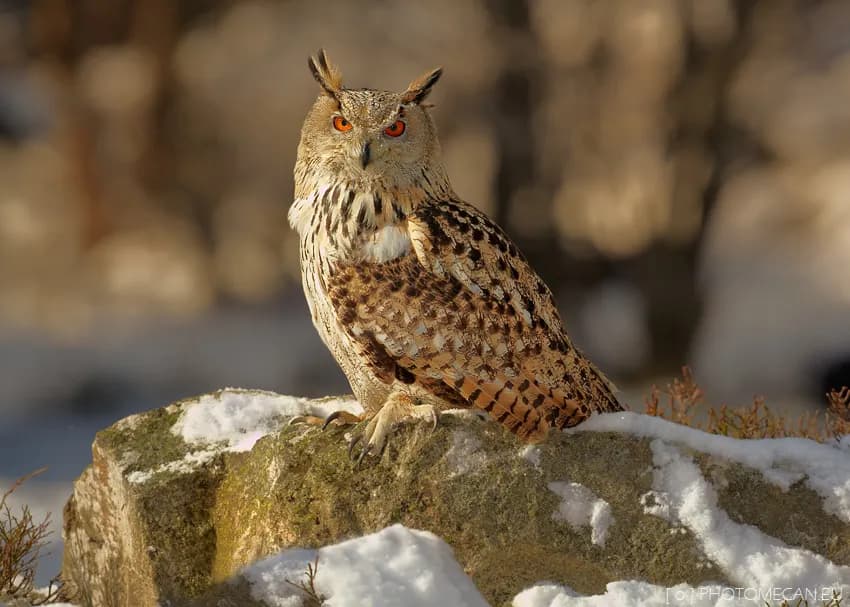
The great horned owl, also known as the tiger owl or hoot owl, is a large owl native to the Americas and the most widely distributed true owl species in the region. It is an extremely adaptable bird, occupying a vast range that stretches across the hemisphere. Ornithologists often compare it to the Eurasian eagle-owl, a closely related species that fills a similar ecological role in Eurasia despite growing notably larger, and to the red-tailed hawk, which shares similar habitat, prey, and nesting habits during the day — making the hawk something of a daytime counterpart to the nocturnal owl. The great horned owl is also among the earliest nesting birds in North America, frequently laying eggs weeks or even months ahead of other raptors.
The species was formally described in 1788 by German naturalist Johann Friedrich Gmelin, based on an earlier description and illustration by English naturalist George Edwards, who had examined a live specimen from Virginia in 1747. It was originally placed in the genus Strix before being moved to Bubo in 1805. More than 20 subspecies have been named over the years, though many represent only individual or regional variation rather than true distinct subspecies; 15 are currently recognized, differing mainly in color and size according to well-known biogeographic patterns.
In coloring, the great horned owl is built for camouflage: light underparts marked with brown horizontal barring, and mottled brown upperparts and upper wings carrying heavier, darker markings, with dark barring along the sides in every subspecies. A variable white patch marks the throat, sometimes extending down the breast as a streak that can widen into a large white area on paler individuals; South American birds typically show a smaller, less visible throat patch. Coloring also varies by region, from washed-out, light-buff birds in the subarctic to dark brownish, blackish-blotched individuals along the Pacific Coast, Central America, and much of South America. The bill and talons are dark gunmetal-gray, and though largely hidden by feathers, the legs and feet are black — even in tropical subspecies, the legs and feet remain feathered. The species' signature "horns" are simply tufts of feathers called plumicorns; researchers generally accept that these serve as a visual signal in territorial and social interactions with other owls, though their exact purpose isn't fully understood.
Behavior and diet
Diet
Primarily rabbits and hares, rats and mice, and voles; also rodents, larger mid-sized mammals, birds, reptiles, amphibians, and invertebrates; one of the few regular predators of skunks
The great horned owl is the heaviest owl in Central and South America and the second-heaviest in North America, behind only the snowy owl. It has a heavily built, barrel-shaped body, a large head, and broad wings, with size varying across its range — birds from interior Alaska and Ontario run largest, while those from California and Texas run smallest, and populations from the Yucatán Peninsula and Baja California appear smaller still. Like other owls, it is capable of nearly silent flight, made possible by serrated leading-edge feathers that break up the turbulence of flapping, softer feathers that deaden sound, and a fringed trailing edge that finishes cutting noise from the wingbeat. That wing structure also lets the bird fly remarkably slowly for its size — as little as 2 miles per hour while gliding on air currents.
Its legs, feet, and talons are large and powerful, capable of applying at least 300 psi (2,100 kPa) of crushing force — considerably more than a human hand can generate, and in large females comparable to the grip of much bigger raptors such as the golden eagle. Hearing is highly developed, estimated at up to ten times that of a human, aided by asymmetrical ear openings — differently positioned on each side of the head — that let the owl triangulate sound precisely enough to locate prey hidden under cover such as snow. The disc-shaped face helps funnel sound toward the ears. Vision is similarly specialized for night hunting: the eyes are large even by owl standards, cylindrical in shape to create extra distance between lens and retina for better long-range focus, and dominated by rod cells for low-light sensitivity, though this comes at some cost to color vision. Instead of turning its eyes, the owl turns its head, which can rotate 270 degrees.
The great horned owl's call is a low-pitched, resonant ho-ho-hoo hoo hoo lasting four or five syllables, described variously as "solemn" and "terrifying"; the female's call is higher-pitched and rises at the end, a difference driven by a smaller syrinx in the larger sex. Calling tends to peak after midnight and generally decreases in February or March as egg-laying begins. Birds also produce a wide range of other sounds — growls, laughs, screeches, and squawks — uttered when disturbed at the nest, during courtship, or in territorial disputes, and young owls still dependent on their parents give loud hissing or piercing screeches often mistaken for barn owl calls.
Diet centers on rabbits and hares, rats and mice, and voles, though the great horned owl also takes larger mid-sized mammals, birds, reptiles, amphibians, and invertebrates, and is one of the few animals that regularly preys on skunks.
Range and habitat
Habitat
Highly adaptable; occupies a vast range across the Americas
The great horned owl is native to the Americas and holds the distinction of being the most widely distributed true owl species across the region. Fifteen recognized subspecies occupy different parts of that range, from west Alaska and central Alaska through the western and eastern United States, Mexico, Central America, and much of South America down to Brazil, Argentina, Bolivia, and Peru.
Conservation status
The great horned owl is listed as Least Concern on the IUCN Red List, in a 2018 assessment by BirdLife International. It is the most widely distributed true owl in the Americas, found from Alaska to South America in a huge variety of habitats, which keeps it well clear of the threatened categories.
Adults have almost no natural enemies apart from North American eagles and other great horned owls. Young owls face the steepest odds: during their first dispersal in fall, more than half of juveniles often die.
The owl's success can be a problem for rarer animals. Great horned owls have slowed the comeback of reintroduced peregrine falcons and ospreys by killing peregrines and osprey nestlings, and they prey on species the IUCN rates as threatened, such as black-footed ferrets and Kirtland's warblers.
Where to see great horned owl in the U.S.
51 zoos across 27 states
Find the closest one
Rank the 46 zoos holding great horned owl by how far they are from you. Your location is used in your browser to sort this list and is never sent to us.
5 more zoos hold great horned owl but have no coordinates on file yet, so they aren't ranked here. They're in the full list below.
Alabama· 2
Alaska· 1
Arizona· 2
California· 6
Colorado· 1
Florida· 2
Georgia· 1
Idaho· 1
Illinois· 4
Kansas· 1
Kentucky· 1
Louisiana· 1
Maryland· 1
Massachusetts· 4
Michigan· 1
Minnesota· 2
Mississippi· 2
Missouri· 1
New Hampshire· 1
New Mexico· 2
New York· 3
Oregon· 3
Pennsylvania· 1
South Dakota· 1
Texas· 1
Utah· 1
Wisconsin· 4
AZAThe Association of Zoos and Aquariums. Accredited members have passed an independent inspection of animal care and welfare, safety, conservation and education, repeated every five years. Many smaller facilities never apply, so “not accredited” isn't a verdict on its own. What accreditation means · How we check this
Built from each zoo's own published animal list.
Great Horned Owl: common questions
Is the great horned owl endangered?
No. It is listed as Least Concern on the IUCN Red List (BirdLife International, 2018), thanks to its enormous range across the Americas.
How big does a great horned owl get?
It measures 43 to 64 cm (17 to 25 in) in length, averaging 55 cm (22 in), with a wingspan of 91 to 153 cm (3 to 5 ft). Females average 1,608 g (3.545 lb) and males average 1,224 g (2.698 lb), with maximum weight reaching 2,503 g (5.518 lb) depending on subspecies.
What does a great horned owl eat?
Mainly rabbits and hares, rats and mice, and voles, along with larger mid-sized mammals, birds, reptiles, amphibians, and invertebrates. It's one of the few regular predators of skunks.
How long do great horned owls live?
A typical top lifespan is about 13 years. The oldest known wild great horned owl in North America was almost 29, and the captive record is 50 years.
Where do great horned owls live in the wild?
Across the Americas — it is the most widely distributed true owl species in the region, with 15 recognized subspecies spread from Alaska to South America.
Which U.S. zoos have great horned owls?
Twenty U.S. zoos list them, including the Saint Louis Zoo, the Oregon Zoo, and the Buffalo Zoo.