Madagascar Hissing Cockroach
Gromphadorhina portentosa
Also known as Madagascar Hissing Cockroaches, Madgascar Hissing Cockroaches, Hissing Cockroach
- Where to see one
- 50 U.S. zoos in our directory hold madagascar hissing cockroach, confirmed against each zoo's own animal list.
- Native range
- Madagascar
- Size
- 5 to 7.5 cm (2 to 3 in) at maturity
- Lifespan
- Up to 5 years in captivity
Conservation status
Not Evaluated
This species has not been assessed for the IUCN Red List, so it sits outside the threat scale entirely.
No IUCN Red List category cited
About the Madagascar hissing cockroach
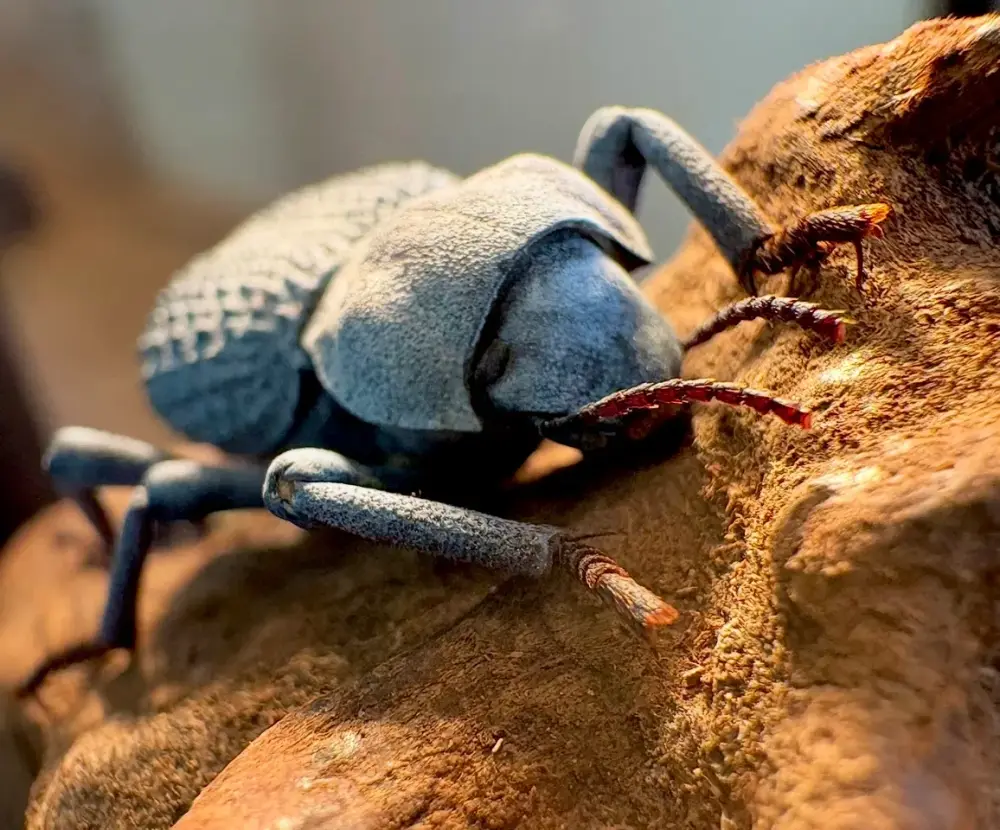
The Madagascar hissing cockroach is one of the largest cockroach species, reaching 5 to 7.5 cm (2 to 3 in) at maturity. It is native to the island of Madagascar, where it is commonly found living in rotting logs, and it is one of roughly 20 known species of large hissing roach from the island, several of which are kept as pets and easily confused with one another — Gromphadorhina portentosa is most often mistaken for the closely related G. oblongonota and G. picea. Unlike most cockroaches, hissers are wingless, which is part of why hissing through their bodies became their main defense: unable to fly away, they rely instead on startling would-be predators with sound.
The species was first collected in the 1840s by the German explorer Wilhelm Peters during an expedition to Mozambique and Madagascar and later described from a specimen found in the Bay of Saint-Augustin, Madagascar. German entomologist Hermann Rudolph Schaum recognized it as new to science, and Swiss entomologist Carl Brunner von Wattenwyl later judged it different enough from other cockroaches to warrant its own genus, creating Gromphadorhina in 1865 and naming this species its type. Males and females can be told apart by looking closely at the head and body: males have thicker, hairier antennae and far more pronounced bumps on the pronotum, the shield-like plate behind the head, than females do.
Females are ovoviviparous, meaning they carry their egg case, or ootheca, internally and release live young nymphs only once the offspring have already emerged within them. As in some other wood-dwelling roaches, Madagascar hissing cockroach parents and their young commonly stay in close physical contact for extended stretches after birth. The species feeds primarily on vegetable material and, in captivity, has been recorded living as long as five years.
Behavior and diet
Diet
Vegetable material
The hiss that gives the species its name is produced by forcefully pushing air out through spiracles — small breathing openings — concentrated on the fourth abdominal segment, though spiracles run along all of the abdomen's segments. This is an unusual way for an insect to make noise; most, such as crickets, do so by rubbing body parts together instead. The Madagascar hissing cockroach is the only member of its group able to produce an audible sound this way, and it can make the hiss in three distinct forms: a disturbance hiss, used by any cockroach from its fourth molt onward when threatened; a female-attracting hiss, used only by males; and an aggressive or fighting hiss, also used only by males, to settle disputes over breeding territory. New hissers will typically sound off when first picked up, but quickly settle down and grow used to being handled.
The species has an unusual roommate: a mite, Androlaelaps schaeferi, that lives along the undersides and leg bases of the cockroach and feeds on some of its host's food as well as particulates on its body. Because the mites don't harm the cockroaches — and research suggests they may actually help by cleaning off pathogenic mold spores, extending the cockroaches' lifespan — the relationship is considered commensal rather than parasitic, unless mite numbers grow high enough to start starving their host.
In the wild, the species eats vegetable material and lives in rotting logs on Madagascar. In captivity, hissers are commonly fed fresh vegetables along with high-protein pellet food such as dry dog food, and they need a small, dark hiding space, since they dislike light and prefer warmth over cold. They are strong climbers, capable of scaling smooth surfaces like glass, so captive habitats have to be checked to make sure the animals can't climb out; keepers often coat the top few inches of an enclosure with petroleum jelly for that reason.
Range and habitat
Habitat
Rotting logs
The Madagascar hissing cockroach is native to the island of Madagascar, where it is commonly found in and around rotting logs. It is one of roughly 20 known species of large hissing cockroach native to the island, some of which are visually similar enough to be confused with it by pet dealers. Outside its native range, the species has become widely kept in captivity as an exotic pet, though several U.S. states, including Florida, require a permit to keep or breed it — a rule driven by concern that its needs and Florida's climate are similar enough that an escaped or released population could become invasive.
Conservation status
No IUCN Red List category is cited for the Madagascar hissing cockroach. It is widely available and commonly bred in captivity, both for the pet trade and as a high-protein live food for reptiles and other pets.
In the United States, regulation focuses on keeping it from spreading rather than on protecting it. Florida, for example, requires a permit to keep or breed the species, because the state's climate is close enough to its needs that escaped insects could establish a wild population.
Where to see madagascar hissing cockroach in the U.S.
50 zoos across 25 states
Find the closest one
Rank the 48 zoos holding madagascar hissing cockroach by how far they are from you. Your location is used in your browser to sort this list and is never sent to us.
2 more zoos hold madagascar hissing cockroach but have no coordinates on file yet, so they aren't ranked here. They're in the full list below.
Arizona· 1
California· 7
Colorado· 1
Connecticut· 1
Florida· 1
Idaho· 2
Illinois· 6
Indiana· 1
Kansas· 3
Kentucky· 1
Louisiana· 2
Maine· 1
Maryland· 1
Massachusetts· 5
Michigan· 1
Minnesota· 1
Mississippi· 1
Missouri· 1
Montana· 1
New York· 4
North Carolina· 1
Oregon· 2
Pennsylvania· 2
Virginia· 1
Wisconsin· 2
AZAThe Association of Zoos and Aquariums. Accredited members have passed an independent inspection of animal care and welfare, safety, conservation and education, repeated every five years. Many smaller facilities never apply, so “not accredited” isn't a verdict on its own. What accreditation means · How we check this
Built from each zoo's own published animal list.
Madagascar Hissing Cockroach: common questions
Is the Madagascar hissing cockroach endangered?
No IUCN Red List category is cited for it. It is common in captivity, where it is widely bred for the pet trade and as live food for reptiles.
How big does a Madagascar hissing cockroach get?
It reaches 5 to 7.5 cm (2 to 3 in) at maturity, making it one of the largest cockroach species.
What does a Madagascar hissing cockroach eat?
It feeds primarily on vegetable material; captive hissers are typically fed fresh vegetables along with high-protein pellet food.
How long do Madagascar hissing cockroaches live?
Up to five years in captivity.
Where do Madagascar hissing cockroaches live in the wild?
They are native to Madagascar, where they are commonly found living in rotting logs.
Which U.S. zoos have Madagascar hissing cockroaches?
Twenty-one U.S. zoos list them, including the Phoenix Zoo, Oakland Zoo, and Buffalo Zoo.