Mexican Red-knee Tarantula
Brachypelma hamorii
Also known as Euathlus Smithi, Mexican Red Kneed Tarantula, Mexican Redknee Tarantula, Red-kneed Tarantula, Red Knee Tarantula
- Where to see one
- 14 U.S. zoos in our directory hold mexican red-knee tarantula, confirmed against each zoo's own animal list.
- Native range
- Colima, Jalisco, and Michoacán, Mexico
- Size
- Adult females over 50 mm (about 2 in) body length; males' legs up to 75 mm (about 3 in)
- Lifespan
- Females up to 30 years; males around 5 years
Brachypelma hamorii, a Mexican redknee tarantula, is a large terrestrial spider native to the western slopes of the Sierra Madre Occidental and Sierra Madre del Sur in the Mexican states of Colima, Jalisco and Michoacan. It lives in hilly deciduous tropical forest, building or extending burrows under logs, rocks and tree roots, where it ambushes passing prey. Adult females exceed 50 mm in body length, and the black to reddish-black legs carry orange and yellowish rings. If disturbed it kicks urticating hairs from its abdomen rather than biting, and it is considered extremely docile. It is a popular choice among enthusiasts.
About the Mexican red-knee tarantula
The Mexican red-knee tarantula is a large, ground-dwelling spider native to the western slopes of the Sierra Madre Occidental and Sierra Madre del Sur, in the Mexican states of Colima, Jalisco, and Michoacán. For decades it was confused with a very similar species, Brachypelma smithi, and both were called by the same common name. The mix-up ran deep: an old description of B. smithi turned out to actually describe what we now call B. hamorii, and the confusion between the two wasn't formally resolved until 2017, when researchers used DNA barcoding to show the two are genetically distinct despite their near-identical looks.
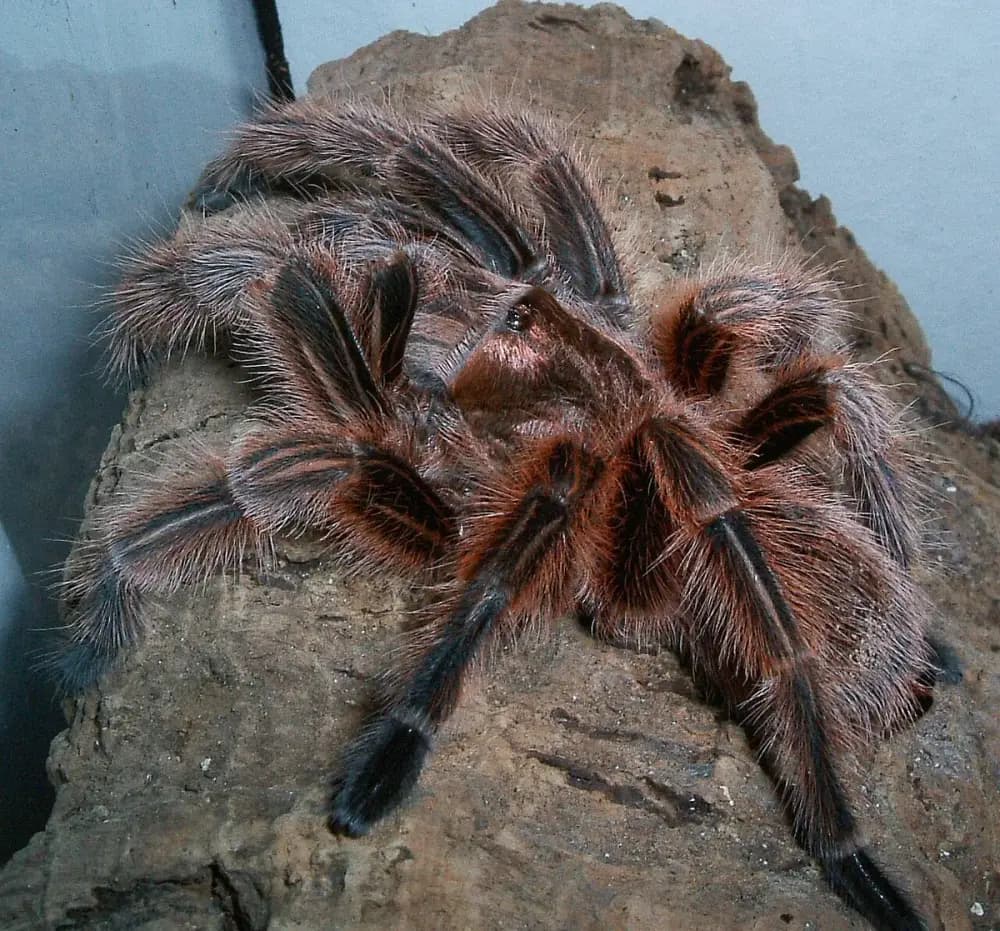
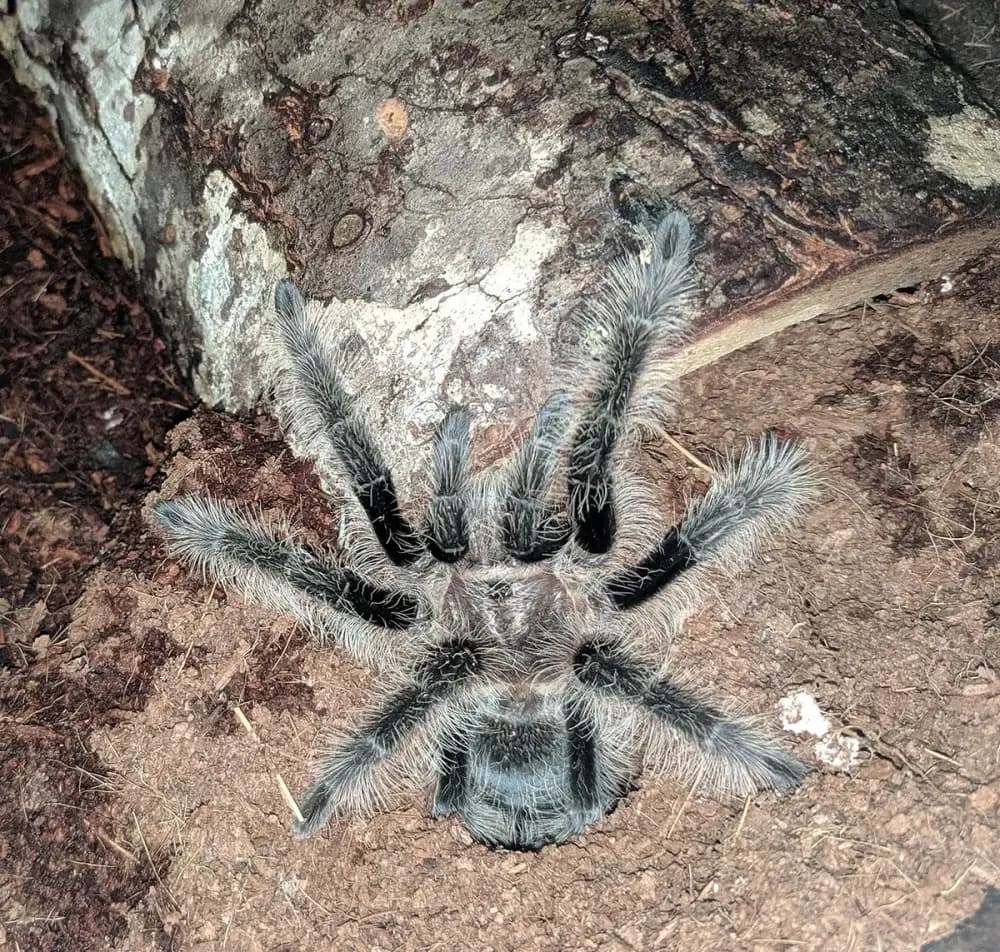
In terms of size, a sample of seven adult females measured 52–54 mm (about 2.0–2.1 in) in body length, while eleven males ran slightly smaller at 46–52 mm (about 1.8–2.0 in). Males, though shorter-bodied, have longer legs — the front-to-back fourth leg reached 75 mm (3.0 in) in one measured male. The legs and palps are black to reddish-black with three colored rings: deep orange near the body, pale orange-yellow further out, and yellowish-white at the tips. Adult males have a light greyish-red-bordered carapace with a darker reddish-black stripe down the middle and a solid black abdomen. Females show more variation, with carapaces that are mostly black with a pinkish-brown border, or broken into a pale "starburst" pattern.
In the wild, the species builds or takes over burrows tucked among thorny shrubs and tall grass, usually near vegetation. A single entrance — sized just larger than the spider's own body — leads down a tunnel about three times the length of the tarantula's leg span to a chamber roomy enough for molting, and then further to a larger chamber used for resting and eating. When the spider needs privacy, for molting or egg-laying, it seals the entrance with silk, sometimes reinforced with soil and leaves.
Behavior and diet
Diet
Not detailed in this record
Like most tarantulas from the Americas, the Mexican red-knee defends itself passively rather than aggressively: when disturbed, it kicks urticating hairs from its abdomen and back legs instead of biting. It's considered only mildly venomous to humans and notably docile, though its large fangs can still cause a painful puncture wound that carries a risk of secondary infection, and allergic reactions to a bite may intensify.
As an arthropod, the species must molt to grow, since its exoskeleton can't stretch. Molting happens multiple times a year depending on age, and the process also lets the spider regenerate any lost legs bit by bit over successive molts. Before molting, the tarantula slows down and stops eating to conserve energy; its abdomen darkens as the new exoskeleton forms underneath. It flips onto its back for the molt itself, pushing fluid beneath the old shell and working its legs to loosen and shed it — a process that can take several hours. Afterward, because its fangs are also shed and take time to harden, the spider typically won't eat again for days, and sometimes up to a month.
Deep burrows do double duty for this species: they shelter it from predators such as the white-nosed coati and give it a place to ambush passing prey. Females, in particular, spend most of their lives inside their burrow. The species is notable for its longevity even among tarantulas, and it has proven straightforward to breed in captivity, and it is a popular choice among invertebrate keepers and enthusiasts.
Range and habitat
Habitat
Hilly deciduous tropical forest, in burrows under logs, rocks, and tree roots
The Mexican red-knee tarantula and the closely related B. smithi split the Pacific coast of Mexico on either side of the Balsas River basin where it meets the ocean. B. hamorii occupies the northern side, across the states of Colima, Jalisco, and Michoacán. Its natural habitat is hilly, deciduous tropical forest, where it digs into or extends existing burrows beneath logs, rocks, and tree roots, often among thorny shrubs and tall grass.
The record here doesn't describe any range changes, only the pressures on the population within it.
Conservation status
The Mexican red-knee tarantula is listed as Vulnerable (VU). Threats named in the record include the international pet trade — large numbers of wild-caught spiders continue to be smuggled out of Mexico, with an estimated 3,000-plus specimens (mostly this species) sent to the United States or Europe in the years before 2017 — and, separately, direct killing by some local people, driven by fear and myth surrounding the spider, using methods including pesticides and gasoline poured into burrows.
The species (originally under the name B. smithi, before the two were told apart) was placed on CITES Appendix II in 1985, and in 1994 all remaining Brachypelma species were added to the same appendix, restricting international trade. Whether that listing has actually helped wild populations recover remains uncertain. On a more positive note, the species breeds successfully in captivity, which reduces (though does not eliminate) pressure on wild-caught animals to supply the pet trade.
Where to see mexican red-knee tarantula in the U.S.
14 zoos across 11 states
Find the closest one
Rank the 14 zoos holding mexican red-knee tarantula by how far they are from you. Your location is used in your browser to sort this list and is never sent to us.
California· 1
Florida· 1
Georgia· 2
Kansas· 1
Maryland· 1
Michigan· 2
Mississippi· 1
Missouri· 1
Ohio· 2
Oregon· 1
Tennessee· 1
AZAThe Association of Zoos and Aquariums. Accredited members have passed an independent inspection of animal care and welfare, safety, conservation and education, repeated every five years. Many smaller facilities never apply, so “not accredited” isn't a verdict on its own. What accreditation means · How we check this
Built from each zoo's own published animal list.
Mexican Red-knee Tarantula: common questions
Is the Mexican red-knee tarantula endangered?
It's listed as Vulnerable (VU), one step below Endangered. Threats include illegal collection for the pet trade and, in parts of its range, direct killing by people.
How big does a Mexican red-knee tarantula get?
Adult females have a body length over 50 mm (about 2 in). Males are slightly shorter-bodied but have longer legs, reaching up to about 75 mm (3 in).
How long do Mexican red-knee tarantulas live?
Females can live up to 30 years. Males live much shorter lives, typically around 5 years.
Where do Mexican red-knee tarantulas live in the wild?
They're native to hilly, deciduous tropical forest on the western slopes of Mexico's Sierra Madre Occidental and Sierra Madre del Sur, across the states of Colima, Jalisco, and Michoacán.
Which U.S. zoos have Mexican red-knee tarantulas?
Six zoos in our directory list this species, including the Saint Louis Zoo, the Oregon Zoo, and the Cincinnati Zoo and Botanical Garden.
Does the Mexican red-knee tarantula bite?
It can, but it's considered docile and typically defends itself by kicking urticating hairs rather than biting. A bite is more likely to cause a painful puncture wound than serious venom effects.