African Spurred Tortoise
Centrochelys sulcata
Also known as Spurred Tortoise
- Where to see one
- 69 U.S. zoos in our directory hold african spurred tortoise, confirmed against each zoo's own animal list.
- Native range
- Southern edge of the Sahara Desert and the Sahel, across countries including Chad, Mali, Senegal, Sudan, Ethiopia, and Mauritania
- Size
- Males average about 81 kg (179 lb), with some over 100 kg (220 lb) and one over 120 kg (260 lb); male straight carapace length about 86 cm (34 in), female about 57.8 cm (22.8 in); hatchlings measure about 44 mm (1.7 in)
- Lifespan
- About 54 years in captivity; believed to exceed 75 years in the wild
Conservation status
Endangeredassessed 2021
IUCN Red List category EN — step 4 of 7.
Endangered (EN), assessed 2021
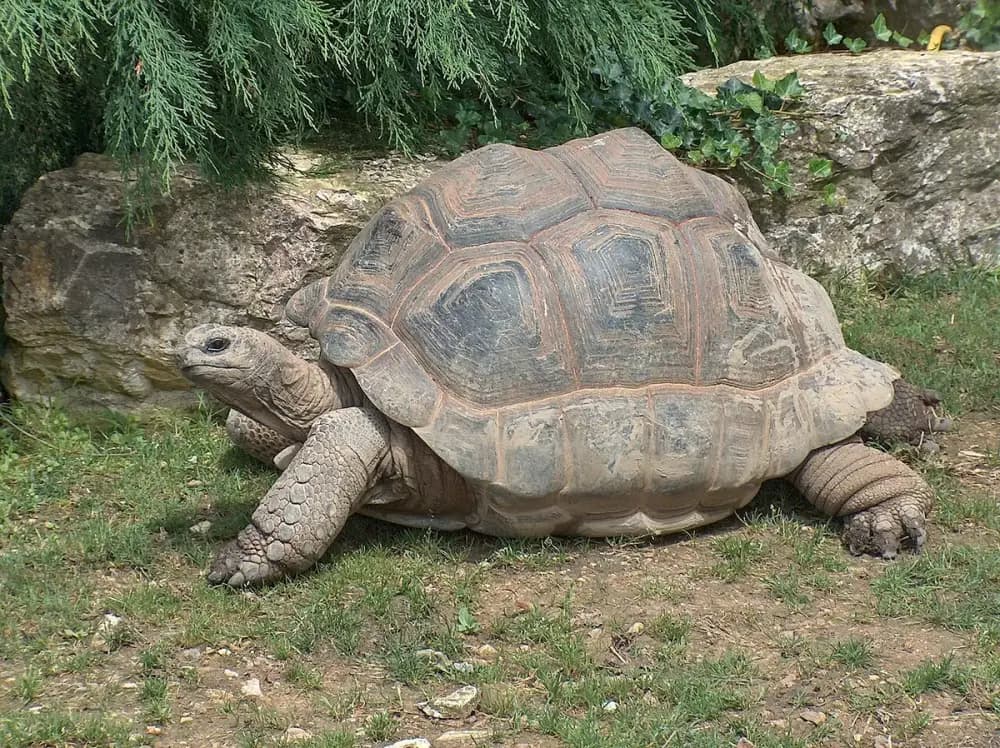
The African spurred tortoise, also called the sulcata tortoise, lives along the southern edge of the Sahara Desert and in the Sahel, on hills, stable dunes and flat areas with shrubs and high grass. It is the largest mainland tortoise in Africa, the third-largest in the world, and the only living species in its genus. Mostly herbivorous, it eats grasses, succulents and hay, and occasionally feeds on carcasses. To escape the hottest part of the day it retreats into burrows it digs itself. Males are territorial and fight for breeding rights, and in the wild the leading cause of death is being unable to right themselves after being flipped onto their backs.
About the African spurred tortoise
The African spurred tortoise, also called the sulcata tortoise, is native to the southern edge of the Sahara Desert and the Sahel, the semiarid band of grasslands, savannas, and thorn shrublands that separates true desert from wetter habitat further south. It is the largest species of tortoise native to mainland Africa and the third-largest tortoise in the world, behind only the Galápagos tortoise and the Aldabra giant tortoise. It is also the sole living species in its genus, Centrochelys.
The species was first given a scientific name in 1779, when English illustrator John Frederick Miller published a hand-colored plate of it and coined the binomial Testudo sulcata. The specific name, sulcata, comes from the Latin word for "furrow," a reference to the furrowed pattern on the tortoise's scales. No subspecies are formally recognized, though the species has two distinct populations — one in West Africa, one in East Africa — and three genetically distinct haplotypes, one centered around Sudan, one in the western part of the range, and one spanning Senegal, Mali, and Sudan.
Adults have a straight carapace length of around 86 cm (34 in) in males and about 57.8 cm (22.8 in) in females, with curved carapace lengths of roughly 101 cm (40 in) and 67 cm (26 in) respectively. Males average about 81 kg (179 lb), though some have been weighed at over 100 kg (220 lb) and one at more than 120 kg (260 lb). Despite that eventual bulk, hatchlings start out at just 44 mm (1.7 in) long and around 40 grams (1.4 oz), growing quickly to 15–25 cm (6–10 in) within their first few years — faster in wetter conditions, slower in dry ones. The species has distinctive spurs on its hind legs and unique scute patterns on each individual's shell.
Behavior and diet
Diet
Mostly grasses, succulent plants, and hay, plus flowers, vegetables, and occasionally carrion
Sulcata tortoises are mostly herbivores, eating grasses, succulent plants, hay, flowers, and vegetables such as endive and dandelion greens and other dark leafy greens; in the wild they've also been seen eating algae off the surface of water. Despite being herbivores, they occasionally eat carrion, mostly the carcasses of dead goats and zebras that wash downstream during the wet season near the rivers and streams where the tortoises settle. Where human settlements are nearby, they'll also scavenge refuse. Their diet needs to be high in fiber and low in protein; too much protein causes them to grow too quickly, which can lead to metabolic bone disease, a condition marked by skeletal distortion and weakened bones.
In arid regions, the tortoise digs burrows to reach cooler, more moist soil and spends the hottest part of the day underground, a behavior known as aestivation. Wild burrows can run remarkably deep — up to 15 m (49 ft) down and 30 m (98 ft) long. Grasses and succulents tend to grow around these burrow entrances if the soil stays moist, giving the tortoise a nearby food source that regenerates as its droppings fertilize the ground.
Breeding follows the rainy season, with copulation occurring from September through November, usually in the morning. Males are highly territorial and fight each other for access to females, with larger males typically winning. About 60 days after mating, a female begins searching for a nesting site, often digging and rejecting four or five test nests over five to 15 days before settling on one. She may lay two or three clutches, each with 14 to 40 eggs; digging the nest itself can take up to five hours, and laying proceeds at roughly one egg every three minutes. Incubation runs 90 to 120 days at 86 to 88°F (30–31°C). Tortoises reach sexual maturity at 10 to 15 years old, and their leading cause of death in the wild is being unable to right themselves after flipping onto their backs, usually as a result of fighting among adult males.
Range and habitat
Habitat
Hills, stable dunes, and flat areas with shrubs and high grass, often near interrupted streams or rivers
The African spurred tortoise is native to the Sahara Desert and the Sahel, with a range that includes Burkina Faso, the Central African Republic, Chad, Eritrea, Ethiopia, Mali, Mauritania, Nigeria, Senegal, Saudi Arabia, Sudan, and Yemen, and possibly Somalia, Algeria, Benin, and Cameroon. It is possibly extirpated from Djibouti and Togo. Within this range it favors hills, stable dunes, and flat areas with shrubs and tall grass, particularly places near interrupted streams or rivers where it can dig burrows down to moister soil.
Conservation status
The African spurred tortoise is listed as Endangered on the IUCN Red List, based on a 2021 assessment. Surveys suggest the species now occupies only about 16.7% of the area where it was previously found, and site counts averaging just one to five tortoises indicate a rapid population decline.
It faces competition from livestock, particularly cattle grazing the same grasslands, a pressure worsened by wildfires that destroy grazing land outright. The pet trade is a major threat as well: CITES records show 9,132 tortoises taken from the wild for the trade between 1990 and 2010, a figure believed to significantly undercount the real total. Because the species doesn't reach sexual maturity until around age 15, animals removed from the wild before then never get the chance to reproduce, compounding the decline. Habitat loss from climate change and predation on tortoises and their eggs add further pressure.
Conservation efforts have focused mainly on reintroduction programs, including ones in Ferlo and elsewhere in Senegal, which have seen survival rates of about 80% for released tortoises. Captive colonies exist in several countries, often within protected national parks and wildlife sanctuaries, and there is interest in expanding reintroduction by involving private tortoise owners, since more African spurred tortoises now live in captivity than in the wild.
Where to see african spurred tortoise in the U.S.
69 zoos across 28 states
Find the closest one
Rank the 56 zoos holding african spurred tortoise by how far they are from you. Your location is used in your browser to sort this list and is never sent to us.
13 more zoos hold african spurred tortoise but have no coordinates on file yet, so they aren't ranked here. They're in the full list below.
Arizona· 1
California· 6
Colorado· 2
Delaware· 2
Florida· 7
Georgia· 2
Idaho· 1
Illinois· 3
Kansas· 2
Kentucky· 2
Louisiana· 2
Maine· 1
Maryland· 2
Massachusetts· 3
Michigan· 4
Mississippi· 2
New Mexico· 1
New York· 4
North Carolina· 2
North Dakota· 1
Ohio· 2
Oregon· 2
Pennsylvania· 1
Tennessee· 2
Texas· 5
Utah· 1
Virginia· 2
Wisconsin· 4
AZAThe Association of Zoos and Aquariums. Accredited members have passed an independent inspection of animal care and welfare, safety, conservation and education, repeated every five years. Many smaller facilities never apply, so “not accredited” isn't a verdict on its own. What accreditation means · How we check this
Built from each zoo's own published animal list.
African Spurred Tortoise: common questions
Is the African spurred tortoise endangered?
Yes. It is listed as Endangered on the IUCN Red List (2021 assessment). Its range has shrunk to roughly 16.7% of its previously known area, and the pet trade and livestock grazing are major threats.
How big does an African spurred tortoise get?
It's the largest tortoise native to mainland Africa. Males average about 81 kg (179 lb) and can exceed 120 kg (260 lb), with a straight carapace length around 86 cm (34 in).
What does an African spurred tortoise eat?
Mostly grasses, succulent plants, and hay, along with flowers and vegetables, and occasionally carrion such as goat or zebra carcasses.
How long do African spurred tortoises live?
About 54 years in captivity, and believed to exceed 75 years in the wild.
Where do African spurred tortoises live in the wild?
Along the southern edge of the Sahara Desert and the Sahel, across a range that includes Chad, Mali, Senegal, Sudan, Ethiopia, and several neighboring countries.
Which U.S. zoos have African spurred tortoises?
Twenty U.S. zoos list one, including the San Diego Zoo, Houston Zoo, and Detroit Zoo.