Corn Snake
Pantherophis guttatus
Also known as Albino Corn Snake, Cornsnake, Red Rat Snake
- Where to see one
- 37 U.S. zoos in our directory hold corn snake, confirmed against each zoo's own animal list.
- Native range
- southeastern and central United States, from New Jersey to the Florida Keys
- Size
- 61–182 cm (2.00–5.97 ft) total length as an adult
- Lifespan
- 10 to 15 years in the wild; up to 23 years or more in captivity, with a recorded captive age of 32 years and 3 months
About the corn snake
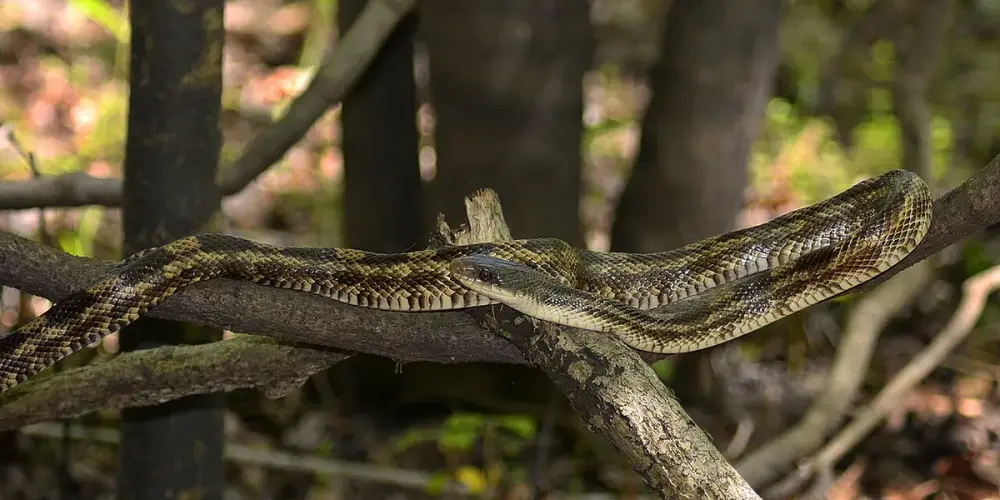
The corn snake is a species of North American rat snake in the family Colubridae, found throughout the southeastern and central United States. It ranges from New Jersey down to the Florida Keys, and it is one of the more commonly encountered snakes across that stretch of the country. As an adult it typically measures between 61 and 182 cm (2.00 to 5.97 ft) in total length, including the tail, making it a mid-sized, slender snake rather than a bulky one.
Its coloring is one of its most recognizable features. A wild corn snake usually has an orange or brown body marked with large red blotches outlined in black running down its back, while the belly carries distinctive rows of alternating black and white marks that resemble a checkerboard. That checkered pattern, similar to the look of Indian corn, is one of the theories behind the snake's common name; the other traces the name to the snake's habit of turning up near grain stores, where it hunts the mice and rats drawn to stored corn.
The corn snake is frequently mistaken for the venomous copperhead and is sometimes killed as a result, but it lacks functional venom and poses no threat to people. It can be told apart from a copperhead by its brighter colors, slimmer build, narrower head, round pupils, and the absence of heat-sensing pits. Taxonomically, the corn snake was reclassified from the genus Elaphe into Pantherophis after molecular studies showed it is more closely related to kingsnakes than to Old World rat snakes, though many older references still use the name Elaphe guttata. Until 2002 it was considered to include the Great Plains rat snake as a subspecies; that population has since been split off as its own species.
Behavior and diet
Diet
rodents, plus reptiles, amphibians, and bird eggs
Corn snakes are constrictors: they subdue their prey by coiling around it rather than through venom. Over half of the wild diet is made up of rodents such as hispid cotton rats, white-footed mice, and eastern moles. In Florida, the diet shifts toward reptiles and amphibians, a difference that may explain why snakes in that region tend to run smaller. Corn snakes will also climb into trees to raid unguarded nests for bird eggs, and, like many snakes, they will eat anything smaller than themselves, including other corn snakes.
The species is nocturnal and uses the warmth of the ground at night to help regulate its body temperature. After a meal in fall, a corn snake's body temperature runs several degrees warmer than its surroundings as digestion proceeds, though this thermoregulatory response is not seen in winter. In captivity, keepers replicate this with under-tank heat mats. When threatened, a corn snake may vibrate its tail and release a foul-smelling musk, a holdover from ancestors that were venomous before the species evolved constriction as its method of capturing prey.
Breeding follows a period of winter cooling, or brumation, typically lasting 60 to 90 days at temperatures of 10 to 16 °C (50 to 61 °F). Snakes usually mate shortly after this cooling period ends. About a month after mating, the female lays 12 to 24 eggs in a warm, hidden, moist spot and then leaves them; there is no further parental care. Roughly ten weeks later, hatchlings use a specialized egg tooth to cut their way out of the shell, emerging at about 5 in (13 cm) long. Corn snakes reach sexual maturity based on size rather than age, generally around 75 cm (30 inches) in length or 250 g in weight.
Range and habitat
Habitat
overgrown fields, forest openings, palmetto flatwoods, and abandoned buildings and farms
In the wild, the corn snake favors overgrown fields, forest openings, wooded areas, palmetto flatwoods, and abandoned or rarely used buildings and farms, and it can be found from sea level up to elevations of about 6,000 ft (1,800 m). Young snakes tend to stay on the ground until around four months old, after which they become capable of climbing trees, cliffs, and other elevated surfaces.
Its native range runs through the Southeastern United States, from New Jersey south to the Florida Keys. In colder parts of that range the corn snake brumates through winter, while along the milder coast it instead shelters in rock crevices and logs during cold spells, emerging on warm days to bask. The species has also been introduced outside its native range: in Australia it is treated as a pest species, with active removal campaigns underway in Victoria, New South Wales, and Queensland, and it has become popular enough as a pet in Brazil that it carries some risk of becoming invasive there as well.
Conservation status
The corn snake is classified as Least Concern (LC), reflecting a wide range and no indication of a threatened population.
Outside the United States, the picture is different only in the sense that the corn snake has become a management concern rather than a conservation one: as an introduced species in Australia, it is the target of extermination efforts rather than protection.
Where to see corn snake in the U.S.
37 zoos across 24 states
Find the closest one
Rank the 30 zoos holding corn snake by how far they are from you. Your location is used in your browser to sort this list and is never sent to us.
7 more zoos hold corn snake but have no coordinates on file yet, so they aren't ranked here. They're in the full list below.
California· 1
Colorado· 1
Delaware· 1
District of Columbia· 1
Florida· 3
Georgia· 2
Idaho· 1
Illinois· 3
Indiana· 1
Kansas· 1
Louisiana· 2
Maine· 1
Maryland· 2
Massachusetts· 3
Minnesota· 1
New Jersey· 1
New York· 2
North Carolina· 2
Ohio· 1
Pennsylvania· 2
South Dakota· 1
Texas· 2
Virginia· 1
Wisconsin· 1
AZAThe Association of Zoos and Aquariums. Accredited members have passed an independent inspection of animal care and welfare, safety, conservation and education, repeated every five years. Many smaller facilities never apply, so “not accredited” isn't a verdict on its own. What accreditation means · How we check this
Built from each zoo's own published animal list.
Corn Snake: common questions
Is the corn snake endangered?
No. It is classified as Least Concern, reflecting its wide range across the southeastern and central United States.
How big does a corn snake get?
Adults typically reach a total length of 61 to 182 cm (2.00 to 5.97 ft), including the tail.
What does a corn snake eat?
Mostly rodents such as cotton rats and white-footed mice, along with reptiles, amphibians, and occasionally bird eggs raided from nests.
How long do corn snakes live?
Around 10 to 15 years in the wild. In captivity they often live much longer, sometimes past 20 years, with a recorded age of 32 years and 3 months.
Where do corn snakes live in the wild?
In the southeastern and central United States, from New Jersey to the Florida Keys, in habitats like overgrown fields, forest edges, and abandoned farm buildings.
Which U.S. zoos have corn snakes?
Fourteen zoos in the Feather & Fang directory list corn snakes, including Zoo Atlanta, the Maryland Zoo in Baltimore, and the Cincinnati Zoo and Botanical Garden.