- Where to see one
- 50 U.S. zoos in our directory hold ball python, confirmed against each zoo's own animal list.
- Native range
- West and Central Africa, from Senegal through Cameroon to Sudan and Uganda
- Size
- Maximum length 182 cm (72 in); females up to 1.635 kg (3.60 lb), males up to 1.561 kg (3.44 lb)
- Lifespan
- Commonly 15–30 years in captivity with good care; the oldest recorded individual lived 62 years
About the ball python
The ball python, also called the royal python, is a python species native to West and Central Africa, where it lives in grasslands, shrublands, and open forests. It is a nonvenomous constrictor and the smallest of the African pythons, reaching a maximum length of 182 cm (72 in). Its common name comes from its signature defense: when stressed or frightened, it curls into a tight ball with its head and neck tucked into the center rather than attempting to bite, a habit that has made it unusually easy for people to handle.
The species has a long taxonomic history. Albertus Seba described a specimen from the coast of Mozambique in 1735, and George Shaw proposed the name Boa regia in 1802 based on that description. The genus Python was established by François Marie Daudin in 1803 for non-venomous flecked snakes, and the species reached its current name, Python regius, in 1844 courtesy of André Marie Constant Duméril and Gabriel Bibron. The specific name regius is Latin for "royal."
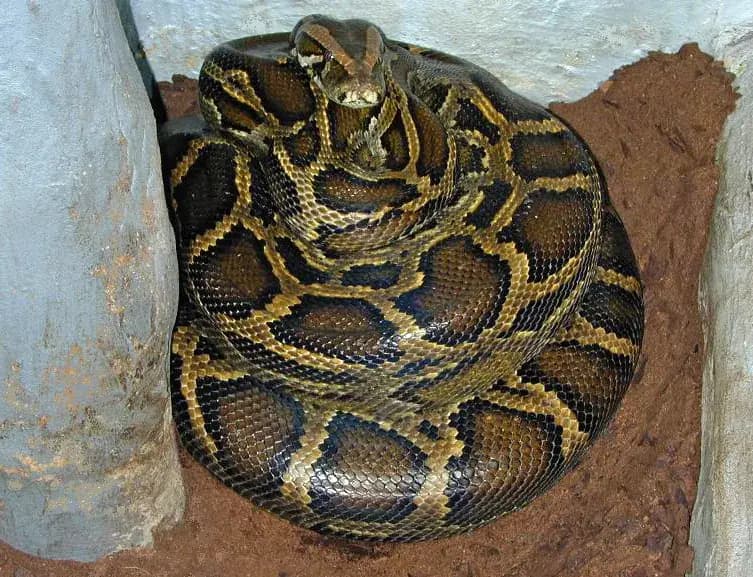
In appearance, the ball python is black, or albino and dark brown, with light brown blotches along the back and sides, and a white or cream belly scattered with black markings. It's a stocky snake with a relatively small head and smooth scales. Females average a snout-to-vent length of 116.2 cm (45.7 in) with a maximum weight of 1.635 kg (3.60 lb), while males run smaller, averaging 111.3 cm (43.8 in) in snout-to-vent length with a maximum weight of 1.561 kg (3.44 lb). Both sexes carry pelvic spurs on either side of the vent, which males use to grip females during mating; because spur size varies, sex is more reliably determined by probing or manual eversion.
Behavior and diet
Diet
Small mammals and, in juveniles, small birds
Ball pythons are typically nocturnal or crepuscular, most active at dusk, dawn, or during the night. In the wild they favor mammal burrows and other underground hiding spots, where they also aestivate during dry periods. Males tend toward more semi-arboreal behavior, while females are more often found on the ground.
Diet in the wild consists mostly of small mammals — including Woermann's bat, the Gambian pouched rat, Tullberg's soft-furred mouse, the typical striped grass mouse, and the forest giant squirrel — along with Prince Demidoff's bushbaby and juvenile grey parrots. Young ball pythons under 70 cm (28 in) feed mainly on small birds before shifting toward mammals once they exceed about 100 cm (39 in); males as a group prey more often on birds, and females more often on mammals.
Females are oviparous, laying three to eleven large, leathery eggs that hatch after 55 to 60 days; the female provides no further care once the eggs hatch. Sexual maturity depends on both age and weight — males typically mature at 11 to 18 months, and females at 20 to 36 months, with males generally needing to reach at least 600 g (21 oz) and females at least 800 g (28 oz) before breeding, though captive breeders often wait for higher weights. Notably, parthenogenetic reproduction — a female producing offspring without a mate — has been documented in a pet ball python through genetic comparison of a mother and her embryos.
Range and habitat
Habitat
Grasslands, savannas, shrublands, and sparsely wooded open forests
The ball python is native to west sub-Saharan Africa, ranging from Senegal through Cameroon to Sudan and Uganda. It prefers grasslands, savannas, and sparsely wooded areas within that range.
Conservation status
The ball python is listed as Near Threatened, facing a high level of exploitation, with the wild population believed to be declining across most of West Africa. The primary driver is poaching for the international exotic pet trade, though the species is also hunted for its skin and meat and for use in traditional medicine; habitat loss from intensified agriculture and pesticide use adds further pressure. In Togo, rural hunters collect gravid females and egg clutches to sell to snake ranches — in 2019 alone, 58 interviewed hunters reported collecting 3,000 live ball pythons and 5,000 eggs. The IUCN notes that while captive-bred animals are widely available in the pet trade, continued capture of wild individuals for sale is doing significant damage to wild populations.
In captivity, the ball python is the most popular pet snake and the second most popular pet reptile after the bearded dragon, commonly living 15 to 30 years with good care; the oldest recorded captive individual lived 62 years, 59 of them at the Saint Louis Zoo. Breeders have developed more than 7,500 cosmetic color and pattern variations known as "morphs," most considered harmless, though the "spider" morph has been linked to a genetic defect known as wobble syndrome, caused by an inner-ear abnormality — a concern serious enough that the International Herpetological Society banned the sale of spider morphs at its events starting in 2018. Disease is also a documented risk in captive populations: reptile nidoviruses (sometimes called serpentoviruses) have been tied to fatal respiratory disease outbreaks in ball pythons, alongside other viral, bacterial, and parasitic threats worsened by poor transport, overcrowding, and inadequate biosecurity in the trade.
Where to see ball python in the U.S.
50 zoos across 30 states
Find the closest one
Rank the 45 zoos holding ball python by how far they are from you. Your location is used in your browser to sort this list and is never sent to us.
5 more zoos hold ball python but have no coordinates on file yet, so they aren't ranked here. They're in the full list below.
Alabama· 1
California· 2
Colorado· 2
Connecticut· 1
Delaware· 1
Florida· 3
Georgia· 1
Hawaii· 1
Idaho· 1
Illinois· 3
Kansas· 3
Kentucky· 1
Louisiana· 3
Maryland· 2
Massachusetts· 3
Michigan· 1
Minnesota· 1
Mississippi· 1
Montana· 1
Nebraska· 1
New York· 4
North Carolina· 1
North Dakota· 1
Oregon· 2
Pennsylvania· 1
South Dakota· 1
Texas· 1
Utah· 1
Virginia· 2
Wisconsin· 3
AZAThe Association of Zoos and Aquariums. Accredited members have passed an independent inspection of animal care and welfare, safety, conservation and education, repeated every five years. Many smaller facilities never apply, so “not accredited” isn't a verdict on its own. What accreditation means · How we check this
Built from each zoo's own published animal list.
Ball Python: common questions
Is the ball python endangered?
It is listed as Near Threatened, with wild populations believed to be declining across most of West Africa due to poaching for the pet trade.
How big does a ball python get?
It reaches a maximum length of 182 cm (72 in), making it the smallest of the African pythons. Females can weigh up to 1.635 kg (3.60 lb) and males up to 1.561 kg (3.44 lb).
What does a ball python eat?
In the wild it eats mainly small mammals such as rodents and bats, along with small birds when young.
How long do ball pythons live?
In captivity they commonly live 15 to 30 years with good care; the oldest recorded individual lived 62 years, most of that time at the Saint Louis Zoo.
Where do ball pythons live in the wild?
They are native to west sub-Saharan Africa, from Senegal through Cameroon to Sudan and Uganda, favoring grasslands, savannas, and sparsely wooded areas.
Which U.S. zoos have ball pythons?
Twenty-three zoos in the Feather & Fang directory have ball pythons, including the Oakland Zoo, Cheyenne Mountain Zoo, and Oregon Zoo.