- Where to see one
- 51 U.S. zoos in our directory hold red-tailed hawk, confirmed against each zoo's own animal list.
- Native range
- Breeds from western Alaska and northern Canada south to Panama and the West Indies
- Size
- Length 18–26 in (45–65 cm); wingspan 43–57 in (110–145 cm); weight 1.5–3.5 lb (690–1,600 g), with females about 25% heavier than males
About the red-tailed hawk
The red-tailed hawk is a bird of prey and among the most common hawks in North America, breeding across most of the continent from western Alaska and northern Canada as far south as Panama and the West Indies. It's one of the largest members of the genus Buteo in North America, typically weighing 690 to 1,600 grams and measuring 18 to 26 inches in length, with a wingspan of 43 to 57 inches. As is typical for many raptors, females run larger than males, weighing about 25% more on average.
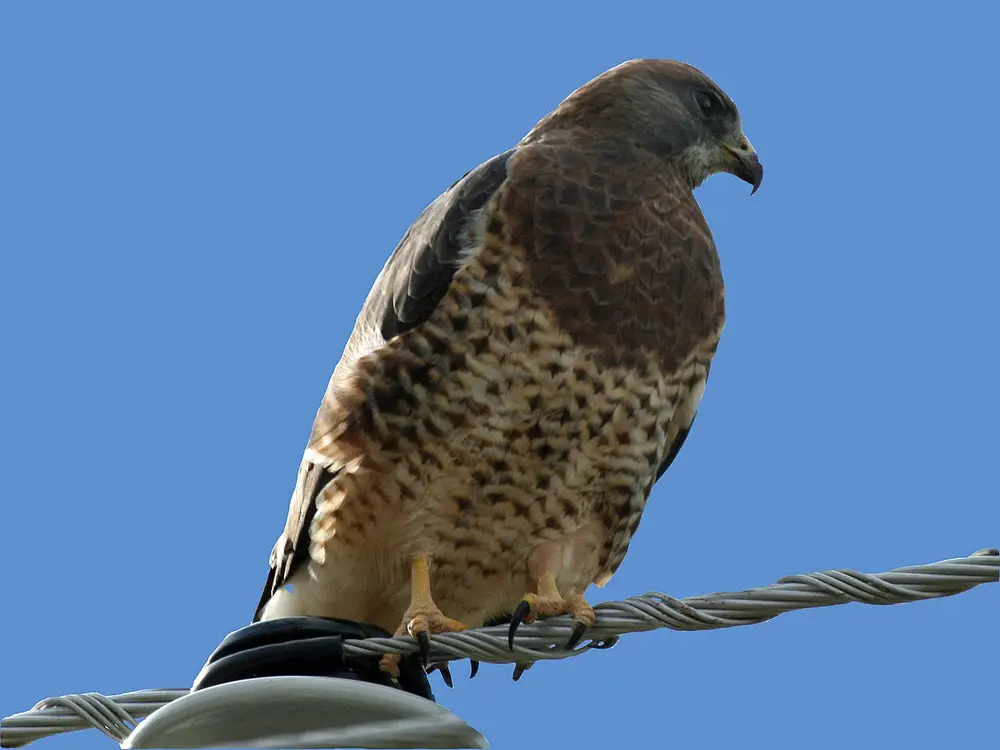
The species gets its name from its most identifiable feature: a tail that is uniformly brick-red above and light buff-orange below, ending in a single black band in adult birds. Immature red-tailed hawks lack the solid red tail, instead showing about six darker bars, and their eyes start out yellowish before slowly darkening to reddish-brown over three to four years as they reach full maturity. Overall, the bird is blocky and broad-shaped, often heavier-looking than other Buteo species of similar length, with a whitish underbelly marked by a dark band of streaking across the belly, a short dark hooked bill, and yellow cere, legs, and feet.
At least 14 subspecies are recognized, varying in range and coloring; the western population, B. j. calurus, is the most variable, occurring in light, dark, and intermediate color morphs, with the darker forms making up 10 to 20 percent of that population. One subspecies, Harlan's hawk, looks so different — blackish and white rather than warm-toned, with a variably colored tail — that it's sometimes classified as its own species. The red-tailed hawk was formally described in 1788 by German naturalist Johann Friedrich Gmelin, based on a specimen sent from Jamaica, which is reflected in its scientific name.
Behavior and diet
Diet
Small mammals such as rodents and lagomorphs, plus birds, fish, reptiles, and amphibians
Red-tailed hawks hunt using one of two main techniques: scanning for prey from an elevated perch before swooping down to seize it, or watching for prey while soaring, then either snatching a bird out of the air or chasing prey on the ground until they can pin it with their talons. In flight, the species conserves energy by soaring with its wings held in a slight dihedral, flapping as little as possible; in windy conditions it will sometimes hover on beating wings, remaining stationary above the ground. Soaring or flapping flight typically runs 40 mph, but a diving hawk can exceed 120 mph.
Rodents make up the bulk of the diet, comprising up to 85% of what a red-tailed hawk eats, including mice, gophers, voles, chipmunks, and both ground and tree squirrels. The species also takes lagomorphs, shrews, bats, birds such as pigeons and quail, other raptors, reptiles, fish, crustaceans, insects, and earthworms, and it will opportunistically go after prey as large as adult black-tailed jackrabbits, striped skunks, and western diamondback rattlesnakes — animals that outweigh most red-tails themselves. On Caribbean islands, where reptiles are the dominant native land animals, red-tailed hawks prey mostly on snakes and lizards instead. They'll scavenge carrion when necessary, though it's not a preferred food source, and a captive red-tail eats roughly 4.8 ounces of food per day in winter.
Pairs form long-term bonds, staying together for life and taking a new mate only if the original one dies. They build a stick nest high in a tree and lay one to three eggs per clutch. The species vocalizes with a distinctive two- to three-second rasping scream, described as kree-eee-ar, that's often used as a stock raptor sound effect in film and television — frequently for birds other than red-tailed hawks.
Range and habitat
Habitat
Deserts, grasslands, coniferous and deciduous forests, agricultural fields, and urban areas; absent from unbroken forest and the high Arctic
Red-tailed hawks breed from central Alaska, the Yukon, and the Northwest Territories east to southern Quebec and Canada's Maritime provinces, and south through Florida, the West Indies, and Central America; their winter range extends from southern Canada south through the rest of that breeding range. The species occupies an unusually wide range of habitats and altitudes for a raptor — deserts, grasslands, coastal regions, mountains, foothills, coniferous and deciduous woodlands, tropical rainforests, agricultural fields, and cities — second only to the peregrine falcon in habitat diversity among North American birds. It's absent from areas of unbroken forest and the high Arctic.
Historic land-use changes in North America have generally favored the species: clearing forests in the Northeast opened up hunting grounds while surviving woodlots supplied nest sites, fire suppression and tree planting across the Great Plains created new perching habitat, and highways lined with utility poles over treeless medians gave the hawks ideal spots to hunt from. The bird is largely unfazed by human activity and now nests successfully even in dense urban settings — one famous individual, nicknamed "Pale Male," became the subject of a nonfiction book after nesting for years in New York City's Central Park.
Conservation status
The red-tailed hawk is listed as Least Concern on the IUCN Red List, consistent with its status as among the most widespread and common hawks in the Americas. It's legally protected across its range in Canada, Mexico, and the United States under the Migratory Bird Treaty.
The species does face localized threats in cities, where rodenticides used to control rats and mice can poison hawks that eat contaminated prey; ingesting rodents that have consumed warfarin-based bait can affect the hawks as well. Even so, the population overall remains large and secure, and the bird's adaptability to human-altered landscapes — from farmland to city parks — has helped keep it common across nearly the entire continent.
Where to see red-tailed hawk in the U.S.
51 zoos across 25 states
Find the closest one
Rank the 45 zoos holding red-tailed hawk by how far they are from you. Your location is used in your browser to sort this list and is never sent to us.
6 more zoos hold red-tailed hawk but have no coordinates on file yet, so they aren't ranked here. They're in the full list below.
Alabama· 1
Arizona· 2
California· 8
Florida· 2
Georgia· 1
Idaho· 3
Illinois· 2
Indiana· 2
Kansas· 2
Kentucky· 1
Louisiana· 3
Maryland· 1
Massachusetts· 2
Michigan· 2
Minnesota· 2
Mississippi· 1
New Hampshire· 1
New York· 4
North Carolina· 1
Ohio· 1
Oregon· 1
Pennsylvania· 2
South Dakota· 1
Texas· 2
Wisconsin· 3
AZAThe Association of Zoos and Aquariums. Accredited members have passed an independent inspection of animal care and welfare, safety, conservation and education, repeated every five years. Many smaller facilities never apply, so “not accredited” isn't a verdict on its own. What accreditation means · How we check this
Built from each zoo's own published animal list.
Red-tailed Hawk: common questions
Is the red-tailed hawk endangered?
No. It's listed as Least Concern by the IUCN and is among the most common hawks in North America.
How big does a red-tailed hawk get?
Adults measure 18 to 26 inches long with a wingspan of 43 to 57 inches, and weigh between 1.5 and 3.5 pounds, with females larger than males.
What does a red-tailed hawk eat?
Mostly rodents, which make up as much as 85% of the diet, along with lagomorphs, birds, fish, reptiles, and amphibians.
Where do red-tailed hawks live in the wild?
They breed from western Alaska and northern Canada south to Panama and the West Indies, and occupy habitats ranging from desert to farmland to city parks.
Which U.S. zoos have red-tailed hawks?
Twenty zoos in our directory list one, including the San Diego Zoo, the Cincinnati Zoo and Botanical Garden, and the Staten Island Zoo.