- Where to see one
- 6 U.S. zoos in our directory hold swainson's hawk, confirmed against each zoo's own animal list.
- Native range
- Breeds in western North America from Alaska and Canada to northern Mexico; winters mainly in Argentina, Uruguay and southern Brazil
- Size
- 43–56 cm (17–22 in) long, wingspan 117–137 cm (46–54 in), weight 0.5–1.7 kg (1.1–3.7 lb)
- Lifespan
- Oldest known wild bird 26 years 1 month
- Migration
- Up to 11,400 km (7,100 mi) each way
- Nicknames
- Grasshopper hawk, locust hawk
Conservation status
Least Concernassessed 2016
IUCN Red List category LC — step 1 of 7.
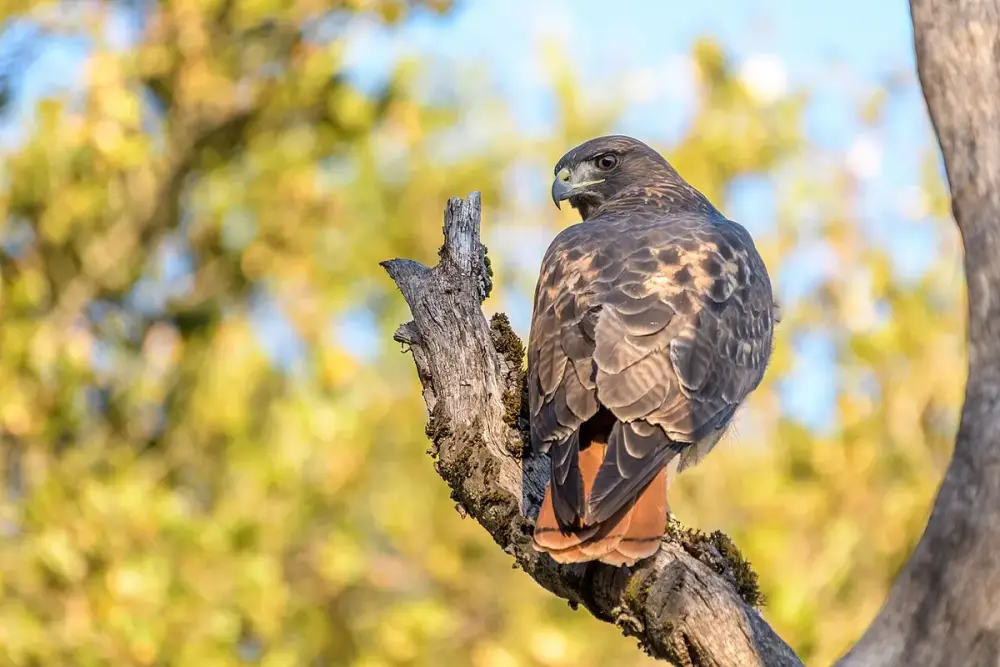
Swainson's hawk is a large raptor that breeds on prairie and dry grasslands of western North America, building a stick nest in a tree, shrub or on a cliff edge. It is 43-56 cm long with a wingspan of 117-137 cm. Known as the grasshopper hawk or locust hawk, it is very fond of grasshoppers and locusts and may be largely insectivorous except when nesting, when it switches mainly to small mammals and other vertebrates for its young. It follows tractors and wildfires for fleeing prey. A long-distance migrant, it winters mainly on the pampas of Argentina, Uruguay and southern Brazil.
About the Swainson's hawk
Swainson's hawk (Buteo swainsoni) is a medium-sized hawk of the genus Buteo, related to the red-tailed hawk, that breeds on the prairies and dry grasslands of western North America and winters on the pampas of South America. Its taste for grasshoppers and locusts earned it the nicknames grasshopper hawk and locust hawk.
The species is named after William Swainson, a British naturalist. Research shows that Swainson's hawk, or its immediate ancestor, gave rise to the Galápagos hawk, which split from the mainland birds perhaps 300,000 years ago.
In size it overlaps broadly with the red-tailed hawk. It is slightly shorter at 43–56 cm (17–22 in) and slightly lighter at 0.5–1.7 kg (1.1–3.7 lb), but its wings are longer and more slender, spanning 117–137 cm (46–54 in). Females are bigger than males, averaging 1.15 kg (2.5 lb) against the male's 0.81 kg (1.8 lb). In flight it holds its wings in a shallow V, called a dihedral, and rocks gently from side to side as it soars.
More than 90% of Swainson's hawks are light-morph birds. These have white underparts, a dark reddish "bib" across the chest and a clear white throat and face. From below, the underwings show pale linings along the leading edge and dark flight feathers along the trailing edge, a pattern unique among North American raptors. The gray-brown tail carries about six narrow dark bands and one wider band near the tip. Dark-morph birds, most common in the far west, are dark brown apart from a pale patch under the tail, and a rufous variant has reddish bars on lighter underparts.
Behavior and diet
Diet
Grasshoppers, locusts and other large insects; small mammals, birds and reptiles when nesting
Outside the nesting season, Swainson's hawk is largely an insect eater, which sets it apart from other Buteo hawks in its range that focus on rodents and other small vertebrates. Grasshoppers, crickets and locusts are standard prey. It catches dragonflies in midair, grabbing them with a foot and passing them straight to the bill, and it has been seen plucking free-tailed bats out of streams of bats in flight.
It hunts in many ways. It watches from a perch such as a tree, pole or mound, soars over open ground, glides low like a harrier, hovers, or walks on the ground running down insects. The hawk follows tractors, mowers and plows for exposed rodents and insects, and it is drawn to grass fires, where it picks off fleeing insects, lizards, snakes and birds at the edge of the flames.
Breeding pairs switch to vertebrate prey for their young. Young ground squirrels, young cottontails, pocket gophers, mice and young jackrabbits make up much of the nestling diet, along with snakes, lizards, toads, tiger salamanders and birds. In Saskatchewan, the breeding range of Swainson's hawk matches that of Richardson's ground squirrel exactly.
Pairs are monogamous and show strong loyalty to both mate and territory, which is unusual for a long-distance migrant. They arrive at nest sites in March or April, and the male begins building within one to two weeks. Nests of twigs and grasses sit 2.7–4.6 m (9–15 ft) up in an isolated tree, shrub, shelterbelt or old homestead grove, and are often smaller and flimsier than red-tailed hawk nests. The female lays one to four eggs, usually two or three, and incubates for 34 to 35 days while the male brings food. Young fledge at about 38 to 46 days and depend on their parents for another four to five weeks. Pairs raise one brood a year.
Range and habitat
Habitat
Prairie, dry grassland, desert, hayfields and pasture with scattered trees
Swainson's hawk spends spring and summer in North America. It breeds from east-central Alaska and southwestern Yukon through the Canadian prairie provinces and south through eastern Washington and Oregon, California's Central Valley, Arizona, New Mexico, Colorado and most of Texas, east to Minnesota, Nebraska, Kansas and Oklahoma. It favors wild prairie, hayfields and pasture over wheat and alfalfa, which can give prey too much cover, and it needs elevated perches for hunting.
Its migration is the second longest of any North American raptor, after arctic-nesting peregrine falcons. The trip to the pampas can be as long as 11,400 km (7,100 mi) and takes at least two months. Birds leave from August to October, riding rising thermals and gliding between them. Nearly the whole population funnels through the Isthmus of Panama, where concentrations of migrating hawks are spectacular. Most winter in Argentina, Uruguay and southern Brazil, gathering in flocks that can top 100 birds. Central Valley breeders winter in western Mexico and Central America, and small numbers winter in southeastern Florida and on the Texas coast.
On the breeding grounds, a pair's home range averages 2.6–5.2 square km (1–2 square mi). Swainson's, red-tailed and ferruginous hawks often nest in the same areas and defend territories against each other, splitting the landscape by nest site.
Swainson's hawk vs red-tailed hawk
The two Buteo hawks share the western plains and are similar in size, so they are often confused. These are the main differences:
| Feature | Swainson's hawk | Red-tailed hawk |
|---|---|---|
| Body length | 43–56 cm (17–22 in), a little shorter on average | Overlaps broadly; slightly longer on average |
| Wings | Longer, more slender; held in a shallow V | Slightly shorter wingspan |
| Underwing | Pale linings, dark flight feathers, unique among North American raptors | Lacks this pattern |
| Main non-breeding food | Large insects | Rodents and other small vertebrates |
| Nest | Smaller, flimsy, in isolated trees or shrubs | Larger, in stands of tall trees |
| Winter | Migrates to South America | Resident almost throughout North America |
Conservation status
Swainson's hawk is listed as Least Concern on the IUCN Red List. It declined from the first half of the twentieth century and was Blue-listed in the United States from 1972 to 1982. It was later dropped from the active federal list because it turned out to be more common than thought. California has listed it as threatened since 1983, and the state's Central Valley is a focus of conservation planning, with annual monitoring in the Natomas Basin and other areas.
A major cause of the decline was pesticide use on the Argentine wintering grounds. Farmers there used DDT and monocrotophos against grasshoppers and locusts, and hawks gorged on the dying insects. The United States worked with Argentine farmers to address the problem.
Other threats include traffic collisions, illegal shooting, electrocution, hailstorms and windstorms, which caused 30% of nest failures in one study, and egg losses to great horned owls sharing the same grove. Far western populations in Oregon and southern California have dropped sharply because of habitat loss and farming practices, while birds across much of the plains seem to be holding steady.
Where to see swainson's hawk in the U.S.
6 zoos across 6 states
Find the closest one
Rank the 6 zoos holding swainson's hawk by how far they are from you. Your location is used in your browser to sort this list and is never sent to us.
Arizona· 1
California· 1
Idaho· 1
New Mexico· 1
Oregon· 1
Texas· 1
AZAThe Association of Zoos and Aquariums. Accredited members have passed an independent inspection of animal care and welfare, safety, conservation and education, repeated every five years. Many smaller facilities never apply, so “not accredited” isn't a verdict on its own. What accreditation means · How we check this
Built from each zoo's own published animal list.
Swainson's Hawk: common questions
How big is a Swainson's hawk?
It measures 43–56 cm (17–22 in) long with a wingspan of 117–137 cm (46–54 in). It weighs 0.5–1.7 kg (1.1–3.7 lb), and females are heavier than males.
What do Swainson's hawks eat?
Mostly large insects such as grasshoppers, crickets, locusts and dragonflies. During the breeding season they hunt young ground squirrels, rabbits, gophers, mice, reptiles and birds to feed their chicks.
Where do Swainson's hawks migrate?
To South America. Most winter on the pampas of Argentina, Uruguay and southern Brazil, a trip that can reach 11,400 km (7,100 mi) and takes at least two months.
Why is it called the grasshopper hawk?
Because it eats grasshoppers and locusts greedily whenever they are available. It is also called the locust hawk.
How long do Swainson's hawks live?
The oldest known wild bird reached 26 years and 1 month. In one northern California population, most adults that reached breeding age died at about 9 years old.
Is the Swainson's hawk endangered?
No. It is listed as Least Concern, though California has listed it as threatened since 1983 and some western populations have declined sharply.
How can you tell a Swainson's hawk from a red-tailed hawk?
Look at the underwing. A light-morph Swainson's hawk has pale wing linings and dark flight feathers, plus a dark reddish chest bib and longer, narrower wings.