- Where to see one
- 30 U.S. zoos in our directory hold eurasian eagle-owl, confirmed against each zoo's own animal list.
- Native range
- Continental Europe, Scandinavia, Russia, Central Asia, Anatolia, the northern Middle East, upper South Asia, China, Korea and Japan; small numbers in the United Kingdom
- Size
- Females up to 30 in (75 cm) long with a wingspan up to 74 in (188 cm); males slightly smaller
- Weight
- Females 3.9–10.1 lb (1.75–4.6 kg); males 2.6–7.1 lb (1.2–3.2 kg)
Conservation status
IUCN Red List category LC — step 1 of 7.
Least Concern (LC), with a decreasing population trend
About the Eurasian eagle-owl
The Eurasian eagle-owl is a species of eagle-owl found across much of Eurasia, often simply called "the eagle-owl" in Europe and Asia. It is one of the largest owl species in the world and among the most widely distributed, with a combined European and Asian range of about 19.8 million square miles (51.4 million km²) and a total population estimated between 100,000 and 500,000 individuals.
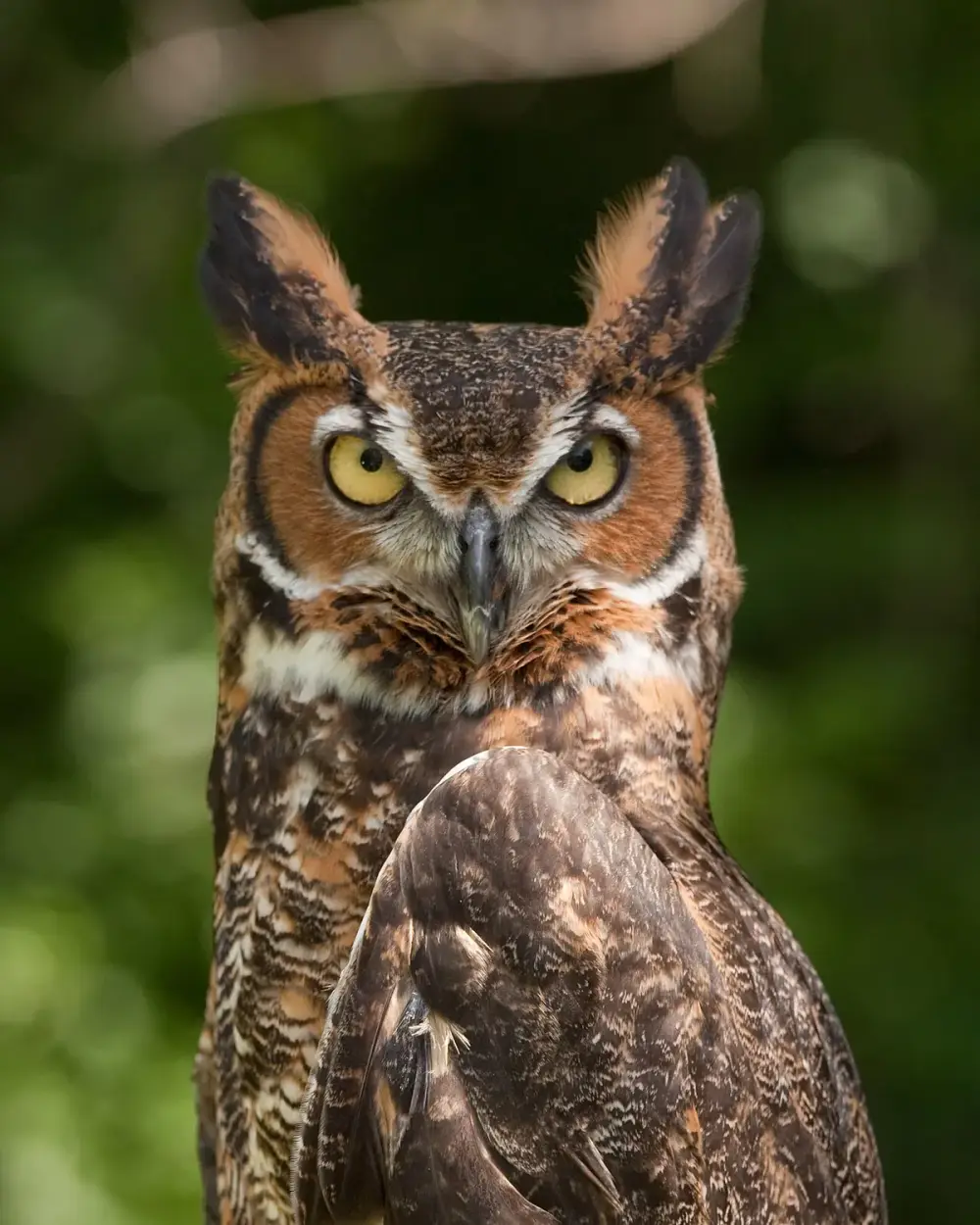
Females are the larger sex, reaching a total length of up to 30 in (75 cm) with a wingspan up to 74 in (188 cm), while males run slightly smaller; wingspans across the species range from 52 to 74 in (131–188 cm), with the largest individuals possibly reaching 79 in (2 m). Females weigh 3.9 to 10.1 lb (1.75–4.6 kg) and males 2.6 to 7.1 lb (1.2–3.2 kg) — for comparison, the barn owl weighs about 1.1 lb (0.5 kg) and North America's great horned owl, which fills a similar ecological role, weighs around 3.1 lb (1.4 kg). The bird is distinguished by prominent ear tufts, mottled blackish-and-tawny upperparts, barred wings and tail, buff underparts streaked with darker markings, an indistinct facial disc and striking orange eyes. At least 12 subspecies are recognized, and plumage color varies considerably between them, from brown-black to tawny-buff to pale creamy gray.
Sexes look similar apart from size, though the ear tufts of males tend to sit more upright than those of females, and in some populations females run slightly darker overall. The talons are notably large for an owl — one female examined in Britain had a middle claw measuring 2.28 in (57.9 mm), comparable to that of a large female golden eagle. Unlike owls that hunt primarily by sound, the Eurasian eagle-owl has a relatively simple ear structure and shallow facial disc, meaning it relies more on sight than hearing, and it tends to be most active in low light around dawn and dusk rather than in full darkness.
Behavior and diet
Diet
Mainly small mammals such as rodents and rabbits, plus birds, larger mammals, reptiles, amphibians, fish, insects and other invertebrates
The Eurasian eagle-owl is mostly a nocturnal predator, hunting predominantly small mammals such as rodents and rabbits, along with birds and larger mammals; reptiles, amphibians, fish, large insects and other invertebrates round out its diet as secondary prey. Its talons are very large and not often exceeded in size by diurnal birds of prey.
The species breeds on cliff ledges, in gullies, among rocks, and in other sheltered, concealed sites. A typical clutch of 2 to 4 eggs is laid at intervals in a simple scrape, and because the eggs are laid days apart, they also hatch at different times, producing chicks of staggered ages in the same nest. The female alone incubates the eggs and broods the young, while the male brings food to her and to the nestlings. Both parents then continue caring for the young for about five months after hatching.
A complete molt takes place once a year, between July and December. The species has occasionally been put to practical use by humans: because of its size, tame eagle-owls have been used in pest control to deter large birds such as gulls from nesting in unwanted areas.
Range and habitat
Habitat
Mountainous and rocky areas, woodland edges, shrubland, wetlands, coniferous forest, steppe, and occasionally farmland or park-like urban settings
The Eurasian eagle-owl occupies an enormous range across Europe and Asia, with the bulk of the population in continental Europe, Scandinavia, Russia and Central Asia; Russia likely holds both the highest numbers and the greatest diversity of subspecies. Smaller populations extend into Anatolia, the northern Middle East, the higher elevations of upper South Asia, China, Korea and Japan. An estimated 12 to 40 pairs are also thought to live in the United Kingdom as of 2016, a population that may be growing and that has bred successfully there since at least 1996, even though the species is considered non-native in Britain.
Habitat use is broad: the bird favors mountainous and rocky terrain, often near varied woodland edges or shrubby areas with clearings or wetlands nearby, but it also lives in coniferous forest, steppe and other remote landscapes. It occasionally turns up in farmland and in park-like settings within European and Asian cities, and very rarely in busier urban areas.
Conservation status
The Eurasian eagle-owl is classified as Least Concern (LC) by the IUCN, reflecting its huge range and substantial total population of an estimated 100,000 to 500,000 individuals. The population trend, however, is listed as decreasing, meaning numbers are declining even though the species remains widespread and is not yet considered threatened.
Where to see eurasian eagle-owl in the U.S.
30 zoos across 20 states
Find the closest one
Rank the 22 zoos holding eurasian eagle-owl by how far they are from you. Your location is used in your browser to sort this list and is never sent to us.
8 more zoos hold eurasian eagle-owl but have no coordinates on file yet, so they aren't ranked here. They're in the full list below.
Alabama· 2
California· 3
Connecticut· 1
Delaware· 1
Florida· 2
Illinois· 2
Kansas· 1
Maine· 1
Massachusetts· 1
Michigan· 1
Minnesota· 1
Missouri· 1
New York· 2
North Carolina· 3
Ohio· 1
Oregon· 2
Pennsylvania· 1
South Carolina· 1
Tennessee· 1
Virginia· 2
AZAThe Association of Zoos and Aquariums. Accredited members have passed an independent inspection of animal care and welfare, safety, conservation and education, repeated every five years. Many smaller facilities never apply, so “not accredited” isn't a verdict on its own. What accreditation means · How we check this
Built from each zoo's own published animal list.
Eurasian Eagle-Owl: common questions
Is the Eurasian eagle-owl endangered?
No. It is listed as Least Concern by the IUCN, although its overall population trend is decreasing.
How big does a Eurasian eagle-owl get?
Females can reach 30 in (75 cm) in length with a wingspan up to 74 in (188 cm); males are slightly smaller. Females weigh 3.9–10.1 lb (1.75–4.6 kg) and males 2.6–7.1 lb (1.2–3.2 kg).
What does a Eurasian eagle-owl eat?
Mainly small mammals such as rodents and rabbits, along with birds, larger mammals, reptiles, amphibians, fish and large invertebrates.
Where do Eurasian eagle-owls live in the wild?
Across a huge range spanning continental Europe, Scandinavia, Russia, Central Asia, parts of the Middle East and South Asia, China, Korea, Japan and small numbers in the United Kingdom.
Which U.S. zoos have Eurasian eagle-owls?
Nine zoos in the Feather & Fang directory list one, including the Los Angeles Zoo, Cincinnati Zoo and Botanical Garden, and Virginia Zoological Park.
How many eggs does a Eurasian eagle-owl lay?
Typically 2 to 4 eggs per clutch, laid at intervals so they hatch at different times.