
Owls in U.S. zoos
Owls are the bird order Strigiformes, more than 200 species of mostly solitary, nocturnal birds of prey. They have an upright stance, a broad head with forward-facing eyes set in a facial disc, very sharp hearing and feathers adapted for near-silent flight. They live in all regions of the world except the polar ice caps and some remote islands.
Most widely held
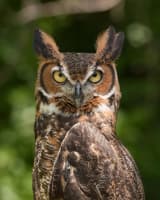 Great Horned OwlBubo virginianusAt 51 zoos · Least Concern
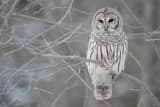 Barred OwlStrix variaAt 36 zoos · Least Concern
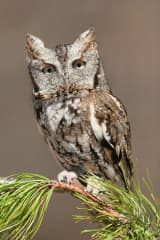 Eastern Screech-OwlMegascops asioAt 30 zoos · Least Concern
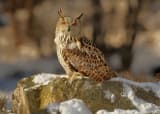 Eurasian Eagle-OwlBubo buboAt 30 zoos · Least Concern
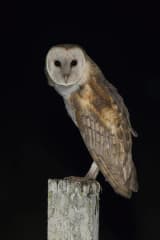 Barn OwlTyto furcataAt 17 zoos · Least Concern
 Snowy OwlBubo scandiacusAt 15 zoos · Vulnerable
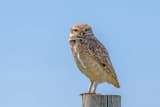 Burrowing OwlAthene cuniculariaAt 14 zoos · Least Concern
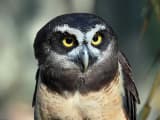 Spectacled OwlPulsatrix perspicillataAt 10 zoos · Least Concern
Built for hunting at night
Owls are birds of prey, but their senses are tuned differently from those of hawks and eagles. Most raptors have eyes on the sides of the head; owls' large eyes face forward, giving the depth perception needed to hunt in low light. Because the eyes are fixed in their sockets, owls turn the whole head instead, as far as 270°. They are farsighted, and they feel prey close to the beak with hairlike feathers.
Hearing matters as much as sight. The facial disc works like a dish that focuses sound onto ear openings that, in many species, sit at different heights on the head. The barn owl uses this lopsided arrangement to pinpoint both the direction and distance of a sound. Soft, specially shaped flight feathers let most owls fly slowly and almost silently, so prey hears nothing coming.
Barn owls and typical owls
Living owls fall into two families: the barn owls and bay owls, and the typical owls. The barn owl's heart-shaped face and lack of ear tufts set it apart. Its feathers, adapted for silence, are not waterproof, which leaves it vulnerable in heavy rain.
The typical owls include the great horned owl, whose "horns" are feather tufts rather than ears, and the Eurasian eagle-owl, one of the two largest owls alive. The small eastern screech-owl comes in gray and rusty color forms, and despite its name it does not screech; its call is a descending whinny. The barred owl is known for a call often written as "who cooks for you".
Not every owl hunts at night. The burrowing owl is long-legged, lives in old rodent burrows in open country and is active by day, and the snowy owl of the Arctic often hunts in daylight, especially in summer.
What to look for on a visit
Most owls are camouflaged to match their surroundings, so a roosting owl can be hard to spot against bark; the snowy owl, the only mainly white owl, is the exception. Look for facial markings, ear tufts and eye color, which tend to be more striking in owls of open habitats and are thought to help them signal to one another in dim light. Owls swallow small prey whole and later cough up pellets of bone and fur.
Threats to owls
Almost all owls are listed in Appendix II of CITES, with four species in Appendix I. Hunting and trade remain a problem in some regions, and habitat loss, pesticides, disease and vehicle collisions add to it. Rodent poisons are a common cause of death: owls that eat poisoned rodents can be poisoned in turn.
Even widespread owls can be in trouble. The barn owl is listed as Least Concern worldwide but has declined in parts of the United States, especially the Midwest. The snowy owl is Vulnerable, with fewer than 100,000 thought to remain, and global warming appears central to its decline.
Common questions
How far can an owl turn its head?
Owls can rotate their heads as much as 270°. They have 14 neck vertebrae, twice as many as humans, and blood vessels adapted so the brain's blood supply is not cut off as they turn.
Why do owls turn their heads instead of their eyes?
Like most birds, owls have eyes fixed in their sockets, so they must turn the whole head to change their view.
Are the tufts on an owl's head its ears?
No. The 'horns' of a great horned owl are just feather tufts. The ears are on the sides of the head, and in many owls they are placed asymmetrically to pinpoint sounds.
What is the largest owl?
The Eurasian eagle-owl and Blakiston's fish owl are the largest, with the biggest females reaching 71 cm (28 in) long, a 190 cm (75 in) wingspan and 4.2 kg (9.25 lb). The smallest is the elf owl, at as little as 31 g (1.1 oz).
Are all owls nocturnal?
No. Most owls hunt at night, but some are active at dawn and dusk, and a few, such as the burrowing owl and the snowy owl, are often active by day.
What is an owl pellet?
An owl pellet is a compact bundle of bones, fur and other indigestible parts of prey that an owl coughs up after swallowing its food whole.
What is a group of owls called?
A group of owls is called a parliament.
Sources
Last reviewed