- Where to see one
- 36 U.S. zoos in our directory hold gila monster, confirmed against each zoo's own animal list.
- Native range
- Southwestern United States and the northwestern Mexican state of Sonora
- Size
- Up to 22 in (56 cm) total length; snout-to-vent length 26 to 36 cm (10 to 14 in); body mass typically 550 to 800 g (1.21 to 1.76 lb)
About the Gila monster
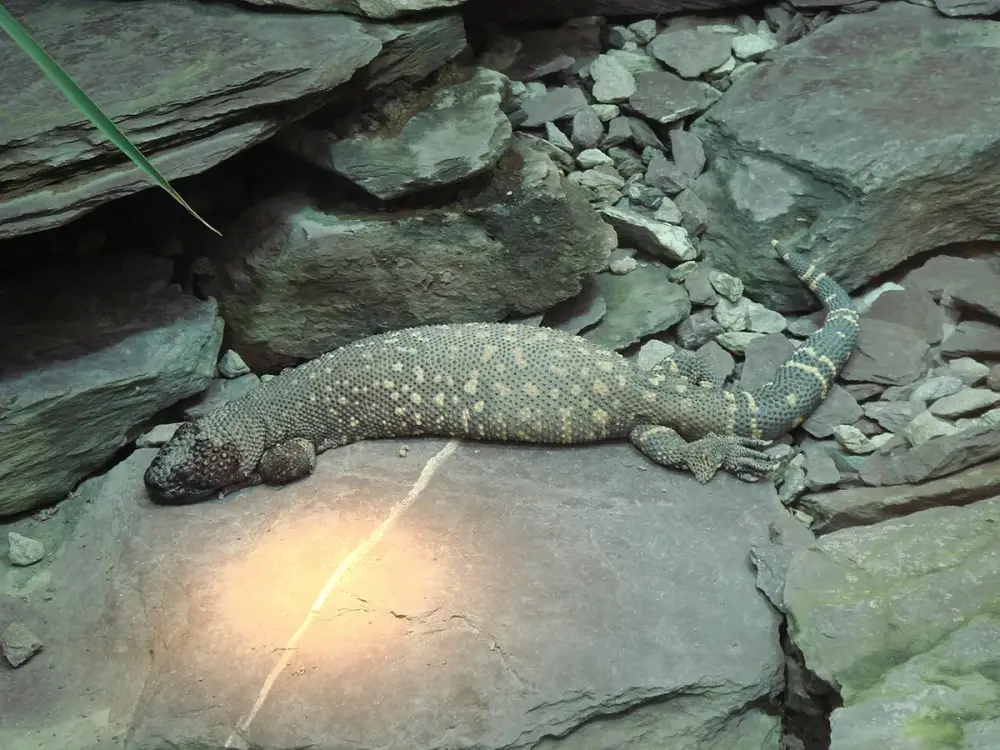
The Gila monster is a species of venomous lizard native to the Southwestern United States and the Mexican state of Sonora. It's a heavy, slow-moving reptile — the largest extant lizard species native to North America north of the Mexican border — and it's the only venomous lizard native to the United States. Despite its fearsome reputation, it's sluggish by nature and rarely poses a real threat to people, though its bite is painful; it's protected by state law in Arizona but is still sometimes killed out of fear.
The name "Gila" comes from the Gila River Basin in Arizona and New Mexico, where the species was once common. "Heloderma" is Greek for "studded skin," and the species name suspectum comes from paleontologist Edward Drinker Cope, who first described the lizard and suspected it was venomous because of grooves he found in its teeth. Those lower teeth do carry venom grooves, and the animal's venom has an outsized modern legacy: one of its peptides, exendin-4, became the basis for the GLP-1 receptor agonist class of drugs used to treat type 2 diabetes and obesity.
Snout-to-vent length runs 26 to 36 cm (10 to 14 in), with the tail adding roughly another 20 percent of body length, so the largest individuals reach 51 to 56 cm (20 to 22 in) overall. Body mass typically falls between 550 and 800 g (1.21 and 1.76 lb). The lizard has a stout snout, a massive head, and small eyes protected by a nictitating membrane. Its four closest living relatives are all beaded lizards — three species in Mexico and one in Guatemala. The family Helodermatidae traces back to the Cretaceous period, and the genus Heloderma has existed since the Miocene; because the group has changed so little morphologically over that span, it's sometimes described as a living fossil, and fossil fragments have turned up in Late Pleistocene deposits near Las Vegas, Nevada.
The lizard's scales on the head, back, and tail contain small, pearl-shaped bones called osteoderms, though the belly scales lack them. Adults are patterned in yellow to pink tones on a black background, while hatchlings start out with a simpler, less colorful pattern that changes dramatically within their first six months. Females undergo a full shed lasting about two weeks before laying eggs, typically shedding the dorsal skin in one large piece, while adult males tend to shed in smaller segments in August.
Behavior and diet
Diet
Small mammals, birds, snakes, lizards, frogs, insects, invertebrates, carrion, and eggs
Gila monsters spend about 90 percent of their lives underground in burrows or rocky shelters, generally staying most active during mornings in the dry spring and early summer, and switching shelters every four to five days early in the season to find the best microhabitat. They maintain a surface body temperature around 30 °C (86 °F) and, as temperatures near 37 °C (99 °F), can lower their body temperature by up to 2 °C (3.6 °F) through limited evaporation via the cloaca. One study of a population in southwestern Utah found they typically travel around 210 m (690 ft) during bouts of activity, occasionally covering more than a kilometer, but across a roughly 90-day active season they were only active on about 10 of those days. They're slow sprinters but have relatively high endurance, and their predators include coyotes, badgers, and raptors, with eggs and young especially vulnerable.
Diet is broad: small mammals such as young rabbits, hares, mice, and ground squirrels, plus small birds, snakes, lizards, frogs, insects, other invertebrates, carrion, and the eggs of birds, lizards, snakes, and tortoises. A Gila monster's acute sense of smell, aided by a strong, forked, black-blue tongue, does most of the work of locating prey by day or night. Because they can store fat reserves in their tails, they don't need to eat often — three or four large meals in spring can supply enough energy for the whole season — but they'll still feed opportunistically whenever suitable prey turns up. Hatchlings can swallow up to half their body weight in a single meal, while adults may eat up to a third of their body weight at once.
Gila monsters reach sexual maturity at four to five years old and emerge from brumation in early March. Mating takes place in April and May, with males using tongue-flicking to locate a female's scent; a female that rejects a male's advances will bite him and chase him off. When successful, copulation observed in captivity has lasted anywhere from 15 minutes to two and a half hours. Females lay their eggs from late May into June, in clutches of up to eight, and hatching happens near the end of October — hatchlings, about 6.5 in (17 cm) long and weighing around 0.075 lb (34 g), go straight into hibernation without ever surfacing first. Social behavior is otherwise little studied, though males have been observed in combat, with the dominant male lying on top of a subordinate to pin it down.
Range and habitat
Habitat
Scrubland, succulent desert, and oak woodland
The Gila monster ranges across the Southwestern United States and Mexico, including Sonora, Arizona, and parts of California, Nevada, Utah, and New Mexico, with no confirmed records from Baja California. It occupies scrubland, succulent desert, and oak woodland, sheltering in burrows, thickets, and under rocks wherever the microclimate and humidity are favorable — often in rocky areas of Navajo sandstone or basaltic lava flows. The species depends on water resources and can be seen at puddles after summer rain, and it avoids open flats and grasslands.
Conservation status
The Gila monster is classified as Near Threatened (NT). It's protected by state law in Arizona, though it's still sometimes killed because of its reputation. The species' bite, while painful and capable of inducing shock, is rarely fatal to healthy adult humans: only one confirmed fatality has occurred since 1930, involving a Colorado man who died in February 2024 after a four-minute bite from a pet Gila monster; earlier rare fatalities recorded before 1930 involved victims who were intoxicated or whose bites were poorly treated. Beyond direct persecution, no additional population threats are detailed here.
Where to see gila monster in the U.S.
36 zoos across 22 states
Find the closest one
Rank the 36 zoos holding gila monster by how far they are from you. Your location is used in your browser to sort this list and is never sent to us.
Arizona· 2
California· 7
Colorado· 2
District of Columbia· 1
Florida· 1
Indiana· 1
Kansas· 2
Kentucky· 1
Massachusetts· 2
Michigan· 1
Minnesota· 1
Missouri· 1
New Mexico· 1
New York· 2
North Carolina· 1
Ohio· 1
Pennsylvania· 2
Tennessee· 1
Texas· 2
Utah· 1
Virginia· 1
Wisconsin· 2
AZAThe Association of Zoos and Aquariums. Accredited members have passed an independent inspection of animal care and welfare, safety, conservation and education, repeated every five years. Many smaller facilities never apply, so “not accredited” isn't a verdict on its own. What accreditation means · How we check this
Built from each zoo's own published animal list.
Gila Monster: common questions
Is the Gila monster endangered?
It's classified as Near Threatened (NT).
How big does a Gila monster get?
Total length reaches up to 22 in (56 cm), with body mass typically between 550 and 800 g (1.21 and 1.76 lb).
What does a Gila monster eat?
Small mammals, birds, snakes, lizards, frogs, insects, carrion, and eggs — a broad, opportunistic diet.
Is a Gila monster's bite dangerous?
It's painful and can induce shock, but it's rarely fatal to healthy adults; only one confirmed human fatality has occurred since 1930.
Where do Gila monsters live in the wild?
In scrubland, desert, and oak woodland across the Southwestern United States and Sonora, Mexico.
Which U.S. zoos have Gila monsters?
Twenty-one zoos in the Feather & Fang directory list them, including the Phoenix Zoo, the San Diego Zoo, and the Cincinnati Zoo and Botanical Garden.