- Where to see one
- 14 U.S. zoos in our directory hold mexican beaded lizard, confirmed against each zoo's own animal list.
- Native range
- Pacific drainages from southern Sonora to southwestern Guatemala, and Atlantic drainages from central Chiapas to southeastern Guatemala
- Size
- 57 to 91 cm (22–36 in) long; average adult body mass about 800 g (1.8 lb), with large specimens exceeding 2,000 g (4.4 lb) and a maximum recorded weight of 4,000 g (8.8 lb)
Conservation status
Least Concernassessed 2014
IUCN Red List category LC — step 1 of 7.
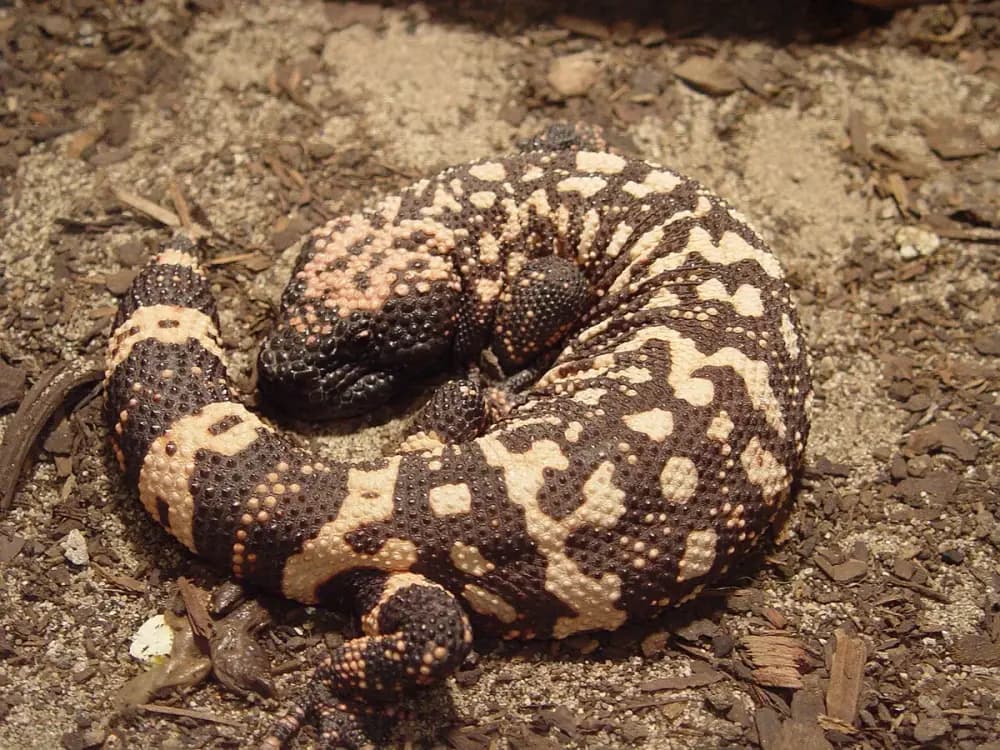
The Mexican beaded lizard is a stocky, venomous lizard found principally in Mexico, with adults 57 to 91 cm (22 to 36 in) long. Its small, beadlike scales are black with yellow spots or bands, and its short tail stores fat for months of estivation. It lives from southern Sonora to Oaxaca in desert, tropical deciduous forest, thorn scrub and pine-oak forest, and is active above ground for only about an hour a day. A semiarboreal nest predator, it feeds mainly on bird and reptile eggs, and occasionally on small birds, mammals, frogs and lizards. It and the Gila monster are the only lizards known to have an overt venom delivery system.
About the Mexican beaded lizard
The Mexican beaded lizard is a species of venomous lizard in the family Helodermatidae, found principally in Mexico and southern Guatemala. Along with the other members of its genus, including its closest living relative, the Gila monster (Heloderma suspectum), it belongs to the only lizards known to have evolved an overt venom delivery system. The Mexican beaded lizard is the larger of the two, with duller coloration — a black body marked with varying amounts of yellow spots or bands, rather than the more vivid patterning of the Gila monster.
Adults range from 57 to 91 cm (22–36 in) in total length, with a snout-to-vent length averaging 33 to 48 cm (13–19 in). The average adult weighs about 800 g (1.8 lb), roughly 45% heavier than the average Gila monster, and large individuals can exceed 2,000 g (4.4 lb); the maximum weight on record is 4,000 g (8.8 lb). Males run slightly larger than females, though the species is not strongly sexually dimorphic overall, and both sexes are stocky with broad heads, males' somewhat more so. The lizard's small, beadlike scales don't overlap and are underlaid with bony osteoderms across most of the body except the underside. Its short tail stores fat to sustain it through months of estivation and, unlike many other lizards, does not regenerate if lost. Forked, pink tongues let it gather scent particles and pass them to a Jacobson's organ for smelling.
The genus Heloderma traces back to the Miocene, and the beaded lizard's close relatives include many extinct helodermatids reaching back to the Cretaceous; because the family has changed relatively little over that span, it is sometimes described as a living fossil. Although beaded lizards superficially resemble the monitor lizards of Africa, Asia, and Australia, their wide geographic separation and distinct features place them in their own family instead.
Behavior and diet
Diet
primarily bird and reptile eggs, plus small birds, mammals, frogs, lizards, and insects
The Mexican beaded lizard is a specialized nest predator, feeding mainly on bird and reptile eggs; it is semiarboreal and will climb deciduous trees in search of them. It occasionally takes small birds, mammals, frogs, lizards, and insects as well. In captivity, breeders have found that beaded lizards do best on a diet of small vertebrates such as mice and rats, and reluctant wild-caught specimens can sometimes be coaxed to eat by smearing egg on prey items. In the wild, the lizards are active only from April to mid-November, spending roughly an hour a day above ground.
Its venom glands are modified salivary glands in the lower jaw, each with a duct leading to the base of grooved teeth; when biting, the lizard hangs on and chews to work its venomous saliva into the wound, even though its unsocketed teeth break off easily at their base. The venom is a weak hemotoxin that can cause respiratory failure, though human deaths are rare — nearly all of the eight documented bites in the past century came from people prodding captive lizards. In humans, a bite causes excruciating pain that can spread beyond the bite site and last up to 24 hours, along with swelling, weakness, sweating, and a rapid drop in blood pressure; in mammals more generally, the venom can trigger reduced blood flow, cardiac irregularities, hypothermia, and internal hemorrhage. The beaded lizard itself is immune to its own venom, and invertebrates are essentially unaffected by it.
Reproduction begins as early as 3 years of age, with mating typically occurring in summer, though captive breeding can happen in any month. Males engage in hours-long ritual combat, and the winner mates with the female. Clutches of two to 30 eggs are laid in late summer or early fall and hatch the following spring or summer. Young lizards are rarely seen, believed to spend much of their early life underground before emerging at 2 to 3 years old, once they have grown considerably.
Range and habitat
Habitat
desert, tropical deciduous forest, thorn scrub, and pine-oak forest from sea level to 1,500 m
Beaded lizards are found across Pacific drainages from southern Sonora to southwestern Guatemala, and along two Atlantic drainages from central Chiapas to southeastern Guatemala. Within that range, the Mexican beaded lizard specifically occupies Mexico from Sonora to Oaxaca. Its habitats include desert, tropical deciduous forest, and thorn scrub forest, as well as pine-oak forest, spanning elevations from sea level up to 1,500 meters.
Several related beaded lizard species occupy overlapping or nearby ranges: the Rio Fuerte beaded lizard from southern Sonora to northern Sinaloa, the Chiapan beaded lizard in northern Chiapas and adjoining Guatemala, and the Guatemalan beaded lizard, isolated in the dry Río Motagua valley of northeastern Guatemala, where fewer than 200 individuals are believed to survive in the wild.
Conservation status
The Mexican beaded lizard is listed as Least Concern on the IUCN Red List, in a 2014 assessment. Even so, it faces real pressure across its range from overcollection and habitat loss, and it is listed on CITES Appendix II, which regulates international trade.
Myth and superstition add to the danger. In much of its range people wrongly believe the lizard is more venomous than a rattlesnake, can cause lightning strikes with its tail, or can make a pregnant woman miscarry just by looking at her, and as a result it is often killed on sight.
Mexican law protects the species under category A (Threatened), and it lives within several protected areas. Its rarer relative, the Guatemalan beaded lizard, may number fewer than 200 animals in the Motagua Valley and is the focus of Project Heloderma, led by the Nature Conservancy and partners, which helped secure that species a CITES Appendix I listing.
Where to see mexican beaded lizard in the U.S.
14 zoos across 9 states
Find the closest one
Rank the 14 zoos holding mexican beaded lizard by how far they are from you. Your location is used in your browser to sort this list and is never sent to us.
California· 2
Florida· 2
Illinois· 2
New York· 3
North Carolina· 1
Oklahoma· 1
Pennsylvania· 1
Tennessee· 1
Virginia· 1
AZAThe Association of Zoos and Aquariums. Accredited members have passed an independent inspection of animal care and welfare, safety, conservation and education, repeated every five years. Many smaller facilities never apply, so “not accredited” isn't a verdict on its own. What accreditation means · How we check this
Built from each zoo's own published animal list.
Mexican Beaded Lizard: common questions
Is the Mexican beaded lizard endangered?
No. It is listed as Least Concern by the IUCN (2014), though it faces pressure from overcollection and habitat loss and is protected under Mexican law and CITES Appendix II.
How big does a Mexican beaded lizard get?
Adults reach 57 to 91 cm (22–36 in) in length and average about 800 g (1.8 lb), with large individuals exceeding 2,000 g (4.4 lb).
What does a Mexican beaded lizard eat?
It mainly preys on bird and reptile eggs, and occasionally small birds, mammals, frogs, lizards, and insects.
Is a Mexican beaded lizard venomous?
Yes — along with the Gila monster and its other genus-mates, it belongs to the only lizards known to have an overt venom delivery system, though human deaths from bites are rare.
Which U.S. zoos have Mexican beaded lizards?
Six U.S. zoos list this species, including the Los Angeles Zoo, ZooAmerica, and Nashville Zoo at Grassmere.