- Where to see one
- 57 U.S. zoos in our directory hold giraffe, confirmed against each zoo's own animal list.
- Native range
- Savannahs, grasslands, and open woodlands of Uganda and Kenya
- Size
- Up to 5.88 m (19.3 ft) tall and up to 1,100 kg (2,500 lb)
About the giraffe
The detailed record behind this page describes the Rothschild's giraffe, an ecotype of the Nubian giraffe and among the most endangered distinct giraffe populations, with an estimated 1,399 mature individuals left in the wild as of 2018. It's named for Walter Rothschild, founder of the Tring Museum, and is also known as the Baringo giraffe, after Kenya's Lake Baringo area, or the Ugandan giraffe. Every wild individual lives within protected areas in Kenya and Uganda. As of August 2025, the IUCN recognizes four giraffe species split into seven subspecies overall; researchers proposed treating the Rothschild's giraffe as its own species in 2007 and as conspecific with the Nubian giraffe in 2016, but neither reclassification has been widely adopted.
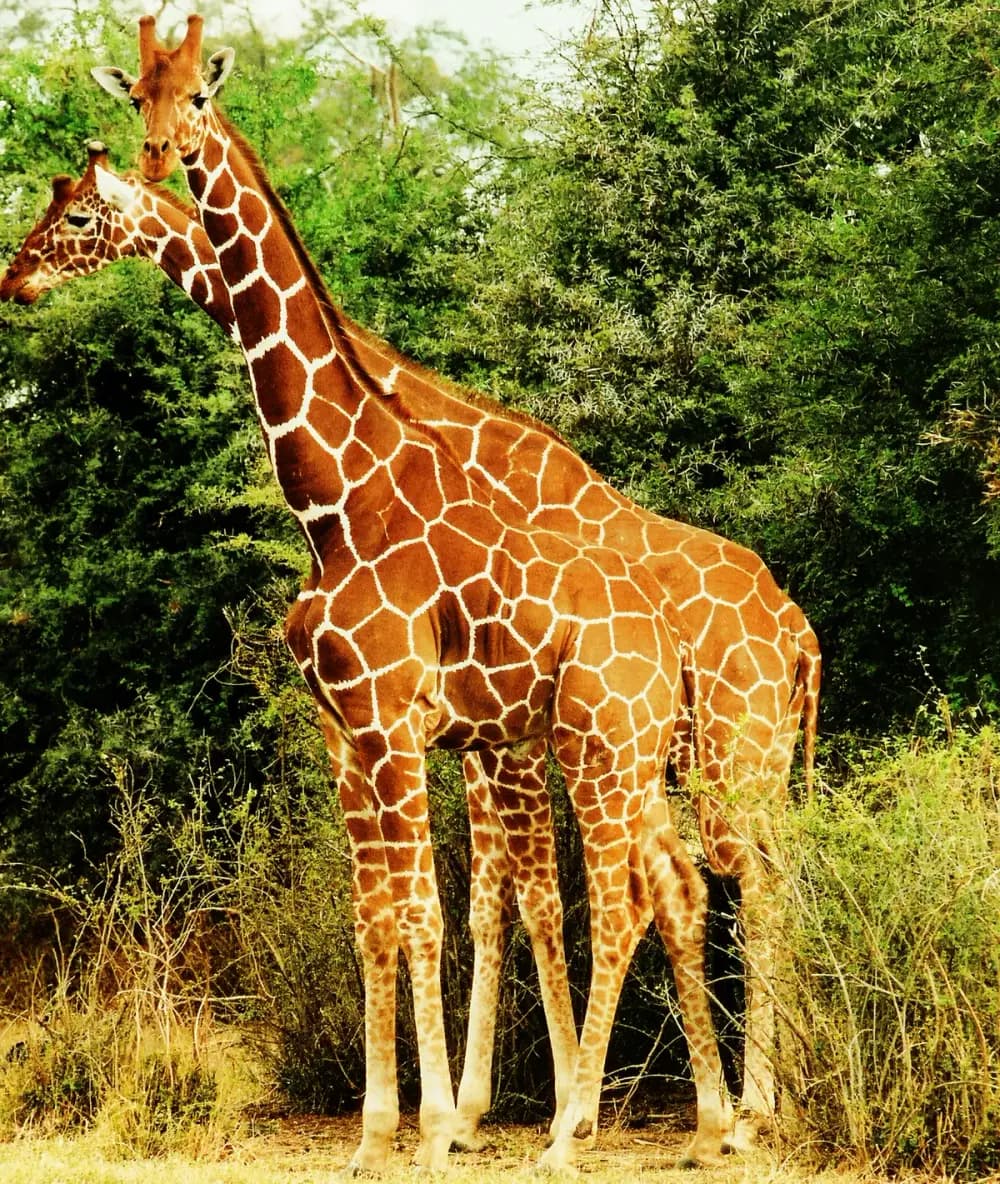
Coat pattern is the clearest way to tell giraffe types apart. Where the reticulated giraffe has sharply defined dark patches separated by bright white channels, the Rothschild's giraffe more closely resembles the Masai giraffe, but with paler, less jagged, less sharply shaped orange-brown patches and creamier connective channels. It also lacks markings on the lower legs entirely, giving the impression that it's wearing white stockings. A subtler distinguishing trait is ossicone count: the Rothschild's giraffe is the only giraffe phenotype born with five ossicones rather than the usual two — a third sits at the center of the forehead, with two more tucked behind the ears. It also carries genetic markers distinct from other giraffe types, which helps protect it from hybridization with other populations.
This ecotype stands taller than many other giraffe subspecies, reaching up to 5.88 m (19.3 ft), and can weigh as much as 1,100 kg (2,500 lb), with males outweighing females by a few hundred pounds. The meat of the Rothschild's giraffe is considered notably sweet, and its bones contain a type of fat that some traditional cultures have used as a medicinal ingredient.
Behavior and diet
Rothschild's giraffes can mate at any time of year, with a gestation period of 14 to 16 months that typically produces a single calf. They live in small herds, with males and females — along with their calves — generally kept separate except when mixing to mate. For the most part they're tolerant of other animals nearby and considered friendly, so long as they don't feel threatened, but because mating isn't confined to a single season, males frequently engage in fights over access to females.
Range and habitat
Habitat
Savannah, grassland, and open woodland
Isolated populations of Rothschild's giraffes live in the savannahs, grasslands, and open woodlands of Uganda and Kenya, and the population is possibly regionally extinct in South Sudan and northeastern Democratic Republic of the Congo. About 60 percent of the Rothschild's giraffe population lives in Uganda.
Conservation status
As of 2018, the Rothschild's giraffe is classified as Near Threatened (NT). Very few sites remain where it can be seen in the wild, with Lake Nakuru National Park in Kenya and Murchison Falls National Park in northern Uganda named as its most notable strongholds; its wild predators include hyenas, lions, crocodiles, and leopards. Two dwarf individuals standing only 2.9 m (9.5 ft) tall have turned up at Murchison Falls National Park, and researchers speculate the dwarfism may be linked to inbreeding driven by the population's decline. Three Rothschild's giraffes have also been killed by electrocution from low-hanging power lines at the Soysambu conservancy near Nakuru, Kenya.
Captive breeding programs, most notably the Giraffe Centre in Nairobi, Kenya, aim to expand the population's gene pool. As of January 2011, more than 450 Rothschild's giraffes were held in zoos registered with the International Species Information System — not counting the Nairobi Giraffe Centre itself — making it, alongside the reticulated giraffe, one of the two most commonly kept giraffe types in captivity. The Giraffe Centre releases giraffes back into the wild once they're judged independent enough to survive on their own, typically around two to three years old, and has released more than 40 giraffes to date.
Where to see giraffe in the U.S.
57 zoos across 30 states
Find the closest one
Rank the 51 zoos holding giraffe by how far they are from you. Your location is used in your browser to sort this list and is never sent to us.
6 more zoos hold giraffe but have no coordinates on file yet, so they aren't ranked here. They're in the full list below.
Alabama· 1
Arizona· 2
California· 4
Colorado· 1
Florida· 7
Georgia· 2
Idaho· 1
Illinois· 2
Indiana· 2
Kansas· 3
Kentucky· 1
Louisiana· 1
Maryland· 1
Michigan· 2
Minnesota· 2
Missouri· 1
New Mexico· 1
New York· 1
North Carolina· 2
Ohio· 2
Oklahoma· 2
Oregon· 1
Pennsylvania· 1
South Carolina· 2
Tennessee· 2
Texas· 6
Utah· 1
Washington· 1
West Virginia· 1
Wisconsin· 1
AZAThe Association of Zoos and Aquariums. Accredited members have passed an independent inspection of animal care and welfare, safety, conservation and education, repeated every five years. Many smaller facilities never apply, so “not accredited” isn't a verdict on its own. What accreditation means · How we check this
Built from each zoo's own published animal list.
Giraffe: common questions
Is the giraffe endangered?
The Rothschild's giraffe, among the most endangered giraffe populations, is classified as Near Threatened (NT), with about 1,399 mature individuals estimated in the wild in 2018.
How big does a giraffe get?
The Rothschild's giraffe can stand up to 5.88 m (19.3 ft) tall and weigh as much as 1,100 kg (2,500 lb), with males outweighing females.
Where do giraffes live in the wild?
Rothschild's giraffes live in isolated populations across the savannahs, grasslands, and open woodlands of Uganda and Kenya, with about 60 percent of the population in Uganda.
How many ossicones does a giraffe have?
The Rothschild's giraffe is the only giraffe type born with five ossicones, rather than the usual two.
Which U.S. zoos have giraffes?
Twenty-eight zoos in the Feather & Fang directory list them, including the San Diego Zoo Safari Park, Zoo Atlanta, and the Fossil Rim Wildlife Center.