- Where to see one
- 39 U.S. zoos in our directory hold reticulated giraffe, confirmed against each zoo's own animal list.
- Native range
- Horn of Africa, with its stronghold in Kenya
- Size
- Up to 6 m (about 20 ft) tall — the largest giraffe species and the tallest land animal
Conservation status
Endangeredassessed 2018
IUCN Red List category EN — step 4 of 7.
Endangered (EN), assessed in 2018
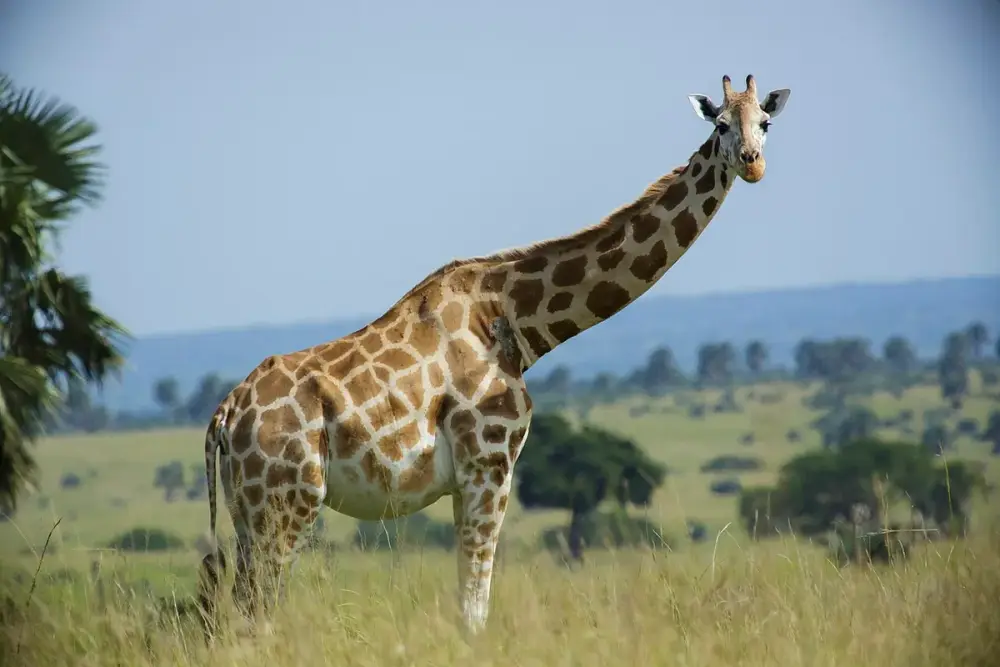
The reticulated giraffe is distinguished from other giraffes by its coat: large, sharply defined liver-brown patches separated by a network of narrow, bright white lines, a pattern far more regular than the ragged blotching of the Masai giraffe. Native to the Horn of Africa, principally northern and north-eastern Kenya, southern Ethiopia and Somalia, it occupies dry savanna, open woodland and thorn scrub. Adults stand roughly 14 to 18 feet tall, with males noticeably larger and darker than females. The long neck contains the same seven cervical vertebrae as almost every other mammal, each one enormously elongated. Giraffes browse primarily on acacia, using a prehensile tongue up to 18 inches long and thickened, leathery lips to strip leaves from between thorns. Wild numbers have fallen sharply over recent decades, driven by habitat fragmentation, poaching and regional instability.
About the reticulated giraffe
The reticulated giraffe, also known as the Somali giraffe, is a species of giraffe native to the Horn of Africa. It stands apart from other giraffe species by its coat: large, polygonal, block-like spots in a prominent liver-red, with much less white showing between them than in other giraffes, and markings that extend down onto the lower legs, tail, and face. Standing up to 6 meters (about 20 feet) tall, it is the largest giraffe species and, by extension, the tallest land animal alive.
All giraffes were classified as a single species by Carl Linnaeus in 1758; the reticulated giraffe was later split out and given its own binomial name, Giraffa reticulata, by British zoologist William Edward de Winton in 1899. As of August 2025, the IUCN recognizes four giraffe species: the northern giraffe, the reticulated giraffe, the Masai giraffe, and the southern giraffe. The reticulated giraffe's closest living relative outside its own genus is the okapi of Central Africa, with the two lineages sharing a common ancestor an estimated 11.5 million years ago; both animals have a long, black, prehensile tongue for browsing and bony, horn-like ossicones on the skull. More distant relatives include the pronghorn of North America and, further out still, deer — all classed together in the infraorder Pecora.
Reticulated giraffes can interbreed with other giraffe species, whether in captivity or where their ranges overlap with species such as the Masai giraffe in the wild. Along with the Masai giraffe and the Rothschild's, or Baringo, giraffe, it is among the giraffe types most commonly seen in zoos and animal parks.
The Cheyenne Mountain Zoo in Colorado Springs, Colorado, is said to have the largest reticulated giraffe herd in North America. Reticulated and Rothschild's giraffes were bred together at some zoos in the past, on the assumption that the two interbred in the wild, but research published in 2016 found that they do not — a few zoos continue the practice regardless. Few zoos keep separate herds of Masai, Rothschild's, and reticulated giraffes side by side; the San Diego Zoo and its sister facility, the San Diego Zoo Safari Park, are among the few that do.
Behavior and diet
Diet
Leaves, shoots, and shrubs, mainly from acacia trees
The reticulated giraffe is a herbivore, feeding on leaves, shoots, and shrubs, with acacia trees as its primary food source. It strips branches using a blue tongue up to 30 centimeters (12 inches) long, spends roughly 13 hours a day feeding, and eats up to 34 kilograms (75 pounds) of food daily. As a ruminant, it digests this high-fiber diet through foregut fermentation. Elephants are its only real competitor for food resources in the wild.
Reticulated giraffes are active during both day and night, described as diel, with peak activity at dawn, dusk, and midnight — timing likely shaped by the heat of their environment. They sleep in short bouts of no more than a couple of hours, typically while standing. Groups usually number three to nine animals, though lone individuals occur too; kinship among females tends to hold a group together, often as mother-and-offspring groups, with females sharing in protecting young from predators. Home ranges overlap broadly between individuals and groups, and there is no evidence of territorial behavior.
Females signal reproductive readiness through scent from their vaginal area and hindparts, and males can enhance detection of that scent by curling the lip to draw it toward a specialized sensory organ. A female's estrous cycle runs about 15 days. Dominant males guard receptive females from rivals, and a male ready to breed signals the female by tapping her hind leg with his foreleg or resting his head on her back; no long-term bond forms between the pair afterward. Gestation lasts roughly 15 months and typically produces a single calf, born standing up, which is itself standing within 5 to 20 minutes of birth. Weaning happens somewhere between 6 and 17 months, with full independence at around 2 years old.
Range and habitat
Habitat
Acacia-dotted savanna, arid woodland, seasonal floodplain, semi-desert, steppe, and open forest
Reticulated giraffes historically ranged widely across Northeast Africa, favoring acacia-dotted savanna, arid woodland, seasonal floodplain, semi-desert, steppe, and open forest. Today the species may still be found in parts of its historic range in Somalia and Ethiopia, but its population stronghold is Kenya, particularly in and around Meru National Park, Samburu National Reserve, the northern side of Mount Kenya, and Tsavo East National Park; individuals have also been recorded as far afield as Habaswein, Mnazini, and Wajir. An estimated 8,500 reticulated giraffes live in the wild, with roughly 15,785 counted across the wild and captive populations combined as of 2024.
Conservation status
The reticulated giraffe is listed as Endangered on the IUCN Red List, in a 2018 assessment of the subspecies Giraffa camelopardalis reticulata. The remaining wild population is estimated at roughly 8,500 to 9,000 animals.
Several conservation groups have organized to protect it. One community program, Twiga Walinzi, or "Giraffe Guards," trains local Kenyans to monitor a network of 120 trail cameras across Northern Kenya's Loisaba and Namunyak conservancies, maintains a photo-ID database to track individual giraffes, reports poaching incidents to rangers, removes snares, cares for orphaned giraffes, and runs community education on giraffe conservation. Numbers within the reserves covered by these efforts have remained stable.
Where to see reticulated giraffe in the U.S.
39 zoos across 22 states
Find the closest one
Rank the 34 zoos holding reticulated giraffe by how far they are from you. Your location is used in your browser to sort this list and is never sent to us.
5 more zoos hold reticulated giraffe but have no coordinates on file yet, so they aren't ranked here. They're in the full list below.
Alabama· 2
California· 3
Colorado· 1
Florida· 3
Illinois· 1
Indiana· 1
Iowa· 1
Kansas· 2
Louisiana· 2
Maryland· 2
Michigan· 2
Mississippi· 1
Missouri· 1
New Mexico· 1
New York· 2
North Dakota· 1
Pennsylvania· 1
South Dakota· 1
Tennessee· 2
Texas· 6
Virginia· 1
Wisconsin· 2
AZAThe Association of Zoos and Aquariums. Accredited members have passed an independent inspection of animal care and welfare, safety, conservation and education, repeated every five years. Many smaller facilities never apply, so “not accredited” isn't a verdict on its own. What accreditation means · How we check this
Built from each zoo's own published animal list.
Reticulated giraffe: common questions
How big does a reticulated giraffe get?
It can stand up to 6 meters (about 20 feet) tall, making it the largest giraffe species and the tallest land animal.
What does a reticulated giraffe eat?
Mainly acacia leaves, shoots, and shrubs, stripped with a tongue up to 30 cm (12 in) long. It eats up to 34 kg (75 lb) of food a day and spends about 13 hours daily feeding.
Where do reticulated giraffes live in the wild?
Their stronghold is Kenya, in areas such as Meru National Park, Samburu National Reserve, and Tsavo East National Park, with an estimated 8,500 living in the wild overall.
Is the reticulated giraffe endangered?
Yes. It is listed as Endangered on the IUCN Red List (2018), with roughly 8,500 to 9,000 left in the wild. Community programs in northern Kenya work to protect the remaining population.
Can reticulated giraffes interbreed with other giraffe species?
Yes. They can interbreed with other giraffe species, such as the Masai giraffe, both in captivity and where wild ranges overlap.
Which U.S. zoos have reticulated giraffes?
19 U.S. zoos keep them, including the Saint Louis Zoo, the Maryland Zoo in Baltimore, and the Denver Zoo.