Blue-and-gold Macaw
Ara ararauna
Also known as Blue Gold Macaw, Blue-and-yellow Macaw, Blue Yellow Macaw
- Where to see one
- 49 U.S. zoos in our directory hold blue-and-gold macaw, confirmed against each zoo's own animal list.
- Native range
- Panama, Trinidad and Tobago, Colombia, Suriname, French Guiana, Venezuela, Guyana, Peru, Brazil, Bolivia, Ecuador, and Paraguay
- Size
- 32–36 in (81–91 cm) long, 2–3 lb (1.0–1.5 kg)
- Lifespan
- 30–35 years in the wild; 60 or more years in captivity with good care
About the blue-and-gold macaw
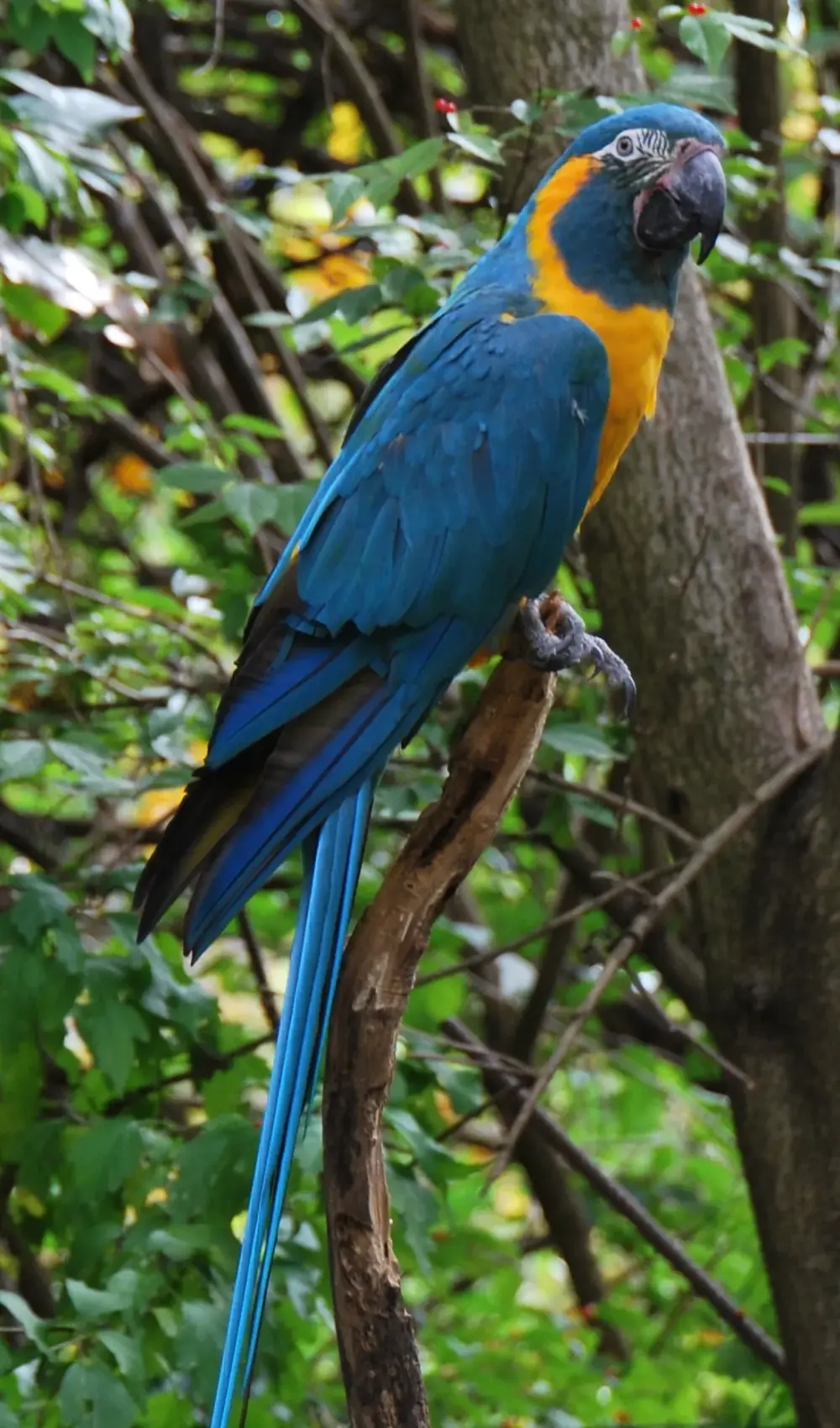
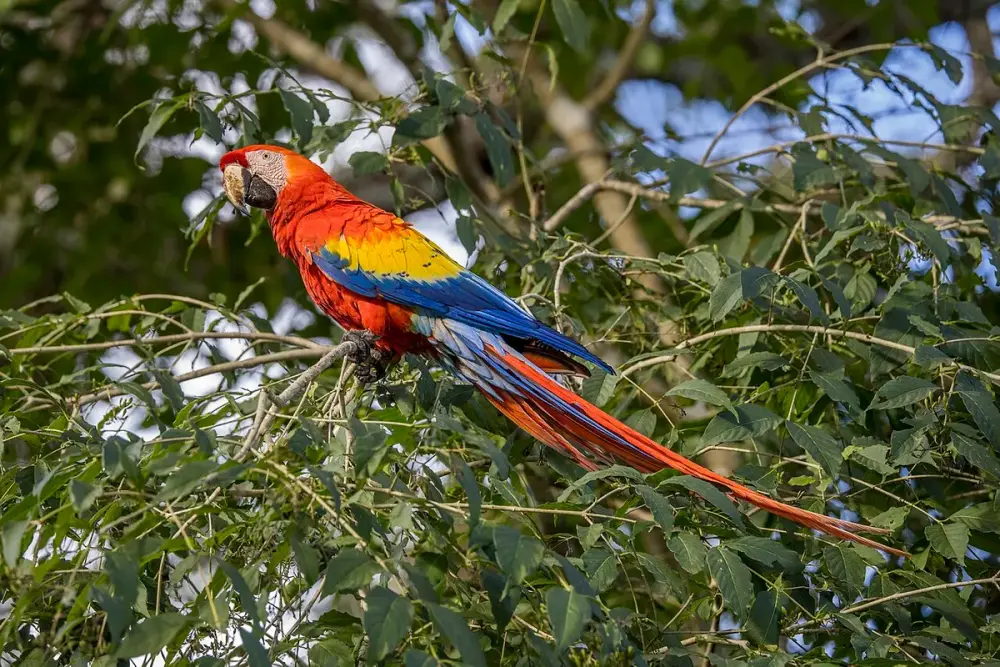
The blue-and-gold macaw, also called the blue-and-yellow macaw, is a large Neotropical parrot named for its mostly blue back, light yellow-to-orange underside, and a band of green at the top of its head. It belongs to the genus Ara, one of the groups of birds known collectively as macaws. The Swedish naturalist Carl Linnaeus formally described the species in 1758, originally placing it, like all parrots of the time, in the genus Psittacus; the genus name Ara comes from the Tupi word for "macaw," an onomatopoeia based on the bird's own call, and the species name ararauna comes from a Tupi phrase meaning "big dark parrot." The species has no recognized subspecies.
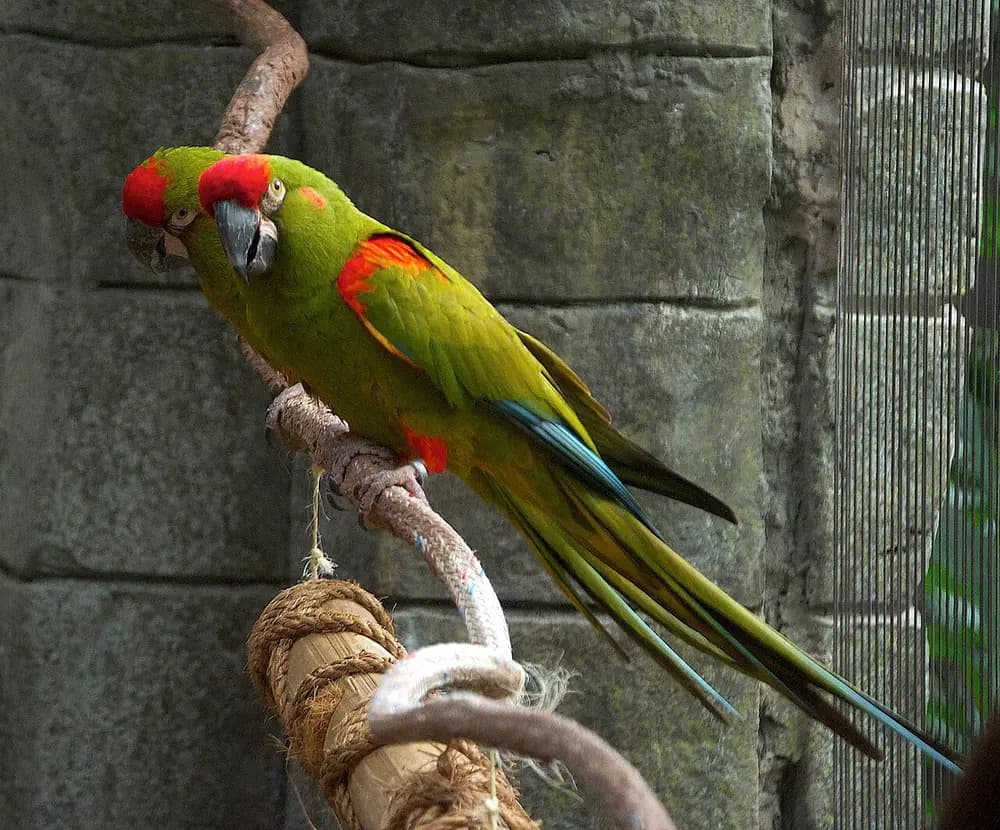
These are sizable birds, reaching 81–91 cm (32–36 in) in length and weighing 1.0–1.5 kg (2–3 lb), putting them among the larger members of the parrot family. Their coloring is vivid and consistent across their range: bright aqua-blue feathers cover the top of the body, the crown is lime green, and the underside is a rich yellow to light orange. The beak and chin feathers are black, the feet gray with black talons, and the mostly bare white face is marked with a scattering of small black feathers that form a striped pattern around pale yellow eyes. Some individuals, particularly those from Trinidad and other parts of the Caribbean, show a more orange, "butterscotch" tone on the underside.
The blue-and-gold macaw's powerful, hooked beak is built for cracking nutshells and for climbing and hanging from branches. It's also a familiar bird well beyond its native range: as of 2025, an estimated one million blue-and-gold macaws live in captivity worldwide, among the highest captive populations of any large parrot, and it's the most commonly kept macaw species as a pet, as well as the least expensive of the large macaws.
Behavior and diet
Diet
Nuts, seeds, fruits, vegetable matter, bark, and leaves; rarely insects and snails
In the wild, the blue-and-gold macaw eats mainly nuts, seeds, fruit, vegetable matter, bark, and leaves, with insects and snails taken only rarely. Its strong beak lets it break open nutshells that would stop most other birds.
The species generally mates for life. Pairs nest almost exclusively in dead palm trees, most often Mauritia flexuosa, and the female typically lays two or three eggs, which she incubates alone for about 28 days. Only one chick in the nest tends to dominate and receive most of the food, and the others often don't survive. Chicks fledge roughly 97 days after hatching. A male's plumage plays a role in courtship — brighter, bolder coloring is associated with better odds of attracting a mate — and the birds have also been observed blushing the bare skin of their face and fluffing the feathers of their cheeks, head, and nape when interacting with people, a behavior thought to express emotional state.
In captivity, blue-and-gold macaws are known for being loud: screaming for attention, making other loud vocalizations including "flock calls," and chewing destructively are all considered natural behaviors rather than signs of a problem. Because of their size, they need substantial room to fly, and the World Parrot Trust recommends an enclosure of at least 15 m (50 ft) in length where possible. With good diet, exercise, and veterinary care, captive macaws are known to live 60 years or more — long enough, potentially, to outlive their owners.
Range and habitat
Habitat
Forest (especially varzea, also terra firme), woodland, and savannah
The blue-and-gold macaw is found in Panama, Trinidad and Tobago, Colombia, Suriname, French Guiana, Venezuela, Guyana, Peru, Brazil, Bolivia, Ecuador, and Paraguay, with its range extending into Central America only in Panama. It inhabits forest — especially seasonally flooded varzea forest, but also unflooded terra firme forest — along with woodland and savannah. Most populations breed in rural, forested areas, though small numbers nest in cities such as Rondonópolis, Brazil, using dead ornamental palms planted along roads.
The species was nearly wiped out in Trinidad by human activity in the 1970s, and a reintroduction program between 1999 and 2003 translocated wild-caught birds from Guyana into a protected area around the Nariva Swamp; the IUCN nonetheless still lists the species as extirpated from Trinidad. A small population descended from introduced birds is also established in Puerto Rico, and another has inhabited Miami-Dade County, Florida, since the mid-1980s.
Conservation status
The blue-and-gold macaw is classified as Least Concern (LC) by BirdLife International. Its wild population hasn't been precisely counted but is believed to number above 10,000 individuals, and that population is described as being in decline even though the species remains widespread and fairly common across a large part of mainland South America. It's on the edge of being extirpated in Paraguay. International trade is restricted under CITES Appendix II.
Where to see blue-and-gold macaw in the U.S.
49 zoos across 28 states
Find the closest one
Rank the 41 zoos holding blue-and-gold macaw by how far they are from you. Your location is used in your browser to sort this list and is never sent to us.
8 more zoos hold blue-and-gold macaw but have no coordinates on file yet, so they aren't ranked here. They're in the full list below.
California· 5
Connecticut· 1
Florida· 5
Georgia· 2
Idaho· 1
Indiana· 1
Kansas· 2
Kentucky· 1
Louisiana· 3
Maine· 1
Maryland· 1
Massachusetts· 3
Michigan· 1
Minnesota· 1
Mississippi· 2
Missouri· 1
New Jersey· 1
New York· 2
North Carolina· 1
Ohio· 2
Oregon· 1
Pennsylvania· 1
South Dakota· 1
Tennessee· 1
Texas· 2
Virginia· 1
Washington· 1
Wisconsin· 4
AZAThe Association of Zoos and Aquariums. Accredited members have passed an independent inspection of animal care and welfare, safety, conservation and education, repeated every five years. Many smaller facilities never apply, so “not accredited” isn't a verdict on its own. What accreditation means · How we check this
Built from each zoo's own published animal list.
Blue-and-gold Macaw: common questions
Is the blue-and-gold macaw endangered?
No, it's listed as Least Concern, though its wild population is believed to be in decline and it's nearly extirpated in Paraguay.
How big does a blue-and-gold macaw get?
It reaches 81–91 cm (32–36 in) in length and weighs 1.0–1.5 kg (2–3 lb), making it one of the larger macaw species.
What does a blue-and-gold macaw eat?
Mainly nuts, seeds, fruit, vegetable matter, bark, and leaves, with insects and snails taken only rarely.
How long do blue-and-gold macaws live?
About 30 to 35 years in the wild; in captivity, with good care, 60 years or more.
Where do blue-and-gold macaws live in the wild?
Across Panama and much of northern and central South America, including Colombia, Venezuela, the Guianas, Peru, Brazil, Bolivia, Ecuador, Paraguay, and Trinidad and Tobago.
Which U.S. zoos have blue-and-gold macaws?
Nine zoos in our directory list this species, including the Oregon Zoo, Fossil Rim Wildlife Center, and Connecticut's Beardsley Zoo.