
Parrots in U.S. zoos
Parrots are the bird order Psittaciformes, roughly 410 species with a strong curved beak, an upright stance and feet with two toes forward and two back. Found mostly in the tropics, they include macaws, amazons, cockatoos and lorikeets. They rank among the most intelligent birds, and one-third of species are threatened with extinction.
Most widely held
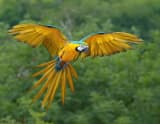 Blue-and-gold MacawAra araraunaAt 49 zoos · Least Concern
- BudgerigarMelopsittacus undulatusAt 23 zoos · Least Concern
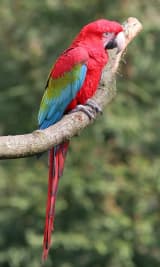 Green-winged MacawAra chloropterusAt 23 zoos · Least Concern
 Scarlet MacawAra macaoAt 23 zoos · Least Concern
 Umbrella CockatooCacatua albaAt 18 zoos · Endangered
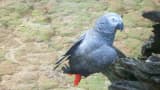 African Grey ParrotPsittacus erithacusAt 17 zoos · Endangered
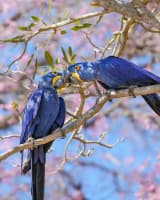 Hyacinth MacawAnodorhynchus hyacinthinusAt 16 zoos · Vulnerable
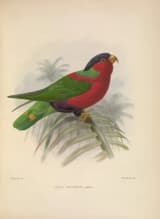 LorikeetTrichoglossus sp.At 15 zoos
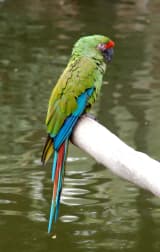 Military MacawAra militarisAt 14 zoos · Vulnerable
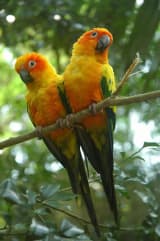 Sun ConureAratinga solstitialisAt 14 zoos · Endangered
 MacawAra sp.At 13 zoos
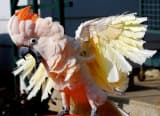 Moluccan CockatooCacatua moluccensisAt 13 zoos · Endangered
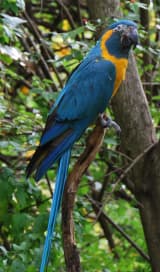 Blue-throated MacawAra glaucogularisAt 11 zoos · Critically Endangered
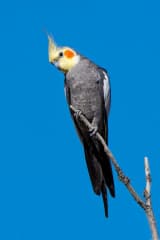 CockatielNymphicus hollandicusAt 9 zoos · Least Concern
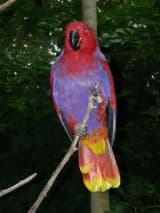 Eclectus ParrotEclectus roratusAt 9 zoos · Least Concern
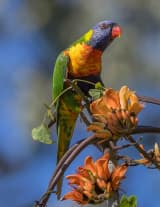 Rainbow LorikeetTrichoglossus moluccanusAt 9 zoos · Least Concern
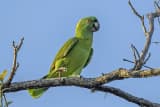 Yellow-naped AmazonAmazona auropalliataAt 9 zoos · Critically Endangered
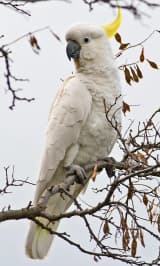 CockatooCacatuidaeAt 6 zoos
 Red-fronted MacawAra rubrogenysAt 6 zoos · Critically Endangered
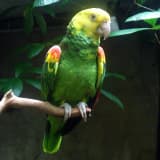 Yellow-headed AmazonAmazona oratrixAt 6 zoos · Endangered
What makes a parrot
Parrots share a strong, curved beak, an upright stance and zygodactyl feet, with two toes pointing forward and two back. Most species use their feet to handle food with a dexterity similar to human hands, and they climb using the beak and neck as a third limb. Almost all nest in tree hollows. Parrots live mainly in tropical and subtropical regions, with the greatest diversity in South America and Australasia.
They are also among the most intelligent birds. Brain-to-body size ratios in parrots are comparable to those of higher primates, and many species can imitate human speech even though they have no vocal cords. The African grey parrot ranks among the most cognitively capable birds studied.
Macaws, amazons, cockatoos and lorikeets
The roughly 410 species fall into four families: Old World parrots, African and New World parrots, cockatoos, and the New Zealand parrots. Within them, a few common groups are easy to tell apart.
Macaws are the big parrots of Central and South America. The hyacinth macaw is the largest flying parrot in the world, and the scarlet macaw has been recorded living 75 to 90 years. The yellow-headed amazon, a green parrot with a bright yellow head, comes from Mexico and northern Central America.
Cockatoos are the Australasian family set apart by movable crests. The Moluccan cockatoo raises a hidden salmon-red crest to startle attackers, and the cockatiel is the smallest cockatoo. Lories and lorikeets feed on nectar and soft fruit; the rainbow lorikeet laps nectar with a brush-tipped tongue.
Most parrots look the same in both sexes, at least to human eyes. The eclectus parrot is a striking exception: males are green and females red, so different that early naturalists thought they were two species.
The most exploited wild birds
One-third of parrot species are threatened with extinction, and parrots carry a higher overall extinction risk than any comparable bird group. Trapping for the pet trade, hunting, habitat loss and invasive species are the main causes, and parrots are exploited more than any other group of wild birds. About 50 million parrots, around half of all parrots, live in captivity, most of them as pets. Importing wild-caught parrots into the United States has been illegal since 1992.
The toll shows in individual species. Wild yellow-headed amazons fell by about 90% in two decades, driven by poaching for the pet trade and habitat loss. The blue-throated macaw and the red-fronted macaw, both from small ranges in Bolivia, are listed as Critically Endangered. Protecting habitat for charismatic parrots has also helped less famous species that share their ecosystems.
Common questions
What is the largest parrot?
The hyacinth macaw is the longest parrot, at about 1 m (3.3 ft), and the largest that can fly. The flightless kākāpō of New Zealand is the heaviest, at 4.0 kg (8.8 lb), and the buff-faced pygmy parrot is the smallest, at under 10 g (0.4 oz).
How long do parrots live?
Large parrots such as big cockatoos, amazons and macaws can live very long lives, with ages of 80 years reported and records of over 100. Small parrots such as budgies and lovebirds usually live up to 15 to 20 years.
Why can parrots talk?
Parrots have no vocal cords; they make sounds by pushing air across the syrinx and changing the shape of the windpipe. Many species can imitate human speech, and grey parrots are known as excellent talkers.
What is the difference between a cockatoo and a parrot?
Cockatoos are parrots too, forming their own family, Cacatuidae, in Australasia. They are set apart from other parrots by their movable crests.
Why are so many parrots endangered?
Trapping for the pet trade, hunting, habitat loss and competition from invasive species have cut wild numbers, and parrots are exploited more than any other group of wild birds. About one-third of species are threatened.
Are parrots smart?
Yes. Parrots and the crow family are considered the most intelligent birds, with brain-to-body size ratios comparable to those of higher primates. Some grey parrots have learned to link words to their meanings.
What do parrots eat?
Most parrots eat seeds, nuts, fruit, buds and other plant material. Lories and lorikeets specialize in nectar and soft fruit.
Sources
Last reviewed