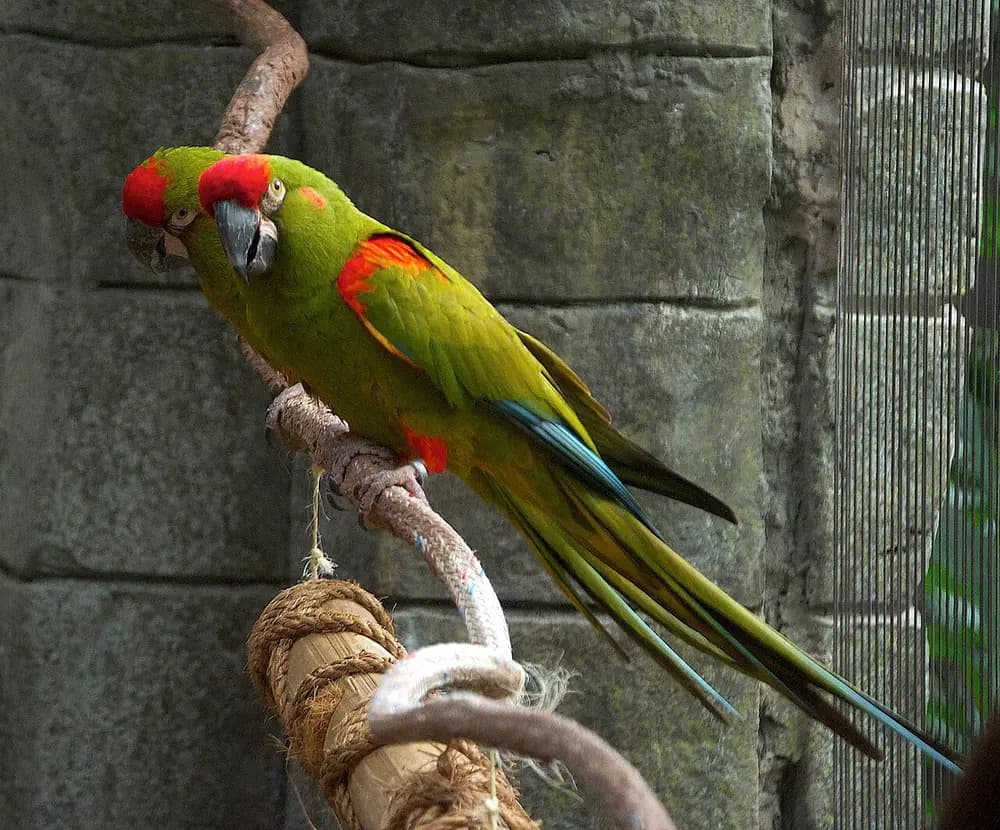
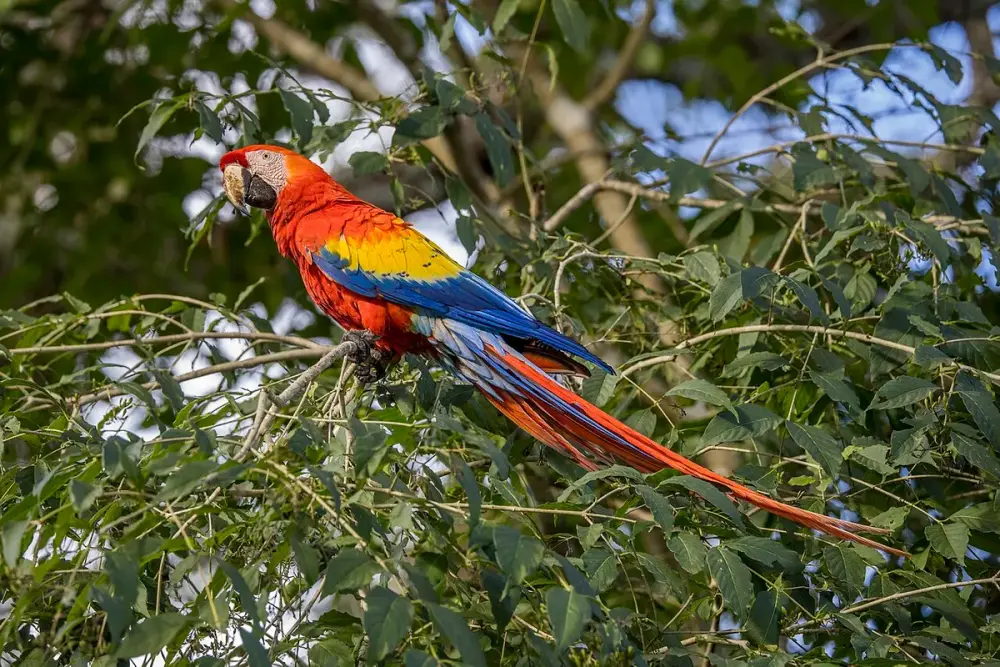
Green-winged Macaw
Ara chloropterus
Also known as Green-Wing Macaw, Greenwinged Macaw
- Where to see one
- 23 U.S. zoos in our directory hold green-winged macaw, confirmed against each zoo's own animal list.
- Native range
- Forests and woodlands of northern and central South America
- Size
- Body length 90 to 95 cm (35 to 37 in); average weight around 1,214 g (2.68 lb), with a reported range of 1,050 to 1,708 g (2.32 to 3.77 lb)
About the green-winged macaw
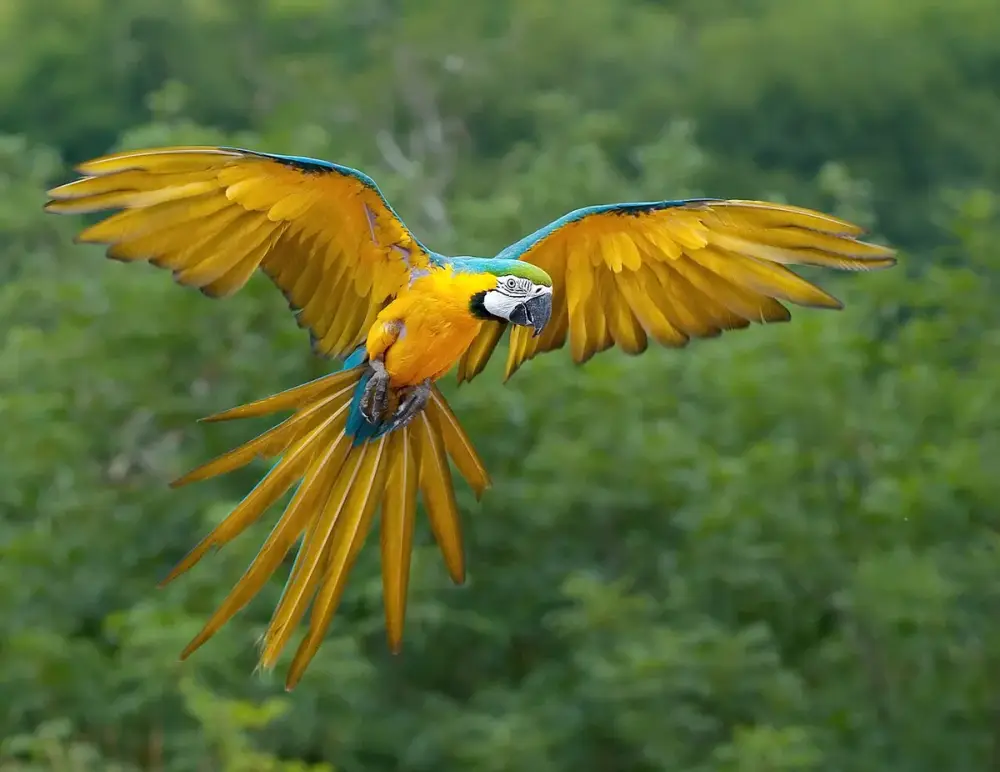
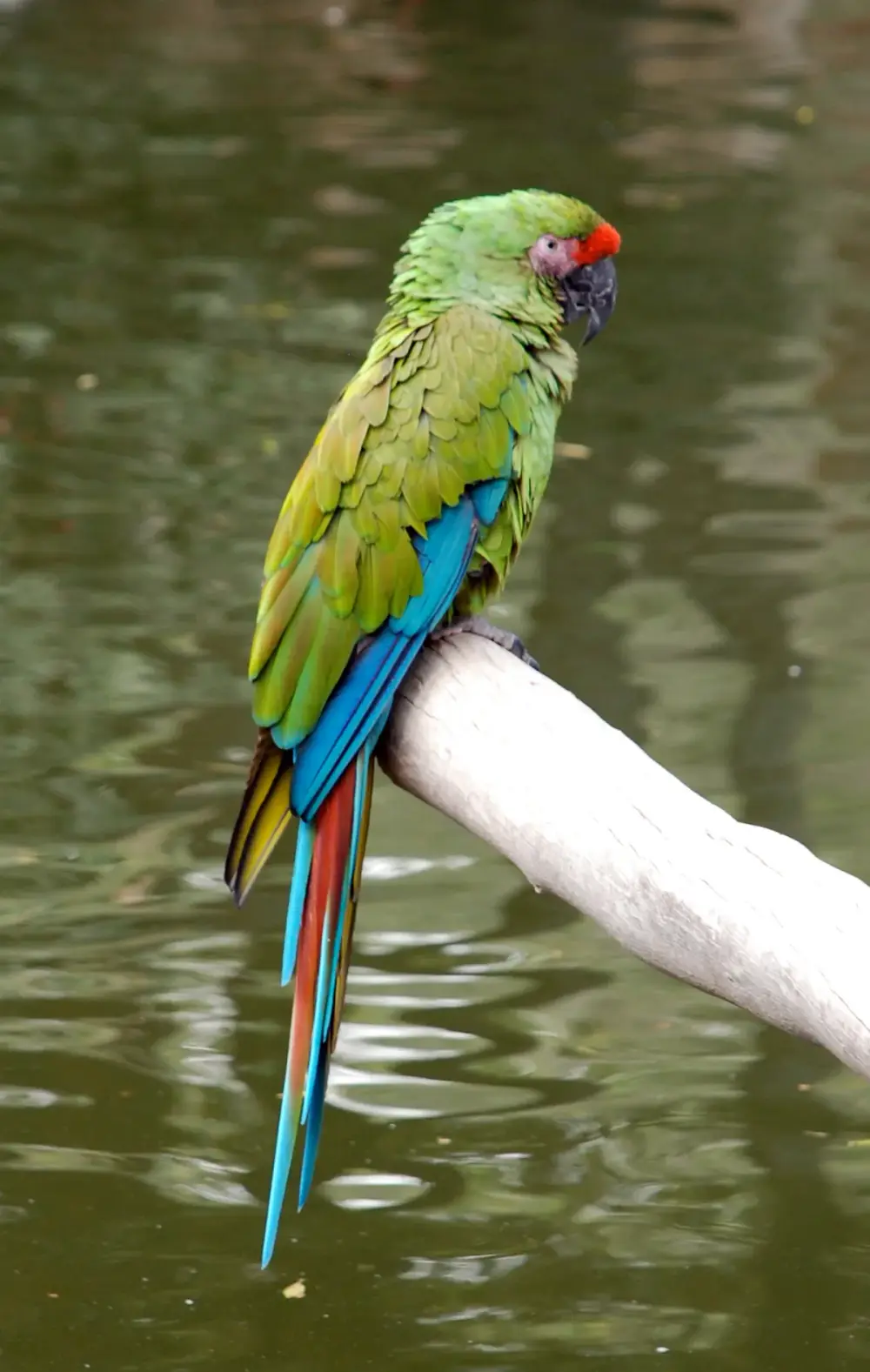
The green-winged macaw, also called the red-and-green macaw, is a large, mostly red parrot in the genus Ara. It is the largest species in that genus, and among all macaws it is second in length only to the hyacinth macaw. Adults reach a total body length of 90 to 95 cm (35 to 37 in). Twelve adults measured for weight averaged 1,214 g (2.68 lb), with a reported range of 1,050 to 1,708 g (2.32 to 3.77 lb). That weight range overlaps broadly with the hyacinth macaw's, though the green-winged macaw's average weight is slightly lower than that of both the hyacinth and the great green macaw, and, among all living parrots, the kākāpō as well.
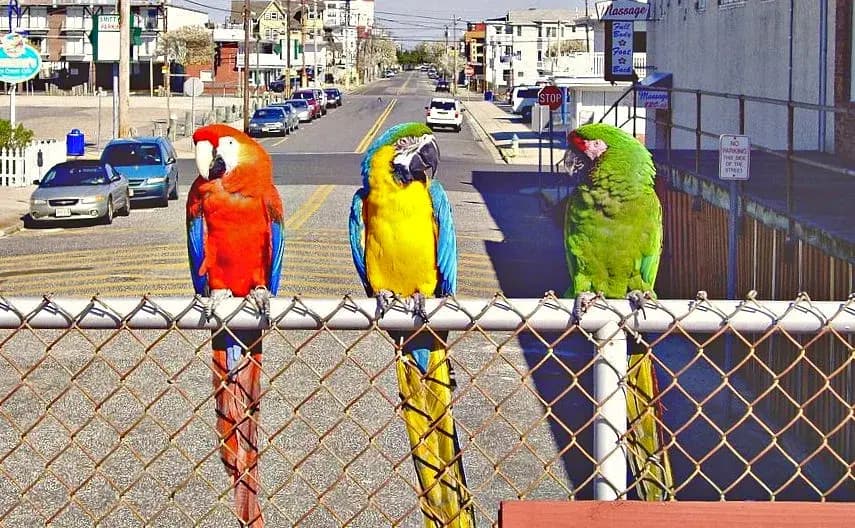
Casual observers often confuse the green-winged macaw with the scarlet macaw, since both have bright red breasts. The clearest difference is on the wing: the green-winged macaw's upper-wing covert feathers are mostly green, where the scarlet macaw's are mostly yellow or a strong mix of yellow and green. The green-winged macaw also has a distinctive pattern of red feather lines running across the otherwise bare white skin patches around its eyes, which the scarlet macaw lacks. Its tail shows iridescent teal feathers bordered by red. Seen side by side, the green-winged macaw is also noticeably larger than the scarlet macaw.
The species is widespread across the forests and woodlands of northern and central South America. It is popular in aviculture and is the second most commonly kept macaw after the blue-and-yellow macaw, though it is far less common in captivity than that species and typically costs roughly double the price of a blue-and-gold macaw. In recent years, wild numbers have declined because of habitat loss and illegal capture for the parrot trade.
Behavior and diet
Green-winged macaws generally mate for life. A breeding female lays two or three eggs in a nest built inside a hole in a tree. She incubates the eggs for about 28 days, and the chicks fledge from the nest roughly 90 days after hatching.
Range and habitat
Habitat
Forests and woodlands
The green-winged macaw's core range covers the forests and woodlands of northern and central South America. Its historical range is thought to have extended south into the Argentine provinces of Chaco, Corrientes, Formosa, and Misiones. Macaw feathers found in a Yschma tomb near Pachacamac, in present-day Peru, point to cross-Andes trade in the species dating to roughly 1000 to 1470 CE. Hunting for meat, the pet trade, and changes in land use are thought to have driven the species to local extinction throughout its Argentine range by the 1960s, and it is now listed as critically endangered within Argentina specifically.
The range picture has shifted since then. Since 1999, a population has appeared on the island of Trinidad; these birds may be escapees from captivity, but they could also represent a natural expansion of the species' wild range. In the mid-2010s, green-winged macaws were found to have recolonized Iguazú National Park in Argentina, and by 2019 the species appeared to be spreading further into the nearby Parque Provincial Puerto Península.
Conservation status
The green-winged macaw is listed as Least Concern (LC), and its wild population is currently estimated at between 50,000 and 499,999 individuals. It is listed on CITES Appendix II, meaning international trade in the species is restricted. Despite the overall Least Concern listing, the species has seen a marked decline in numbers in recent years due to habitat loss and illegal capture for the parrot trade, and it has been extirpated from parts of its historical range, including most of Argentina.
Conservation groups have responded with active recovery work in Argentina, where the species is critically endangered locally. The World Parrot Trust, Aves Argentinas, and Fundación CLT (Conservation Land Trust) have run a reintroduction program to the Iberá Provincial Reserve in Corrientes province, an effort that is also hoped to promote tourism to the area. Captive-bred birds imported from Britain in 2015 formed the basis of this effort, and the first pair of British-origin birds was released into the reserve in February 2019.
Where to see green-winged macaw in the U.S.
23 zoos across 17 states
Find the closest one
Rank the 21 zoos holding green-winged macaw by how far they are from you. Your location is used in your browser to sort this list and is never sent to us.
2 more zoos hold green-winged macaw but have no coordinates on file yet, so they aren't ranked here. They're in the full list below.
California· 2
Florida· 2
Indiana· 1
Kansas· 1
Kentucky· 1
Louisiana· 2
Maine· 1
Maryland· 1
Massachusetts· 3
Mississippi· 1
Missouri· 1
New York· 1
Oklahoma· 1
South Dakota· 1
Tennessee· 2
Virginia· 1
Washington· 1
AZAThe Association of Zoos and Aquariums. Accredited members have passed an independent inspection of animal care and welfare, safety, conservation and education, repeated every five years. Many smaller facilities never apply, so “not accredited” isn't a verdict on its own. What accreditation means · How we check this
Built from each zoo's own published animal list.
Green-winged Macaw: common questions
Is the green-winged macaw endangered?
No. It is listed as Least Concern (LC), with a wild population estimated between 50,000 and 499,999 individuals, though numbers have declined in recent years due to habitat loss and illegal capture for the parrot trade.
How big does a green-winged macaw get?
Adults reach a total body length of 90 to 95 cm (35 to 37 in) and average around 1,214 g (2.68 lb), with individuals reported as heavy as 1,708 g (3.77 lb).
Where do green-winged macaws live in the wild?
They live in forests and woodlands across northern and central South America, with a range that historically extended into northern Argentina.
Which U.S. zoos have green-winged macaws?
Thirteen zoos in the Feather & Fang directory list a green-winged macaw, including the Central Florida Zoo and Botanical Gardens, the Maryland Zoo in Baltimore, and the Buffalo Zoo.