- Where to see one
- 23 U.S. zoos in our directory hold scarlet macaw, confirmed against each zoo's own animal list.
- Native range
- southeastern Mexico south through Central America to Peru, Bolivia, and Brazil, plus Trinidad and Coiba Island
- Size
- about 84 cm (33 in) long, average weight about 1 kg (2 lb 3 oz); the Central American subspecies is larger, averaging 89 cm (35 in)
- Lifespan
- typically 40 to 50 years in captivity, with a maximum of 75 to 90 years recorded
About the scarlet macaw
The scarlet macaw is a large, brilliantly colored Neotropical parrot native to humid evergreen forests of the Americas, with yellow, green, red, and blue in its plumage alongside its dominant scarlet. It also goes by the names red-and-yellow macaw, red-and-blue macaw, and red-breasted macaw. Its range historically extended from southeastern Mexico south through Central America to Peru, Ecuador, Colombia, Bolivia, Venezuela, Honduras, and Brazil, generally in lowlands up to about 1,000 m (3,300 ft), plus the Caribbean island of Trinidad and the Pacific island of Coiba. It is the national bird of Honduras.
Carl Linnaeus formally described the species in 1758 under the name Psittacus macao; it now sits in the genus Ara. Two subspecies are recognized: the nominate South American scarlet macaw, which has green tips on the medium and secondary wing coverts, and the North Central American scarlet macaw, A. m. cyanopterus, which is larger and shows blue rather than green on its wings. In 2013, a team led by researchers at Texas A&M University sequenced the complete scarlet macaw genome, work that produced genetic markers now used to study wild populations of the closely related red-and-green macaw, including in Peru's Amazon, using DNA recovered from feathers.
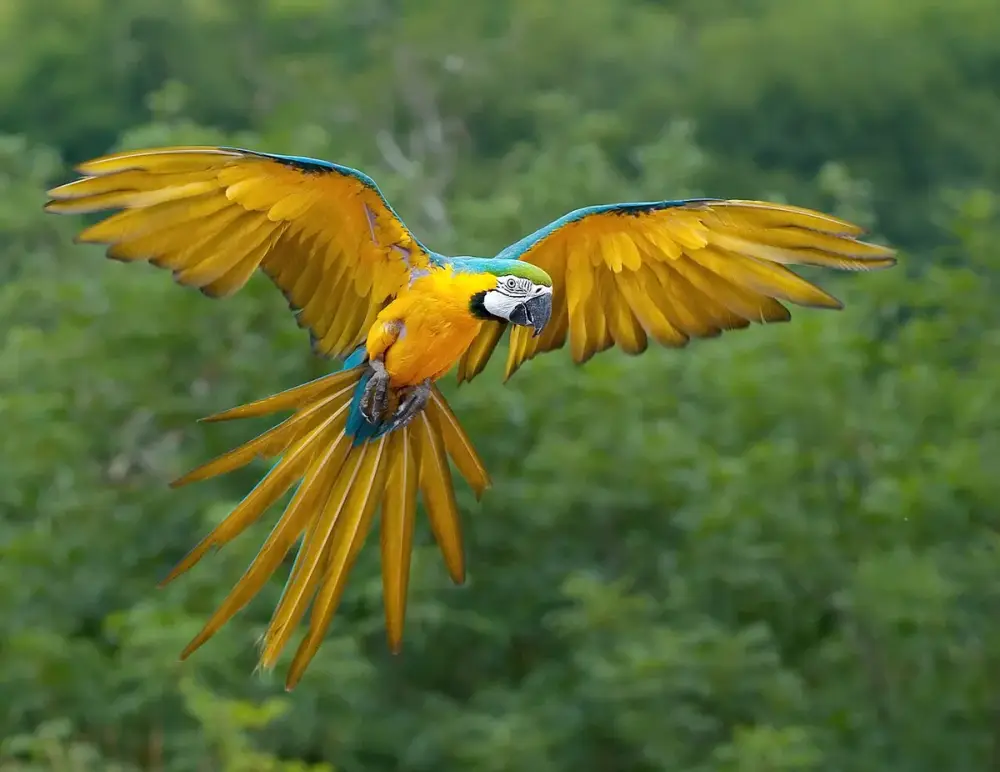
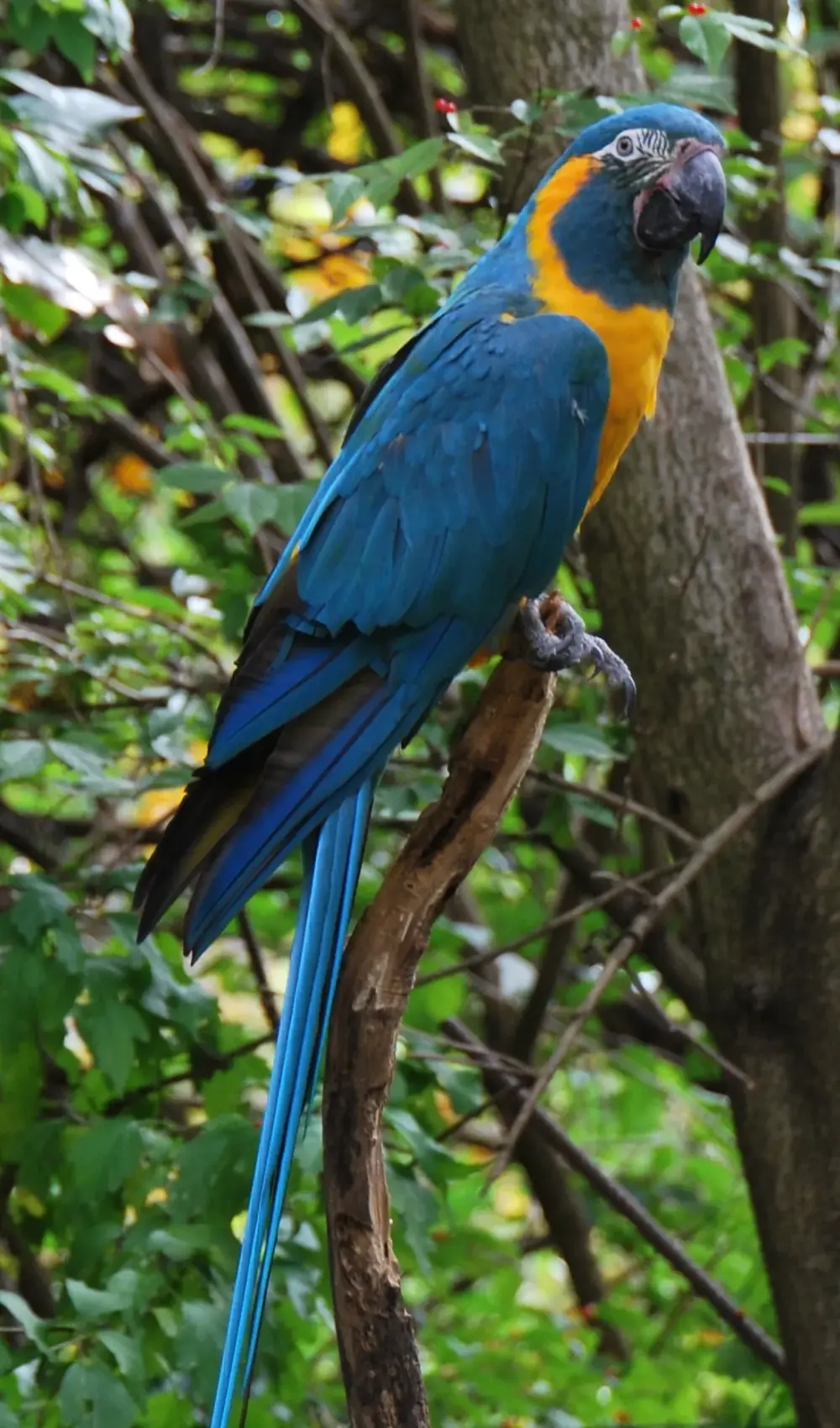
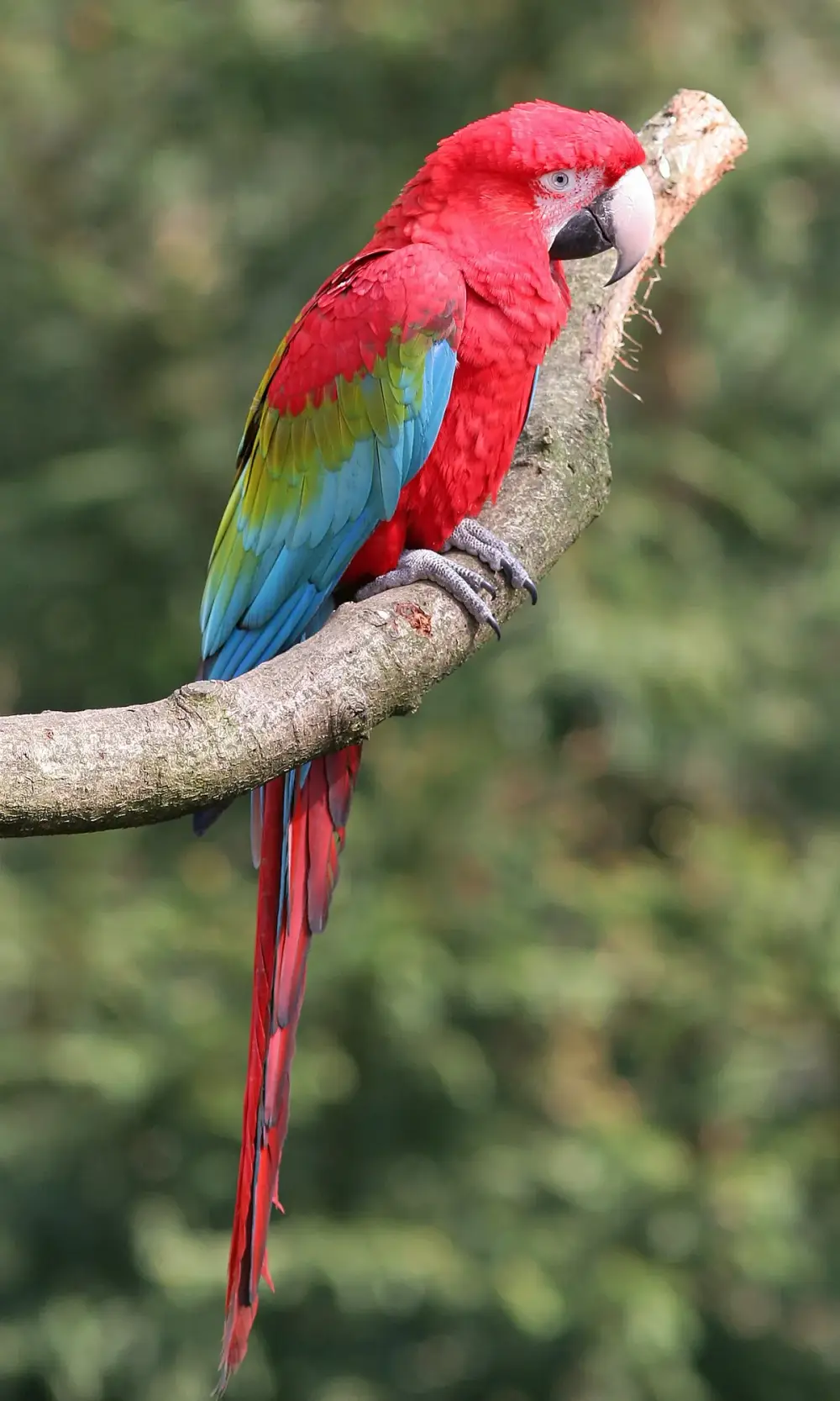
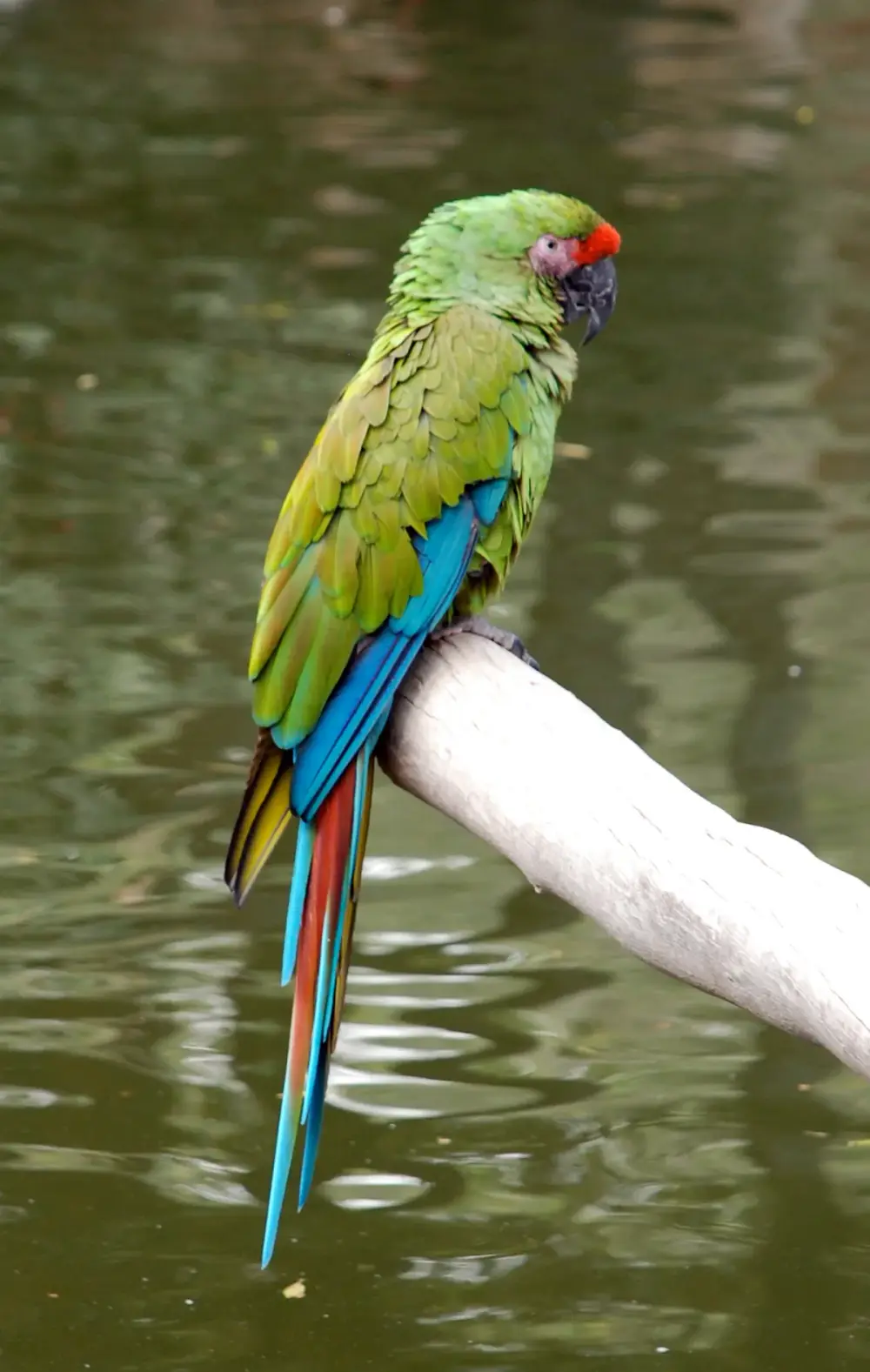
About 84 cm (33 in) long, the scarlet macaw carries more than half that length in its pointed, graduated tail — a larger share of tail than other large macaws have. Its plumage is mostly scarlet, with light blue rump and tail-covert feathers, yellow greater upper wing coverts, dark blue upper flight feathers and tail tips, and undersides of the wing and tail flight feathers in dark red with a metallic gold sheen; some individuals show green in the wings. Bare white skin surrounds the eye and runs to the bill, dotted with tiny white feathers, and the upper mandible is pale horn-colored while the lower is black. Juveniles have dark eyes that turn light yellow in adulthood. The species is often confused with the slightly larger green-winged macaw, which shows more distinct red facial lines and no yellow in the wing. Scarlet macaws are loud birds, producing squawks, squeaks, and screams meant to carry for kilometers, and captive birds are known to be skilled mimics of human speech.
Behavior and diet
Diet
fruits, nuts, seeds, flowers, and nectar, with occasional insects, larvae, and snails
In the wild, scarlet macaws are typically seen singly or in pairs flying above the forest canopy, though flocks appear in some areas. Field studies in Costa Rica found the birds spend nearly all their time high in the canopy, usually more than 10 m above the ground, and rarely come down near or onto the ground — likely both to avoid predators and because most of their food grows up in the canopy. They often gather at clay licks, and communicate mainly through raucous honks alongside a broader range of vocalizations.
Wild birds feed on fruits, nuts, seeds, flowers, and nectar; insects, larvae, and snails appear in their diet only rarely. Seeds of Cnidoscolus and Schizolobium plants are thought to be a key protein source for nestlings. In Costa Rica's Central Pacific region, macaws have adapted to feed on introduced teak and almond beach trees, and local planting of these trees along the coastline, combined with ecotourism, has helped the local population grow.
Scarlet macaws are largely docile outside the breeding season but can turn formidably aggressive while breeding. They are monogamous and pair for life. The hen lays two or three white eggs in a large tree cavity, incubating them herself for about five weeks; chicks fledge roughly 90 days after hatching and leave their parents about a year later, reaching sexual maturity at five years old. Predation on young birds in the nest comes from arboreal snakes, monkeys, and other small carnivores, while adults and fledglings can fall prey to large cats such as jaguars, along with eagles and hawks.
Range and habitat
Habitat
humid lowland rainforest, open woodlands, river edges, and savannas
The scarlet macaw's South American range is extensive, spanning much of the Amazon basin and northern rainforest, extending south as far as Peru, east of the Andes, and Bolivia, where it remains fairly common in the Aquicuana Reserve near Riberalta in the Bolivian Amazon. In North and Central America, its range runs from the Yucatán Peninsula through Belize, Guatemala, El Salvador, Honduras, and Nicaragua, plus Coiba Island. In northern Guatemala, conservation corridors within the Maya Biosphere Reserve, including Tikal National Park and Laguna del Tigre, serve as key nesting areas supported by community-based monitoring. The bird is seen only infrequently in mainland Panama, but persists in isolated pockets of Costa Rica's Pacific coast, notably near the Nicoya Peninsula, Carara National Park, and the Osa Peninsula.
Outside its native range, scarlet macaws have escaped captivity in Florida at various points, sometimes during hurricanes and sometimes through deliberate release, though there is no evidence of an established, self-sustaining breeding population there; the birds that persist likely depend on continued feeding by residents. An introduced population also exists in Puerto Rico, and a small free-flying group, trained to return each evening to a conservation center, has lived around Kirkby Stephen in Cumbria, England, since about 2010.
Conservation status
The scarlet macaw is classified as Least Concern by the IUCN, with a wild population estimated between 50,000 and 499,999 individuals and an estimated maximum territorial range of 6,700,000 km2 — its habitat is considered to have the greatest latitudinal range of any bird in the genus Ara. That range is fragmented, however, and Middle American populations survive mostly as small, scattered groups within the bird's original territory, even as the species remains common across much of its South American range. Commercial international trade in the species is banned under CITES Appendix I because of poaching for the pet trade. The northern subspecies, A. m. cyanopterus, is separately listed as endangered by the U.S. Fish and Wildlife Service, which estimates only 2,000 to 3,000 birds remain in the wild.
Captive breeding has become part of the conservation picture: techniques developed through the pet trade are now used to hand-rear chicks that would otherwise die in the nest and release them into low-population areas, an approach used by projects such as the Tambopata Macaw Project in Peru.
Where to see scarlet macaw in the U.S.
23 zoos across 13 states
Find the closest one
Rank the 20 zoos holding scarlet macaw by how far they are from you. Your location is used in your browser to sort this list and is never sent to us.
3 more zoos hold scarlet macaw but have no coordinates on file yet, so they aren't ranked here. They're in the full list below.
California· 3
Florida· 4
Georgia· 1
Idaho· 1
Kansas· 2
Louisiana· 3
Michigan· 2
New Jersey· 1
New York· 1
Oklahoma· 1
South Dakota· 1
Tennessee· 2
Washington· 1
AZAThe Association of Zoos and Aquariums. Accredited members have passed an independent inspection of animal care and welfare, safety, conservation and education, repeated every five years. Many smaller facilities never apply, so “not accredited” isn't a verdict on its own. What accreditation means · How we check this
Built from each zoo's own published animal list.
Scarlet Macaw: common questions
Is the scarlet macaw endangered?
No, the species overall is Least Concern, though the northern subspecies is listed as endangered by the U.S. Fish and Wildlife Service, with only an estimated 2,000 to 3,000 birds left in the wild.
How big does a scarlet macaw get?
About 84 cm (33 in) long and around 1 kg (2 lb 3 oz), with the Central American subspecies running larger at about 89 cm (35 in).
What does a scarlet macaw eat?
Mostly fruits, nuts, seeds, flowers, and nectar, with insects, larvae, and snails eaten only occasionally.
How long do scarlet macaws live?
Typically 40 to 50 years in captivity, with recorded maximums of 75 to 90 years.
Where do scarlet macaws live in the wild?
In humid lowland forests from southeastern Mexico through Central America into the Amazon basin of South America, plus Trinidad and Coiba Island.
Which U.S. zoos have scarlet macaws?
Nine zoos in our directory, including Brevard Zoo, the Baton Rouge Zoo, and the Tulsa Zoo and Living Museum.