- Where to see one
- 11 U.S. zoos in our directory hold blue-throated macaw, confirmed against each zoo's own animal list.
- Native range
- A small area of north-central Bolivia known as Los Llanos de Moxos, in the Beni Department
- Size
- About 85 cm (33 in) long including tail feathers, with a wingspan of roughly 90 cm (3 ft); weighs 900-1,100 g (32-39 oz)
- Lifespan
- May live over 50 years in captivity
Conservation status
IUCN Red List category CR — step 5 of 7.
About the blue-throated macaw
The blue-throated macaw, also called the Caninde macaw or Wagler's macaw, is a large parrot found in the wild only in a small part of north-central Bolivia. It belongs to the genus Ara, one of six genera of Central and South American macaws, and was for a time thought to be merely a subspecies of the similar-looking blue-and-yellow macaw before being recognized as its own species. In 2014, Bolivia designated it by law as a natural patrimony of the country, and the German naturalist Johann Georg Wagler first described it for European readers in 1832, which is where the alternate name "Wagler's macaw" comes from.
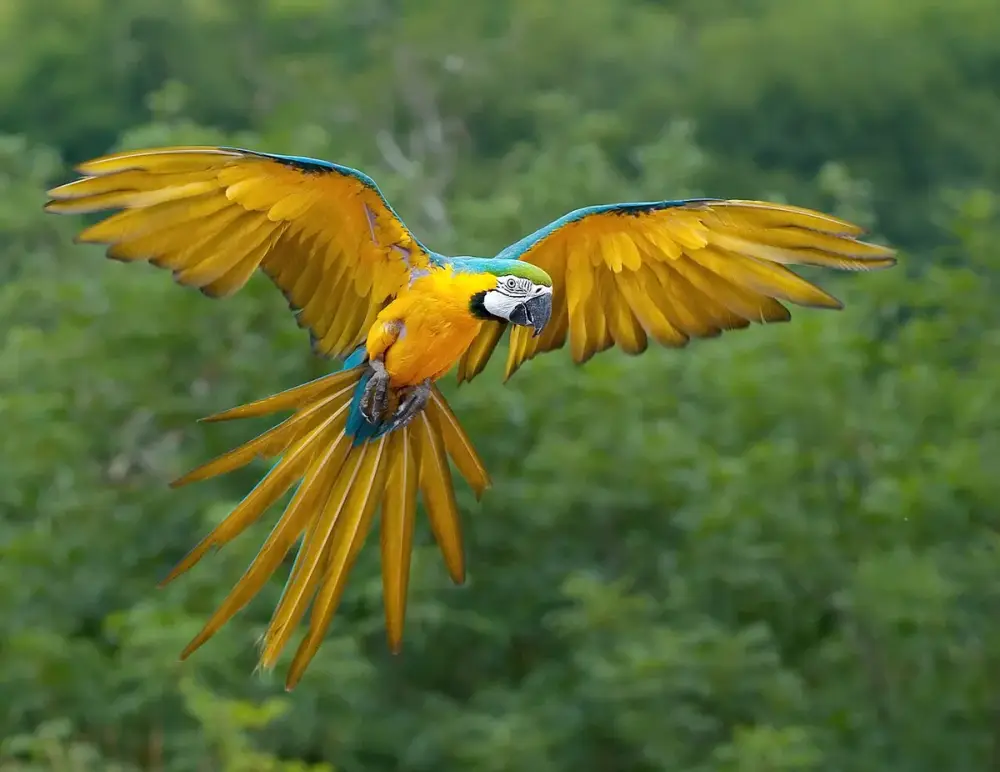
An adult measures about 85 centimeters (33 inches) long, including its long tail feathers, with a wingspan of around 90 centimeters (3 feet), and weighs between 900 and 1,100 grams (32 to 39 ounces). Males tend to run a little heavier than females, at roughly 750 grams versus 950 grams on average, though the difference is not easy to see by eye. The upperparts are turquoise-blue, a shade duller on the crown and brighter on the rump, while the underparts are largely bright yellow except for a pale blue vent. A bare patch of pink-tinted skin surrounds the base of the large, dark bill, crossed by five or six horizontal stripes of blue feathers that form a pattern unique to each bird — distinctive enough that individual adults can be recognized by their facial striping alone.
The species can be told apart from the larger blue-and-yellow macaw by its blue, rather than black, throat, its blue rather than green crown, and less contrast between its flight feathers and wing coverts. Eye color changes dramatically with age: nestlings start with black eyes that turn brown once they open, shift to grey and then white between one and three years old, and gradually turn yellow as the bird matures, with the gold deepening after age 10. In very old birds, a ring of dark grey appears around the pupil as the iris thins.
Behavior and diet
Diet
Fruit from large palms, especially Attalea phalerata
Blue-throated macaws are most often seen in monogamous pairs, though small groups of seven to nine birds occur, and one roosting group of 70 has been recorded. They are active during the day, tend to stay within a fairly consistent home area, and get around mainly by flying, though they can also climb and maneuver through tree branches and walk on the ground. When they sense danger, they let out a loud alarm call and take off; otherwise, they communicate with quieter caws.
Unlike many macaw species, blue-throated macaws do not rely heavily on seeds and nuts. Instead they feed primarily on fruit from large palms, chiefly Attalea phalerata, supplemented by Acrocomia aculeata and Mauritia flexuosa. They eat the mesocarp — the fleshy layer — of ripe and nearly ripe fruit, and have also been seen drinking liquid from fruit that is still very immature.
Breeding normally happens once a year, though a pair may attempt a second clutch if the first is lost. A clutch holds one to three eggs, incubated for 26 days. Chicks weigh about 18 grams (0.63 ounces) at hatching and fledge at 13 to 14 weeks, but they stay fully dependent on their parents for food afterward, sometimes remaining with them for up to a year — during which the parents will skip an entire breeding season. Sexual maturity arrives around age five. Pairs nest in cavities of dead palm trees, most often Attalea phalerata, and compete for those holes with blue-and-yellow macaws, green-winged and scarlet macaws, woodpeckers, toco toucans, barn owls, bats, and bees. The number of suitable nest trees has been declining due to deforestation in its habitat.
Range and habitat
Habitat
Grasslands, marshes, and "islands" of palm trees within a lowland plains landscape
In the wild, the blue-throated macaw is confined to the Llano de Moxos, a lowland plains region in Bolivia's Beni Department, where it nests in "islands" of palm trees scattered across the plains rather than in continuous forest. Two sub-populations are known, one to the northwest of the city of Trinidad and one to the south, occupying a landscape that mixes grasslands, marshes, forest islands, and forest corridors along waterways, generally at elevations between 200 and 300 meters (660 to 980 feet). It is one of the rarest bird species in the world, found nowhere else on Earth.
Conservation status
The blue-throated macaw is listed as Critically Endangered by the IUCN and on Appendix I of CITES, the strictest tier of international trade protection. Recent surveys suggest around 208 to 303 adult individuals remain in the wild, though earlier estimates in the 1980s put the population at 500 to 1,000 birds before it crashed. Trapping for the pet trade, historically a major driver of the decline, was largely halted in the 1990s and is now illegal under Bolivian law, but the species continues to face pressure from nesting competition, predation, tree cutting, invasive species, disease, and even fire-suppression chemicals. On November 4, 2013, it was added to the U.S. Endangered Species Act.
Conservation groups including the World Parrot Trust, Armonia Association, and the Loro Parque Fundacion monitor wild nests, examine chicks for health, supplement feeding when necessary, and have built nest boxes and improved existing nest sites. In 2008, the American Bird Conservancy partnered with several of these organizations to establish the blue-throated macaw Reserve, which was expanded in 2010 to 11,500 acres. Armonia has also worked to replace real feathers in traditional "machetero" ceremonial headdresses — which historically required killing as many as 10 macaws per headdress — with artificial feathers made from hand-painted palm fronds. A substantial captive population, estimated at 1,000 to 1,100 birds, exists in zoos and private collections worldwide, supporting breeding programs aimed at the species' long-term survival.
Where to see blue-throated macaw in the U.S.
11 zoos across 9 states
Find the closest one
Rank the 10 zoos holding blue-throated macaw by how far they are from you. Your location is used in your browser to sort this list and is never sent to us.
1 more zoo holds blue-throated macaw but has no coordinates on file yet, so it isn't ranked here. It's in the full list below.
California· 2
Florida· 1
Georgia· 1
Kansas· 1
Michigan· 1
Ohio· 1
Tennessee· 1
Texas· 2
Utah· 1
AZAThe Association of Zoos and Aquariums. Accredited members have passed an independent inspection of animal care and welfare, safety, conservation and education, repeated every five years. Many smaller facilities never apply, so “not accredited” isn't a verdict on its own. What accreditation means · How we check this
Built from each zoo's own published animal list.
Blue-throated Macaw: common questions
Is the blue-throated macaw endangered?
Yes. It is listed as Critically Endangered by the IUCN, with only about 208 to 303 adults estimated to remain in the wild.
How big does a blue-throated macaw get?
It reaches about 85 cm (33 in) in length including its tail feathers, with a roughly 90 cm (3 ft) wingspan, and weighs 900 to 1,100 g (32-39 oz).
What does a blue-throated macaw eat?
Mostly fruit from large palm trees, especially Attalea phalerata, along with fruit from a couple of other palm species.
How long do blue-throated macaws live?
In captivity they may live for over 50 years.
Where do blue-throated macaws live in the wild?
Only in a small area of north-central Bolivia called Los Llanos de Moxos, in the Beni Department, nesting in palm "islands" amid grassland and marsh.
Which U.S. zoos have blue-throated macaws?
Seven zoos in our directory list the blue-throated macaw, including Zoo Atlanta, the Detroit Zoo, and the Houston Zoo.