- Where to see one
- 6 U.S. zoos in our directory hold red-fronted macaw, confirmed against each zoo's own animal list.
- Native range
- A small area of dry Andean valleys in south-central Bolivia
- Size
- 55–60 cm (21.5–23.5 in) long; wingspan about 81 cm (32 in); 425–550 g (15–19.4 oz)
- Lifespan
- Possibly up to 50 years; often reported at 25 years or more in captivity
- Clutch
- 1–3 eggs, incubated about 26 days
- Other name
- Lafresnaye's macaw
Conservation status
Critically Endangeredassessed 2021
IUCN Red List category CR — step 5 of 7.
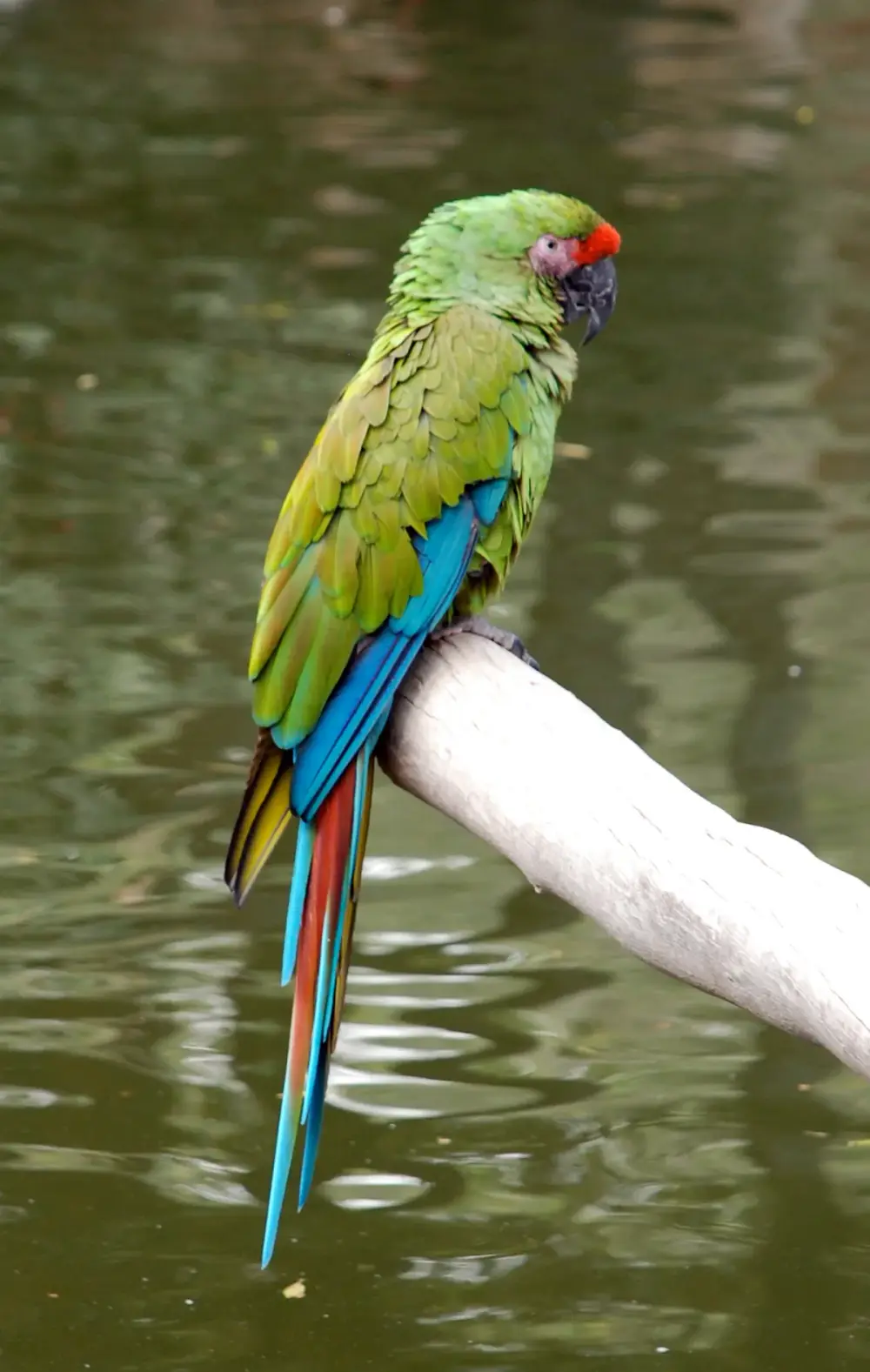
The red-fronted macaw is a parrot endemic to a small semi-desert mountainous area of south-central Bolivia, about 200 km west of Santa Cruz. It is mostly green and 55-60 cm long, with a red forehead, a red patch over the ears, pinkish skin around the eyes, blue primary wing feathers and bright red to orange underwing coverts. The vegetation consists mostly of cactus and thorny trees and scrub, with hot days, cold nights and infrequent heavy storms. Because there are no very large trees in its range, it nests in vertical fissures in cliff faces rather than tree holes. It is critically endangered and has been captured for the pet trade and killed by farmers because it raids their crops.
About the red-fronted macaw
The red-fronted macaw is a mid-sized green macaw found only in a small area of dry, mountainous valleys in south-central Bolivia. A member of the macaw genus Ara, it is a parrot of dry cactus and thorn scrub, and it nests in cliff crevices rather than tree holes. It is critically endangered.
Its scientific name is Ara rubrogenys, and it is sometimes called Lafresnaye's macaw in older literature, after the French ornithologist Frédéric de Lafresnaye, one of the first to describe it. It is one of the smaller macaws, measuring 55 to 60 cm (21.5 to 23.5 in) long with a wingspan of about 81 cm (32 in). It weighs only 425 to 550 g (15 to 19.4 oz).
The plumage is mostly green. A red patch covers the forehead, another sits over the ears and behind the eyes, and there is red at the bend of the wing and on the shoulders. The underwing coverts are edged in bright red to orange. The main flight feathers are a striking teal-blue, and the tail shades from green to teal-blue.
Around each eye is a patch of bare, pinkish skin extending toward the beak. Males and females look alike in both color and size, so mates do not pick each other by appearance. Young birds have all-green heads and wings with only a few red feathers around the thighs. They start to show the red markings between six and twelve months old.
Behavior and diet
Diet
Fruit, seeds, nuts, grasses, cactus, and crops such as corn
Red-fronted macaws are social birds that are rarely seen alone. They often fly in small groups of three to five, and they gather in larger groups of 2 to 30 for feeding and roosting. They are diurnal, but they rest through the middle of the day, during the hottest hours. Larger and younger flocks are busier and noisier. They tend to stay near their nesting sites, flying up and down the cliffs and drainage channels of their valley.
Play is part of daily flock life. Sitting together, red-fronted macaws peck at each other, wrestle and fence with their beaks, jerk their bodies back and forth on branches, and toss objects. Flocks may also act as information hubs where birds learn good feeding spots. When one bird starts a call or behavior, others quickly copy it, which is thought to keep the group together and reduce aggression.
They are loud. Pair members exchange quiet "twitter" calls that start with a squawk and fade into a soft coo and chuckle, while alert calls are long, loud bursts given when a predator is near. Captive birds are intelligent and can learn to talk and whistle.
Their food is mostly plant material: fruit, seeds, nuts, grasses, leaves, and flowers. The fruit of Jatropha hieronymii trees is a main food source, and Cereus cacti provide both food and water in this dry country. As native vegetation has been cleared, the birds have turned to crops, especially corn, and they will spend hours dodging farmers who try to chase them off.
The macaws give back to their habitat. They swallow cactus fruit and pass the seeds unharmed across the valley, helping the cacti spread, and they pollinate some plants while foraging.
Pairs are monogamous and stay together year-round, preening each other, nibbling face feathers, and grasping beaks to keep the bond strong. They breed once a year between October and March. Unlike most macaws, which nest in holes in large trees, red-fronted macaws nest in vertical cracks and cavities in the sandstone cliffs of narrow river gorges, because their range has no very large trees. The female lays one to three eggs, which hatch after about 26 days. Both parents tend the nest, and after the young fledge they travel with their parents in the flock.
The only documented predator is the peregrine falcon. When a raptor approaches, the whole flock flies up in alarm at once, making it hard for the hunter to single out one bird.
Range and habitat
Habitat
Semi-arid valleys with thorn scrub, cacti, and rocky river gorges
The red-fronted macaw lives only in Bolivia. Its range lies about 200 km (125 mi) west of the city of Santa Cruz and runs from southern Cochabamba and western Santa Cruz through northern Chuquisaca to northeastern Potosí. The largest populations are in the valleys of the Río Grande, Mizque, and Pilcomayo rivers.
The climate is mid-elevation semi-desert, with hot days, cold nights, and rain that falls in rare heavy storms, totaling about 300 to 800 mm (12 to 31 in) a year. The vegetation is mostly cacti, large and small, plus thorny trees and scrub. It is the only macaw known to live in this kind of climate zone.
Red-fronted macaw vs military macaw
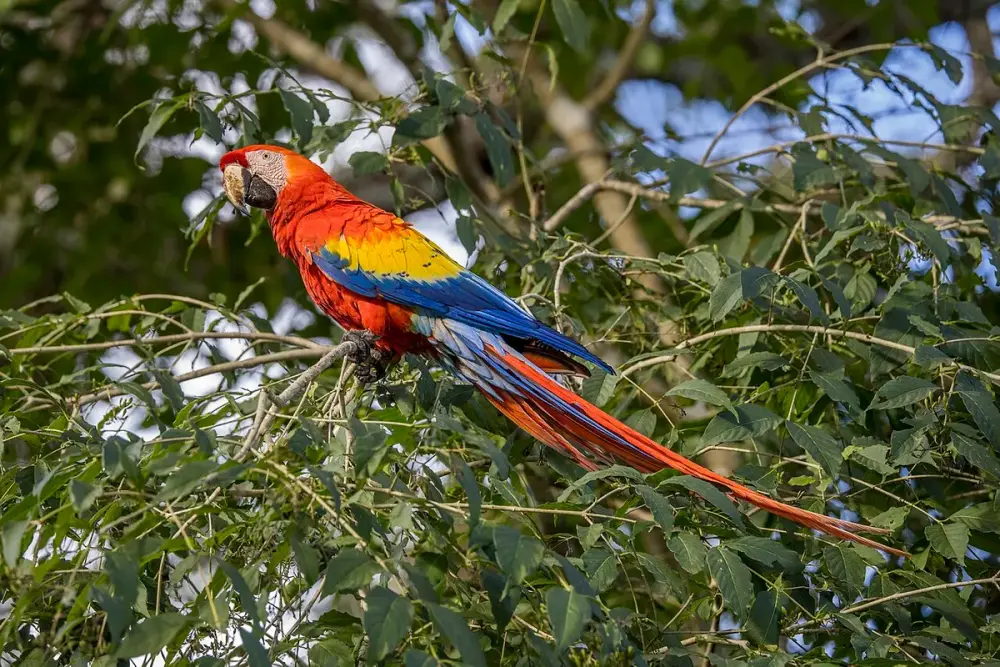
Both macaws are mostly green with a red forehead, and both occur in Bolivia, so they can be mixed up. Size, face markings, and habitat separate them.
| Feature | Red-fronted macaw | Military macaw |
|---|---|---|
| Scientific name | Ara rubrogenys | Ara militaris |
| Length | 55–60 cm (21.5–23.5 in) | 70–85 cm (28–33 in) |
| Red markings | Forehead, ear patch, shoulders, and underwing edges | Bright red forehead patch |
| Bare face | Pinkish skin around the eye | Whitish skin with black lines |
| Range | Dry valleys of south-central Bolivia only | West-central Mexico to Bolivia and northern Argentina |
| Habitat | Cactus scrub and cliff gorges | Deciduous and semi-deciduous forest |
| IUCN status | Critically Endangered | Vulnerable |
The military macaw is also much more widespread and usually nests in large trees or cliffs within forested country.
Conservation status
The red-fronted macaw is listed as Critically Endangered on the IUCN Red List, based on a 2021 BirdLife International assessment. It is also listed on CITES Appendix I.
Its numbers have been falling since at least 1991. By 2009, the wild population was estimated at between 1,000 and 4,000 birds. Within its tiny range, habitat is being destroyed for farming, grazing, and firewood, removing native food plants. That pushes the birds onto corn fields, and many farmers see them as pests and shoot or trap them. In the past the species was also captured for the pet trade. It breeds well in captivity and is available, though not common, as a pet.
Where to see red-fronted macaw in the U.S.
6 zoos across 5 states
Find the closest one
Rank the 6 zoos holding red-fronted macaw by how far they are from you. Your location is used in your browser to sort this list and is never sent to us.
AZAThe Association of Zoos and Aquariums. Accredited members have passed an independent inspection of animal care and welfare, safety, conservation and education, repeated every five years. Many smaller facilities never apply, so “not accredited” isn't a verdict on its own. What accreditation means · How we check this
Built from each zoo's own published animal list.
Red-fronted Macaw: common questions
Where do red-fronted macaws live?
Only in a small area of dry Andean valleys in south-central Bolivia, roughly 200 km (125 mi) west of Santa Cruz.
How big is a red-fronted macaw?
About 55–60 cm (21.5–23.5 in) long, with an 81 cm (32 in) wingspan and a weight of 425–550 g (15–19.4 oz).
What do red-fronted macaws eat?
Fruit, seeds, nuts, grasses, and cactus, plus crops such as corn where their native food has been cleared.
Is the red-fronted macaw endangered?
Yes. It is Critically Endangered, with an estimated 1,000 to 4,000 birds left in the wild as of 2009.
How long do red-fronted macaws live?
They may live up to 50 years. Captive birds are commonly reported to live 25 years or more.
Can red-fronted macaws talk?
Yes. They are intelligent and can learn to speak and whistle, in addition to their loud squawks.
Can you keep a red-fronted macaw as a pet?
They are bred in captivity and sometimes kept as pets, but they are not common, and the species is listed on CITES Appendix I.
Where do red-fronted macaws nest?
In vertical cracks and cavities in cliff faces, since their dry valleys have no large trees for the usual macaw tree-hole nest.