
Primates in U.S. zoos
Primates are the order of mammals that includes lemurs, lorises and galagos on one branch and tarsiers, monkeys and apes on the other. Most live in tropical forests and share grasping hands, forward-facing eyes with color vision and large brains for their body size. Between 376 and 524 living species are recognized, depending on classification.
Most widely held
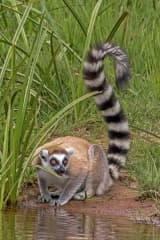 Ring-tailed LemurLemur cattaAt 118 zoos · Endangered
 Black-and-white Ruffed LemurVarecia variegataAt 45 zoos · Critically Endangered
 Black-handed Spider MonkeyAteles geoffroyiAt 41 zoos · Endangered
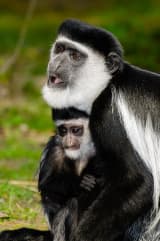 Black-and-white ColobusColobus guerezaAt 39 zoos · Least Concern
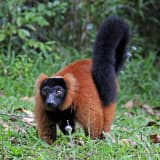 Red Ruffed LemurVarecia rubraAt 37 zoos · Critically Endangered
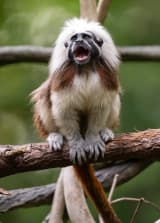 Cotton-top TamarinSaguinus oedipusAt 34 zoos · Critically Endangered
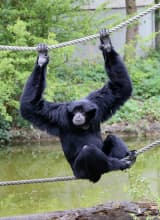 SiamangSymphalangus syndactylusAt 31 zoos · Endangered
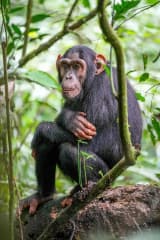 ChimpanzeePan troglodytesAt 29 zoos · Endangered
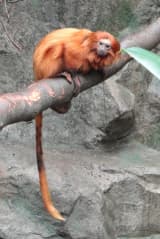 Golden Lion TamarinLeontopithecus rosaliaAt 29 zoos · Endangered
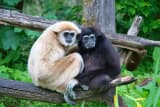 White-handed GibbonHylobates larAt 28 zoos · Endangered
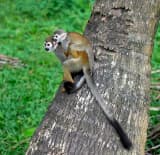 Squirrel MonkeySaimiri sciureusAt 27 zoos · Least Concern
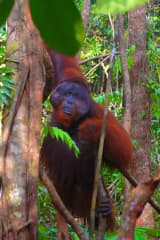 OrangutanPongo pygmaeusAt 26 zoos · Critically Endangered
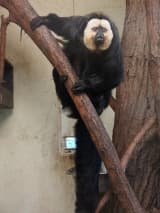 White-faced SakiPithecia pitheciaAt 22 zoos · Least Concern
 Black Howler MonkeyAlouatta carayaAt 19 zoos · Near Threatened
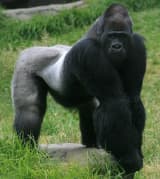 GorillaGorilla gorillaAt 19 zoos · Critically Endangered
 White-cheeked GibbonNomascus leucogenysAt 19 zoos · Critically Endangered
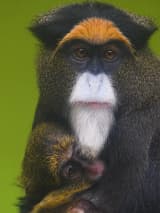 De Brazza's MonkeyCercopithecus neglectusAt 13 zoos · Least Concern
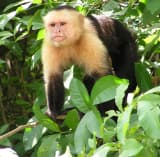 Capuchin MonkeyCebinaeAt 11 zoos
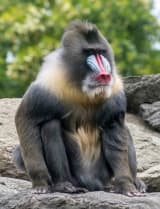 MandrillMandrillus sphinxAt 11 zoos · Vulnerable
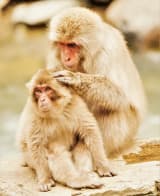 Japanese MacaqueMacaca fuscataAt 10 zoos · Least Concern
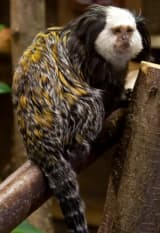 Geoffroy's MarmosetCallithrix geoffroyiAt 9 zoos · Least Concern
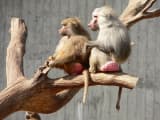 Hamadryas BaboonPapio hamadryasAt 9 zoos · Least Concern
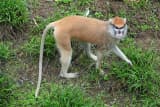 Patas MonkeyErythrocebus patasAt 9 zoos · Near Threatened
 Emperor TamarinSaguinus imperatorAt 8 zoos · Least Concern
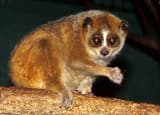 Pygmy Slow LorisXanthonycticebus pygmaeusAt 8 zoos · Endangered
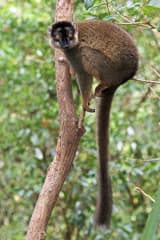 Brown LemurEulemur fulvusAt 7 zoos · Vulnerable
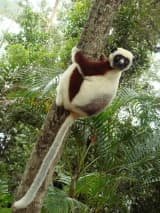 Coquerel's SifakaPropithecus coquereliAt 7 zoos · Critically Endangered
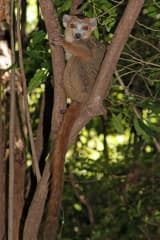 Crowned LemurEulemur coronatusAt 7 zoos · Endangered
 GibbonHylobatidaeAt 7 zoos
 Golden-headed Lion TamarinLeontopithecus chrysomelasAt 7 zoos · Endangered
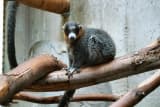 Mongoose LemurEulemur mongozAt 7 zoos · Critically Endangered
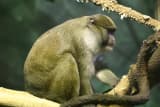 Allen's Swamp MonkeyAllenopithecus nigroviridisAt 6 zoos · Least Concern
 Bolivian Gray Titi MonkeyPlecturocebus donacophilusAt 6 zoos · Least Concern
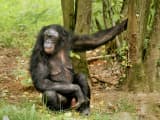 BonoboPan paniscusAt 6 zoos · Endangered
Two branches of one family tree
Primates divide into two suborders. The strepsirrhines are the lemurs, galagos and lorisids; the haplorhines are the tarsiers plus the simians, which are the monkeys and apes. The group arose 74 to 63 million years ago from small mammals that adapted to life in tropical forest canopies.
Many of the traits shared across the order are tree-living adaptations: large brains for body size, binocular and color vision, flexible shoulders and, in most species, opposable thumbs. Monkeys and apes rely more on sight and less on smell than lemurs and lorises do. The ring-tailed lemur of Madagascar and the pygmy slow loris, a nocturnal climber from Southeast Asia with a toxic bite, belong to the strepsirrhine branch.
Telling apes from monkeys
Apes have no tail and more mobile shoulder joints and arms than Old World monkeys, the result of a broad, flat ribcage and a shorter, stiffer spine. The great apes are the largest, from the bonobo at 30 to 40 kg (66 to 88 lb) up to the eastern gorilla. Gibbons are the "lesser apes": the gibbon swings arm over arm through the canopy, a movement called brachiation, at up to 55 km/h (34 mph).
Monkeys fall into two groups. New World monkeys from Central and South America mostly have long tails, and in the howler and spider monkey family those tails are prehensile. The black-handed spider monkey uses its tail as a fifth limb. Old World monkeys from Africa and Asia have tails that cannot grip, or no visible tail. They include the mandrill, the largest monkey, and the Japanese macaque, which lives farther north than any other non-human primate.
Social lives worth watching
Primates are among the most social of all animals. Depending on the species, they live in pairs, family groups, groups with one breeding male or large groups with many males and females. They develop more slowly than other mammals of similar size, mature later and live longer. Non-human primates communicate with facial expressions, hand gestures, smells and calls, and several species use tools in the wild.
On a visit, look for social grooming, which in many species removes skin parasites and cleans wounds, and for food sharing. Listen as well: the siamang inflates a throat pouch as large as its head to produce loud, resonating calls.
A largely threatened order
About 60% of primate species are threatened with extinction, including 87% of species in Madagascar, 73% in Asia, 37% in Africa and 36% in South and Central America. Large-scale tropical forest clearing, mainly for farming, is the leading threat. Hunting for bushmeat, medicine and the pet trade adds pressure, and populations of large primates over 5 kg (11 lb) recover especially slowly because they mature late and give birth at long intervals. All primate species are listed under CITES, most in Appendix II.
Breeding in human care can help. The golden lion tamarin recovered from a few hundred animals to roughly 4,800, helped by releases of zoo-born tamarins, translocations and reforestation. Programs such as the Species Survival Plan manage zoo populations of threatened species as one shared population.
Common questions
What animals are primates?
Primates are lemurs, lorises, galagos, tarsiers, monkeys and apes, including humans. They split into two groups: the strepsirrhines (lemurs, galagos and lorisids) and the haplorhines (tarsiers, monkeys and apes).
What is the smallest and the largest primate?
The smallest is Madame Berthe's mouse lemur, which weighs about 30 g (1 oz). The largest is the eastern gorilla, which can weigh over 200 kg (440 lb).
What is the difference between a monkey and an ape?
Apes, such as gibbons, orangutans, gorillas, chimpanzees and bonobos, are tailless and more mobile shoulders and arms than Old World monkeys. Most New World monkeys have long tails, and Old World monkeys have non-prehensile tails or no visible tail.
Are lemurs monkeys?
No. Lemurs, lorises and galagos are strepsirrhine primates, a separate branch of the primate family tree from monkeys and apes.
How many primates are endangered?
About 60% of primate species are threatened with extinction, and 75% have decreasing populations. The share is highest in Madagascar, where 87% of species are threatened.
Where do primates live in the wild?
Non-human primates live mainly in the tropics of Africa, Asia and the Americas, and more than 90% of species occur in tropical forests. A few, such as the Japanese macaque, live outside the tropics.
What is the biggest threat to primates?
Large-scale clearing of tropical forest, mainly for agriculture, is regarded as the biggest threat. Hunting for food, medicine and the pet trade, forest fragmentation and conflict over crop raiding add to it.
Sources
Last reviewed