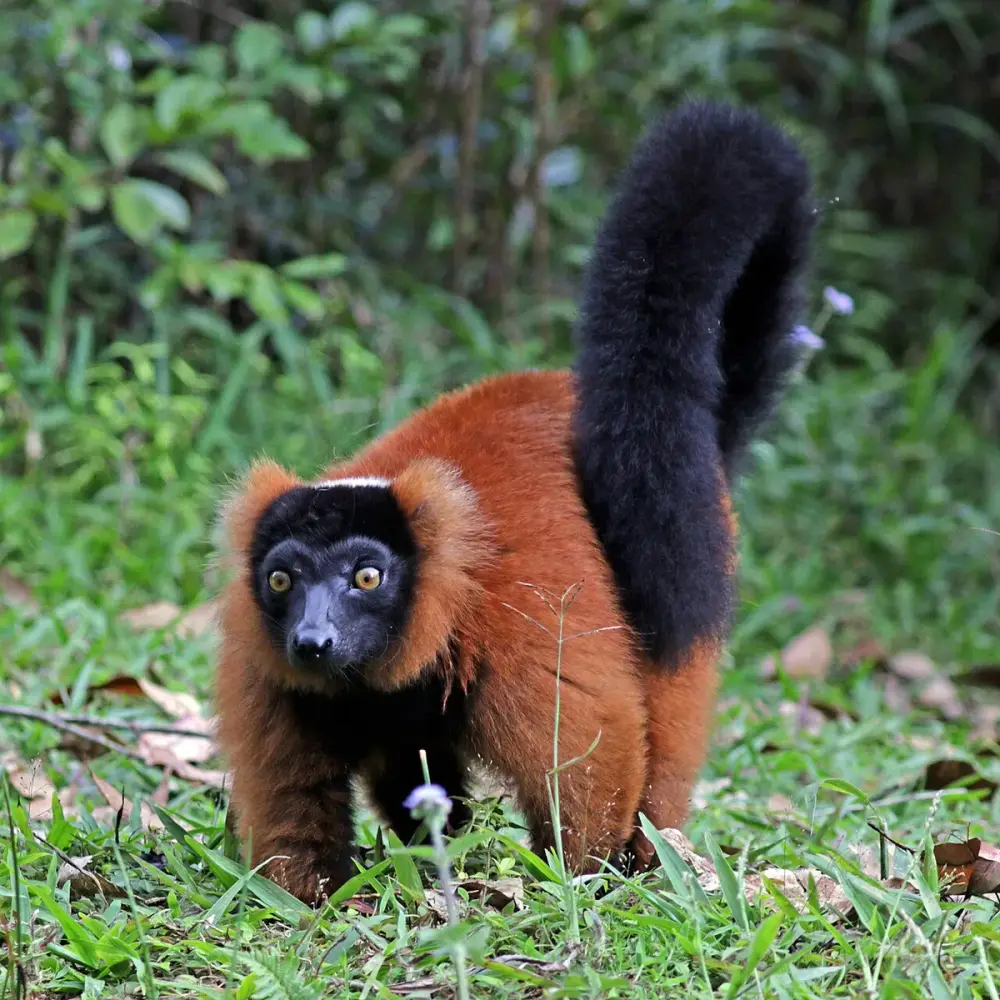
Black-and-white Ruffed Lemur
Varecia variegata
Also known as Black-And-White-Lemur-Ssp, Ruffed Lemur, Ruffed-Lemur.Jpg Image
- Where to see one
- 45 U.S. zoos in our directory hold black-and-white ruffed lemur, confirmed against each zoo's own animal list.
- Native range
- Eastern rainforests of Madagascar
- Size
- 100 to 120 centimeters (39 to 47 in) in length; 3.1 to 4.1 kilograms (6.8 to 9.0 lb)
- Lifespan
- Up to 36 years in captivity
Conservation status
IUCN Red List category CR — step 5 of 7.
The black-and-white ruffed lemur is one of two ruffed lemur species, both endemic to Madagascar. Among the largest members of the lemur family, it measures 100 to 120 cm in length. It lives high in the canopy of seasonal rainforest on the island's eastern side, is active only in daylight, and is the most fruit-eating of the lemurs, with fruit making up 92% of its diet. Groups range from pairs to large gatherings, and females are socially dominant, leading the group to food and eating first. Its loud, raucous chorus calls carry through the day.
About the black-and-white ruffed lemur
The black-and-white ruffed lemur is one of two ruffed lemur species, both found only on the island of Madagascar. Together with its relative the red ruffed lemur, it is the largest living member of the lemur family Lemuridae, measuring 100 to 120 centimeters (39 to 47 in) in length and weighing between 3.1 and 4.1 kilograms (6.8 and 9.0 lb). Its coloring is consistent across individuals: the abdomen, tail, hands and feet, inner limbs, forehead, face, and crown are black, while the sides, back, hind limbs, and hindquarters are white. Males and females look alike.
Three subspecies are recognized — the white-belted black-and-white ruffed lemur in the north, the black-and-white ruffed lemur proper in the middle of the range, and the southern black-and-white ruffed lemur further south — a division that reflects the taxonomy settled after the red ruffed lemur was elevated to full species status in 2001. In the wild, black-and-white ruffed lemurs spend most of their time in the high canopy of Madagascar's eastern rainforests, moving on all fours through the trees and hanging from branches while they feed. They are strictly diurnal, active only during daylight hours.
Compared to the red ruffed lemur, the black-and-white ruffed lemur has a wider geographic range but a much smaller, more scattered population living at lower densities and more cut off from other groups, with less coverage inside large protected national parks.
Behavior and diet
Diet
Highly frugivorous, with fruit making up about 92% of the diet, plus leaves, nectar, seeds, and fungi
As the most frugivorous of all lemurs, the black-and-white ruffed lemur relies on fruit for roughly 92% of its diet, drawing on anywhere from 19 to 40 tree species depending on location, with four types of fruit trees supplying the bulk of what it eats. Leaves, nectar, seeds, and even fungi fill out the remainder, and food choice shifts with the seasons as different fruits ripen.
The species is notable for female social dominance, a trait shared with a few other lemurs. Aggressive encounters between males and females are typically won by the female, and dominant females lead their group to food sources and eat first, a priority tied to the extra energy demands of pregnancy and nursing. Social groups show a fission-fusion pattern: when food is abundant, larger groups form, and when it grows scarce, groups split into smaller units that can later reunite.
Reproduction is unusual for a lemur this size. Females give birth to litters of two to six offspring after a gestation of about 102.5 days — closer to the reproductive strategy of small, nocturnal lemurs than to other large-bodied primates. Rather than clinging to their mother, infants are placed in a nest that both parents guard, and related or even unrelated females sometimes share a communal nest and cooperate in caring for the young, which improves infant survival. Groups also produce loud, distinctive roar-shriek choruses that can last several seconds and serve to coordinate group movement, space out neighboring groups, and warn of predators.
Range and habitat
Habitat
Primary forest with tall, mature trees, at low to moderate elevation
The black-and-white ruffed lemur is found only in the eastern rainforests of Madagascar, at low to moderate elevations. It favors primary forest with tall, mature trees, and prefers to stay deep inside large, contiguous blocks of forest rather than fragmented patches, though it will use patchy forest when it has no other choice.
Its three subspecies occupy adjoining bands of that eastern forest, with the white-belted subspecies furthest north, the southern subspecies furthest south, and the nominate subspecies in between. Black-and-white ruffed lemurs also form a natural hybrid zone with the red ruffed lemur where the two species' ranges meet, a zone believed to have been much larger before humans came into contact with the two subspecies.
Conservation status
All three subspecies of the black-and-white ruffed lemur are classified as Critically Endangered (CR) by the IUCN. The population trend is steep: numbers fell by about 80% over the 21 years before 2020, a span equal to roughly three generations for this species.
The greatest threat comes from people rather than natural predators. The lemur's relatively large size makes it a target for bushmeat hunting by poachers and villagers feeding their families, while slash-and-burn agriculture destroys the intact forest the species needs. Natural predators include the Henst's goshawk, the fossa, the ring-tailed mongoose, and the brown-tailed mongoose, with nesting periods posing the greatest predation risk. Between 1997 and 2001, the Madagascar Fauna Group and the Duke University Primate Center ran a reintroduction program that released 13 U.S.-born individuals into Madagascar's Betampona Reserve; several were later killed by fossa, but at least one released male successfully joined a wild group and reproduced before habitat degradation halted further releases.
Where to see black-and-white ruffed lemur in the U.S.
45 zoos across 26 states
Find the closest one
Rank the 40 zoos holding black-and-white ruffed lemur by how far they are from you. Your location is used in your browser to sort this list and is never sent to us.
5 more zoos hold black-and-white ruffed lemur but have no coordinates on file yet, so they aren't ranked here. They're in the full list below.
Arizona· 2
California· 5
Colorado· 1
Delaware· 1
District of Columbia· 1
Florida· 5
Georgia· 1
Iowa· 1
Kansas· 2
Louisiana· 2
Maine· 1
Maryland· 1
Michigan· 4
Mississippi· 1
Missouri· 2
New York· 4
North Carolina· 2
North Dakota· 1
Oklahoma· 1
Pennsylvania· 1
South Dakota· 1
Tennessee· 1
Texas· 1
Washington· 1
West Virginia· 1
Wisconsin· 1
AZAThe Association of Zoos and Aquariums. Accredited members have passed an independent inspection of animal care and welfare, safety, conservation and education, repeated every five years. Many smaller facilities never apply, so “not accredited” isn't a verdict on its own. What accreditation means · How we check this
Built from each zoo's own published animal list.
Black-and-white Ruffed Lemur: common questions
Is the black-and-white ruffed lemur endangered?
Yes. All three subspecies are classified as Critically Endangered, and the population dropped about 80% over the 21 years before 2020.
How big does a black-and-white ruffed lemur get?
It measures 100 to 120 centimeters (39 to 47 in) in length and weighs between 3.1 and 4.1 kilograms (6.8 and 9.0 lb), making it the largest living lemur species alongside the closely related red ruffed lemur.
What does a black-and-white ruffed lemur eat?
Mostly fruit, which makes up about 92% of its diet, along with leaves, nectar, seeds, and occasionally fungi.
How long do black-and-white ruffed lemurs live?
Up to 36 years in captivity.
Where do black-and-white ruffed lemurs live in the wild?
Only in the eastern rainforests of Madagascar, in primary forest at low to moderate elevations.
Which U.S. zoos have black-and-white ruffed lemurs?
Eleven zoos in our directory list them, including Zoo Atlanta, the Saint Louis Zoo, and the Nashville Zoo at Grassmere.