
Marsupials in U.S. zoos
Marsupials are mammals whose young are born tiny and undeveloped, then finish growing attached to a teat, usually inside a pouch on the mother's belly. About 70 percent of the 334 living species live in Australia and New Guinea, including kangaroos, wallabies and koalas; the rest live in the Americas, mostly in South America.
Most widely held
- Red KangarooOsphranter rufusAt 43 zoos · Least Concern
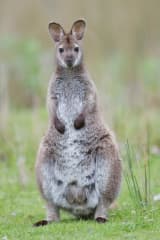 Bennett's WallabyNotamacropus rufogriseusAt 40 zoos · Least Concern
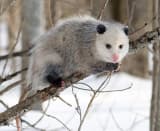 Virginia OpossumDidelphis virginianaAt 26 zoos · Least Concern
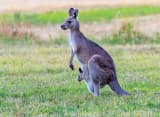 KangarooMacropusAt 22 zoos · Least Concern
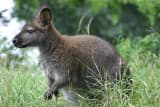 WallabyMacropodidaeAt 15 zoos
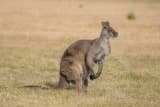 Western Grey KangarooMacropus fuliginosusAt 8 zoos · Least Concern
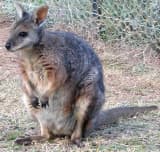 Tammar WallabyNotamacropus eugeniiAt 7 zoos · Least Concern
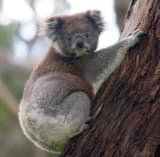 KoalaPhascolarctos cinereusAt 6 zoos · Vulnerable
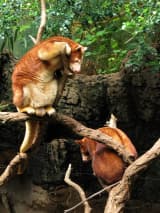 Matschie's Tree KangarooDendrolagus matschieiAt 6 zoos · Endangered
What makes a marsupial
Marsupials split from the ancestors of placental mammals 125 to 160 million years ago, and they reproduce in a very different way. Pregnancy is short, typically 12 to 33 days, and the newborn is blind, furless and roughly as developed as an 8 to 12 week human fetus. It crawls through its mother's fur to a teat and stays attached for months. The word marsupial comes from marsupium, the Latin name for the pouch.
Pouches vary. Hopping kangaroos have a pouch that opens at the front, while many marsupials that walk or climb on all fours have one that opens toward the rear. Even after a joey starts leaving the pouch, it returns to sleep, nurse and shelter when danger threatens. On average marsupials also run cooler than placental mammals, at about 35°C (95°F) against 37°C (99°F).
From South America to Australia
DNA evidence points to a South American origin. Marsupials reached Australia across an Antarctic land bridge about 50 million years ago, probably in a single dispersal. With placental land mammals vanishing early from Australia, they radiated into meat-eaters, omnivores and large herbivores. Today about 70 percent of the 334 living species live in Australia, New Guinea and nearby islands.
The Americas still have opossums. The Virginia opossum is the only marsupial north of Mexico and the northernmost marsupial in the world, and it uses its prehensile tail to grip branches and carry small objects.
Kangaroos, wallabies and koalas
"Kangaroo" is a size label rather than a single branch of the family tree. It covers the four largest members of the family Macropodidae. The red kangaroo is the largest living marsupial, and the western grey kangaroo can be told from the similar eastern grey by its darker fur and face. "Wallaby" covers dozens of smaller macropods. Bennett's wallaby is the Tasmanian form of the red-necked wallaby, and the tammar wallaby is one of the smallest wallabies in its genus.
Some macropods left the ground. Matschie's tree-kangaroo lives in the mountain rainforests of New Guinea's Huon Peninsula. The koala is not a bear but the only living member of its own family, and its closest relatives are the wombats. It feeds almost entirely on eucalyptus leaves.
Common and endangered
Large kangaroos are plentiful, and all four kangaroo species are rated Least Concern. Many smaller macropods are rare: several rock-wallabies are Endangered, and wallabies such as the toolache wallaby and the crescent nail-tail wallaby are already extinct. Introduced red foxes, feral cats and dogs are among the predators that threaten them.
Habitat loss weighs on the forest specialists. The koala is Vulnerable, threatened by land clearing, cars, dogs, disease and bushfires. Matschie's tree-kangaroo is Endangered by forest clearing, hunting and logging, and its captive population is managed through a Species Survival Plan.
Common questions
What is a marsupial?
A marsupial is a mammal that gives birth to very undeveloped young, which then crawl to a teat and keep developing there, usually inside a pouch. Kangaroos, koalas, wombats, Tasmanian devils, wallabies, possums and opossums are all marsupials.
Where do marsupials live?
About 70 percent of marsupial species live in Australia, Tasmania, New Guinea and nearby islands. The rest live in the Americas, mostly South America, and only one, the Virginia opossum, lives north of Mexico.
Are there marsupials in the United States?
Yes, one: the Virginia opossum, which ranges from southern Canada to northern Costa Rica and is the northernmost marsupial in the world.
What is the largest marsupial?
The red kangaroo, which can grow to about 1.8 m (5 ft 11 in) tall and 90 kg (200 lb). Extinct marsupials such as Diprotodon were far larger.
What is the difference between a kangaroo and a wallaby?
Mostly size. Kangaroo is the name for the four largest species in the family Macropodidae, while wallaby is an informal name for dozens of smaller relatives, from brush wallabies and rock-wallabies to pademelons.
How long is a marsupial pregnant?
Marsupial pregnancies are short, typically 12 to 33 days. The newborn joey is blind and furless and then spends months attached to a teat, and joeys can stay in the pouch for up to a year.
Sources
Last reviewed