
Antelopes in U.S. zoos
Antelopes are hoofed, cud-chewing members of the cattle family, Bovidae, other than cattle, sheep and goats. There are 91 species, most native to Africa, with others in Asia. They range from the tiny royal antelope to the eland, and their horns are permanent bone in a keratin sheath, never shed like antlers.
Most widely held
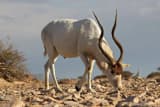 AddaxAddax nasomaculatusAt 15 zoos · Critically Endangered
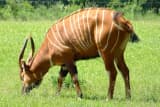 BongoTragelaphus eurycerusAt 13 zoos · Near Threatened
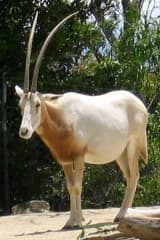 Scimitar-horned OryxOryx dammahAt 13 zoos · Endangered
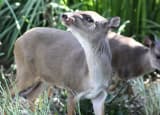 Blue DuikerPhilantomba monticolaAt 11 zoos · Least Concern
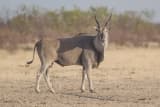 Common ElandTaurotragus oryxAt 10 zoos · Least Concern
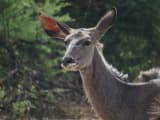 Greater KuduTragelaphus strepsicerosAt 10 zoos · Least Concern
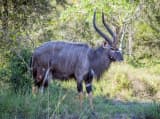 NyalaTragelaphus angasiiAt 10 zoos · Least Concern
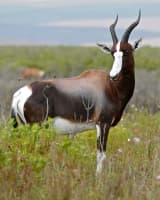 BontebokDamaliscus pygargus pygargusAt 7 zoos · Vulnerable
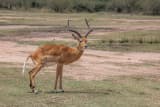 ImpalaAepyceros melampusAt 6 zoos · Least Concern
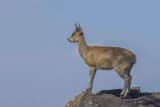 KlipspringerOreotragus oreotragusAt 6 zoos · Least Concern
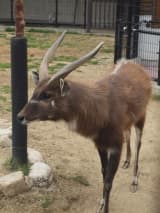 SitatungaTragelaphus spekiiAt 6 zoos · Least Concern
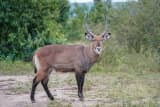 WaterbuckKobus ellipsiprymnusAt 6 zoos · Least Concern
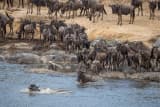 WildebeestConnochaetes taurinusAt 6 zoos · Least Concern
What counts as an antelope
"Antelope" is not a formal scientific group. The name covers the members of the cattle family, Bovidae, that are not cattle, sheep or goats, and there are 91 species in about 30 genera. Like other bovids they are ruminants. Their horns are bone encased in keratin; they grow steadily and never fall off, and in most species both sexes carry them.
More antelope species are native to Africa than to any other continent, mostly on the savannas. Others live in Asia, but none are native to Australasia, and no living species occurs wild in the Americas. The pronghorn of North America only resembles one. Species of forest, woodland and bush tend to stay put, while many plains species make long migrations to follow the rains.
From duikers to elands
Size varies enormously. The blue duiker, the smallest duiker, stands just 32 to 41 cm (13 to 16 in) at the shoulder, while the common eland, one of the two largest antelopes, can weigh more than 900 kg (2,000 lb).
Many species are specialists. The klipspringer, whose Afrikaans name means "rock leaper," lives on cliffs and boulders. The sitatunga is semiaquatic, walking on long, splayed hooves built for swamp mud. The addax of the deep Sahara can go almost without drinking. The impala can leap 3 m (9.8 ft) high, and the wildebeest of the eastern and southern African plains is famous for vast seasonal migrations.
Reading the horns
Horn shape is the quickest way to tell antelope apart. The spiral-horned antelopes of the genus Tragelaphus, such as the greater kudu, the bongo, the nyala and the sitatunga, carry long twisting horns. In the greater kudu only bulls have them, averaging about 120 cm (47 in) measured along the spiral. The addax has horns twisted two to three times, the bontebok has lyre-shaped, ringed horns, and the wildebeest's curve like a pair of parentheses.
Conservation picture
About 25 antelope species are rated by the IUCN as Endangered, and several subspecies are threatened too. The addax is Critically Endangered. The scimitar-horned oryx was declared extinct in the wild in 2000, then reintroduced to Chad and downlisted to Endangered in 2023, and the bontebok of South Africa's Western Cape is Vulnerable.
Common questions
What is the difference between an antelope and a deer?
Antelope have permanent horns of bone covered in keratin that grow steadily and never fall off, while male deer grow bony antlers that are shed and regrown each year. Antelope belong to the family Bovidae; deer are a separate family.
What is the largest antelope?
The elands are the largest antelopes, with the common and giant eland both outweighing the bongo. A male common eland can stand about 178 cm (5 ft 10 in) at the shoulder and weigh almost 950 kg (2,100 lb).
Is the pronghorn an antelope?
No. Despite the nickname American antelope, the pronghorn belongs to a different family, Antilocapridae, and no true antelope species lives wild in the Americas today.
Do female antelopes have horns?
In most antelope species both sexes have horns, though males' tend to be larger. Some species have hornless females, such as the greater kudu and klipspringer, where only males carry horns.
Where do antelopes live?
Most antelopes are native to Africa, chiefly its savannas, where 25 to 40 species can occur together over much of East Africa. Others live in Asia, from the Arabian Peninsula to India and Central Asia.
Are antelopes endangered?
About 25 antelope species are rated by the IUCN as endangered, including the dama gazelle and mountain nyala. The addax of the Sahara is Critically Endangered.
Sources
Last reviewed