
Great apes in U.S. zoos
Great apes are the primate family Hominidae: orangutans, gorillas, chimpanzees, bonobos and humans. They have no tail, use their hands to gather food and nesting material, and build sleeping nests each night. Chimpanzees and bonobos are listed as Endangered, and both gorilla species and all three orangutans as Critically Endangered.
Most widely held
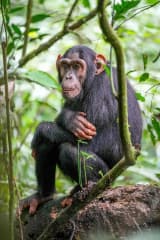 ChimpanzeePan troglodytesAt 29 zoos · Endangered
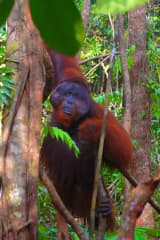 OrangutanPongo pygmaeusAt 26 zoos · Critically Endangered
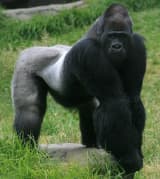 GorillaGorilla gorillaAt 19 zoos · Critically Endangered
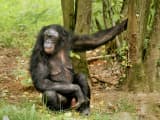 BonoboPan paniscusAt 6 zoos · Endangered
What makes an ape a great ape
The great apes form the family Hominidae, which includes humans. Its eight living species sit in four genera: Pongo (the orangutans), Gorilla, Pan (the chimpanzee and bonobo) and Homo. Orangutans branched off first, about 12 million years ago, while gorillas, chimpanzees and humans share a more recent ancestor.
All great apes are tailless, and males are on average larger and stronger than females, though the gap varies a lot between species. Most move on all fours but use their hands to gather food and nesting material, and some use tools. Every night they build sleeping platforms, or nests, in trees; chimpanzees and gorillas also make nests on the ground. The gibbon is an ape too, but it belongs to a separate family, the lesser apes, that split away 18 to 12 million years ago.
Four apes, four ways of life
The orangutan of Borneo and Sumatra is the most tree-bound and the most solitary of the group, with lasting bonds mainly between mothers and their young. It spends much of its foraging time eating fruit and builds a fresh nest each night.
The gorilla is the heaviest. Western gorillas live in groups of two to twenty animals built around a dominant silverback male. In the dry season, when fruit is scarce, they fall back on tougher leaves and bark.
The chimpanzee and the bonobo together make up the genus Pan, humans' closest living relatives. They are easy to confuse. Bonobos are more slender, with narrow shoulders, long legs, a black face, pink lips and hair that often parts neatly on the head. Chimpanzees are bigger and more robust, with a pronounced brow ridge. Their societies differ most: chimpanzees keep a male-dominated hierarchy and are famous for making and using tools, while bonobo communities are led by coalitions of females, and lethal violence among bonobos is essentially unknown.
Why every great ape is threatened
Every wild great ape is at risk. Both gorilla species and all three orangutan species are listed as Critically Endangered, and the chimpanzee and bonobo as Endangered. The Sumatran orangutan and the Cross River gorilla have stayed on a list of the world's 25 most endangered primates since 2000.
The threats overlap: forest loss to logging, farming and palm oil plantations, hunting for bushmeat, the pet trade and disease. Ebola cut western gorilla numbers in protected areas by a third between 1992 and 2007. Large primates such as great apes are especially vulnerable because they mature late and breed slowly; a female gorilla usually raises only one offspring to maturity every six to eight years, so depleted populations recover slowly.
Cooperative breeding programs such as the Species Survival Plan manage threatened species across many zoos as one population, so that slow-breeding animals like these stay genetically healthy in human care.
Common questions
What are the great apes?
The great apes are the family Hominidae: orangutans, gorillas, chimpanzees, bonobos and humans. The family has eight living species in four genera.
Which is the largest great ape?
The eastern gorilla is the largest, with males weighing 140 to 180 kg (310 to 400 lb). The smallest is the bonobo, at 30 to 40 kg (66 to 88 lb).
Is a gibbon a great ape?
No. Gibbons belong to a separate family, Hylobatidae, often called the lesser apes. Their lineage split from that of the great apes roughly 18 to 12 million years ago.
What is the difference between a bonobo and a chimpanzee?
Bonobos are more slender, with narrow shoulders, long legs, a black face and pink lips, and live only south of the Congo River in female-led communities. Chimpanzees are more robust and live in male-dominated groups across equatorial Africa.
Are all great apes endangered?
Yes, apart from humans. Chimpanzees and bonobos are listed as Endangered, and the eastern gorilla, western gorilla and all three orangutan species are Critically Endangered.
What do great apes eat?
All great apes are omnivorous, but chimpanzees and orangutans eat mainly fruit. Gorillas also prefer fruit and switch to leaves and shoots when fruit is scarce.
Which great ape is closest to humans?
Chimpanzees and bonobos, the two species of the genus Pan, are humans' closest living relatives.
Sources
Last reviewed