- Where to see one
- 7 U.S. zoos in our directory hold brown lemur, confirmed against each zoo's own animal list.
- Native range
- Western and eastern Madagascar; introduced to Mayotte
- Size
- 84–101 cm (33–40 in) total length, including a 41–51 cm (16–20 in) tail; weight 2–3 kg (4.4–6.6 lb)
- Lifespan
- Probably 20–25 years at most in the wild; one captive animal lived over 36 years
- Gestation
- About 120 days; usually one infant
- Group size
- Usually 5–12 animals
Conservation status
Vulnerableassessed 2020
IUCN Red List category VU — step 3 of 7.
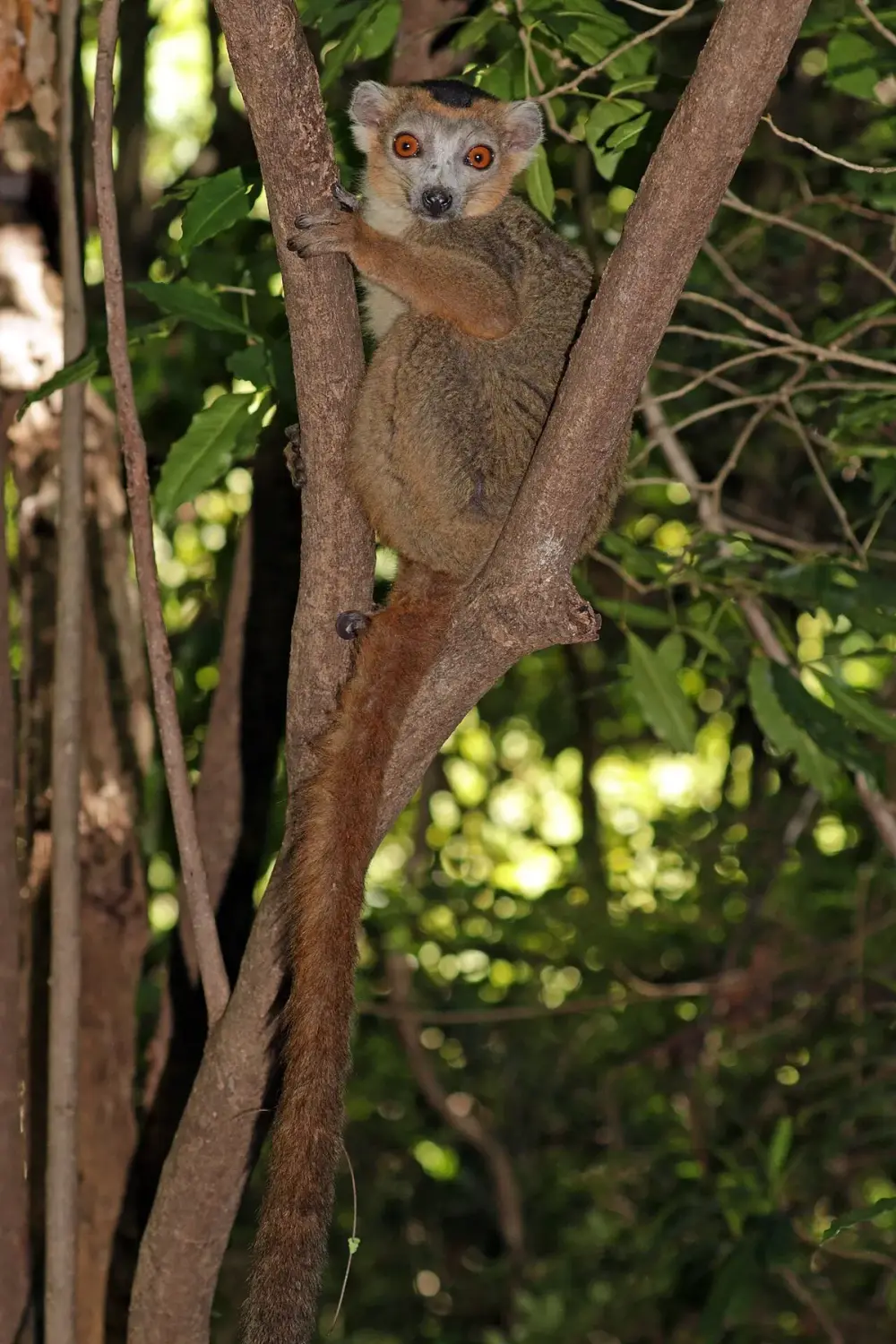
The common brown lemur is a medium-sized primate found in Madagascar and introduced to Mayotte. It measures 84 to 101 cm in total length including the tail and weighs 2 to 3 kg. Unlike others in its genus, males and females look alike, with a dark grey or black face and crown, pale cheeks, deep orange-red eyes and a brown or grey-brown coat. It lives in lowland rainforest, montane rainforest, moist evergreen forest and dry deciduous forest, spending about 95 percent of its time in the upper forest layers. Groups usually number 5 to 12 with no discernible dominance hierarchy. It is mainly active by day but may be active at night, especially around full moons.
About the brown lemur
The common brown lemur is a mostly tree-dwelling primate native to Madagascar, where it lives in rainforest and dry forest in the west and east of the island. It belongs to the lemur family Lemuridae and is one of several "brown lemurs" in the genus Eulemur.
That genus has a tangled history. Until 2001, the white-fronted, gray-headed, collared, red-fronted and Sanford's brown lemurs were all treated as subspecies of Eulemur fulvus. They are now generally counted as separate species, though some zoologists think the white-fronted and red-fronted forms should still be lumped in. Because of this history, common brown lemurs are often misidentified in photos and texts, and confused with red-fronted or gray-headed lemurs or with hybrids. For an overview of the whole group, see lemurs.
A common brown lemur measures 84–101 cm (33–40 in) from nose to tail tip, and the long, bushy tail makes up 41–51 cm (16–20 in) of that. Adults weigh 2–3 kg (4.4–6.6 lb), about the size of a house cat.
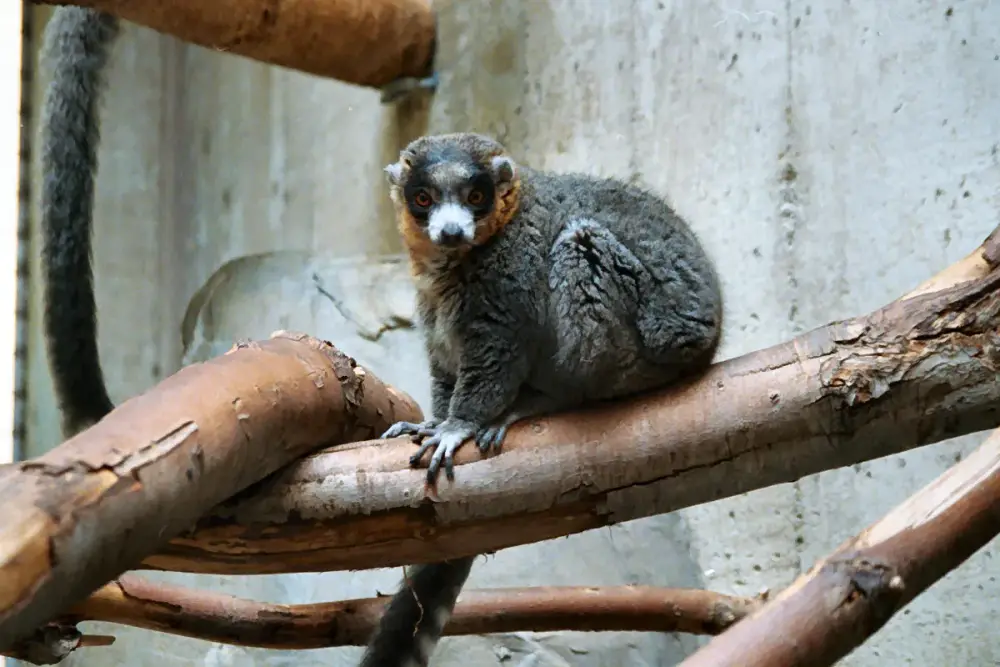
Unlike most of its relatives, it shows little or no difference in color between males and females. Both have a dark gray or black face, muzzle and crown, with white or tan cheeks and almost always deep orange-red eyes. The short, dense body fur is brown or gray-brown, lighter underneath, and the backs of the hands are often orange or reddish. The tail is usually darker than the back, in gray, black or brown.
Like other true lemurs, it has binocular vision and a scent gland at the wrist. Its six lower front teeth jut forward to form a "tooth comb" used for grooming itself and other group members.
Behavior and diet
Diet
Mainly fruit, young leaves and flowers, plus some invertebrates, bark, sap and soil
Common brown lemurs spend about 95 percent of their time in the upper layers of the forest and less than 2 percent on the ground. They move on all fours along branches and leap between trees, using the long tail for balance.
They are mainly diurnal, but their activity can stretch into the night, especially under a full moon and during the dry season. Activity spread across both day and night is called cathemeral.
Groups usually hold 5 to 12 animals of both sexes, including young, and can be larger, especially on Mayotte. Unlike many lemurs, common brown lemurs show no clear female dominance and no obvious dominance hierarchy. Home ranges cover 1–9 ha (2.5–22 acres) in the west of Madagascar but more than 20 ha (49 acres) in the east.
Grooming with the tooth comb keeps social bonds strong. Scent is a major channel of communication, used to signal identity, location and condition. Brown lemurs also have a set of calls: a nasal "ohn" keeps the group together, a high-pitched "cree" works as a territorial call, and "crou" is the alarm call.
The diet is mostly fruit, young leaves and flowers. In some places they also eat invertebrates such as cicadas, spiders and millipedes, and they chew bark, sap, soil and red clay. They can tolerate higher levels of toxic plant compounds than other lemurs. As fruit eaters, they likely help disperse seeds.
In western Madagascar, common brown lemurs share forests with mongoose lemurs. The two species sometimes travel together and shift their activity times to avoid conflict.
Mating takes place in May and June, and after about 120 days a single infant, occasionally twins, is born in September or October. For its first three weeks the infant clings to its mother's belly, then rides on her back. It starts sampling solid food by nibbling what the group is eating and is weaned at around 4–6 months. Brown lemurs mature at about 18 months, and females usually give birth for the first time at 2 years old.
Range and habitat
Habitat
Lowland and montane rainforest, moist evergreen forest and dry deciduous forest
The common brown lemur lives only in Madagascar, apart from an introduced population on the nearby island of Mayotte. In the west it is found north of the Betsiboka River, and in the east between the Mangoro River and the Tsaratanana massif, with inland areas connecting the two ranges.
It uses a wide range of forest types: lowland rainforest, montane rainforest, moist evergreen forest and dry deciduous forest. In the northeast it overlaps and sometimes hybridizes with the white-fronted brown lemur, and it also overlaps with the black lemur in a few northeastern massifs.
Brown lemur vs similar lemurs
Several Eulemur species share parts of the common brown lemur's range and can look alike at a glance.
| Species | Where it overlaps | How to tell it apart |
|---|---|---|
| Common brown lemur (E. fulvus) | Western and eastern Madagascar | Brown or gray-brown body, dark face, pale cheeks, little difference between sexes |
| Mongoose lemur (E. mongoz) | West | Grayer overall |
| Red-bellied lemur (E. rubriventer) | East | More reddish |
| White-fronted brown lemur (E. albifrons) | Northeast, where they hybridize | Treated as a subspecies of the common brown lemur until 2001 |
Conservation status
The common brown lemur is listed as Vulnerable on the IUCN Red List. Its restricted range on Madagascar is part of the reason for that rating.
Forest destruction, driven by the rapid growth of Madagascar's human population, is the main threat. The species is also hunted for meat across much of its range. It does occur in a number of protected areas, and it breeds in captivity. Possible predators include the fossa and birds of prey, though predation on this species has not been well documented.
Where to see brown lemur in the U.S.
7 zoos across 5 states
Find the closest one
Rank the 2 zoos holding brown lemur by how far they are from you. Your location is used in your browser to sort this list and is never sent to us.
5 more zoos hold brown lemur but have no coordinates on file yet, so they aren't ranked here. They're in the full list below.
Alabama· 1
Florida· 2
Michigan· 1
South Carolina· 1
Texas· 2
AZAThe Association of Zoos and Aquariums. Accredited members have passed an independent inspection of animal care and welfare, safety, conservation and education, repeated every five years. Many smaller facilities never apply, so “not accredited” isn't a verdict on its own. What accreditation means · How we check this
Built from each zoo's own published animal list.
Brown Lemur: common questions
What is a brown lemur?
A tree-dwelling lemur from Madagascar with brown or gray-brown fur, a dark face and orange-red eyes. The name usually refers to the common brown lemur, Eulemur fulvus, though several related Eulemur species are also called brown lemurs.
Are brown lemurs endangered?
The common brown lemur is listed as Vulnerable. Habitat loss and hunting are the main threats.
How big is a brown lemur?
About 84–101 cm (33–40 in) long including the tail, and 2–3 kg (4.4–6.6 lb), roughly the size of a house cat.
What do brown lemurs eat?
Mostly fruit, young leaves and flowers. In some places they also eat insects, spiders and millipedes, and chew bark, sap, soil and red clay.
How long do brown lemurs live?
Probably up to 20–25 years in the wild. One captive brown lemur lived more than 36 years.
Where do brown lemurs live?
Only in Madagascar, in western and eastern forests, plus an introduced population on the island of Mayotte.
Are brown lemurs active at night?
Sometimes. They are mostly active by day, but can stay active into the night, especially during a full moon or the dry season.