
Lemurs in U.S. zoos
Lemurs are wet-nosed primates found in the wild only on Madagascar, with around 100 living species in eight families. They evolved separately from monkeys and apes, rely heavily on scent, and females are often dominant over males, a trait rare among primates. The IUCN considers them the world's most endangered mammals.
Most widely held
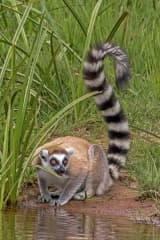 Ring-tailed LemurLemur cattaAt 118 zoos · Endangered
 Black-and-white Ruffed LemurVarecia variegataAt 45 zoos · Critically Endangered
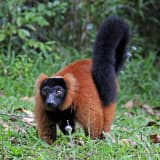 Red Ruffed LemurVarecia rubraAt 37 zoos · Critically Endangered
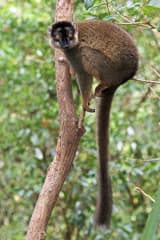 Brown LemurEulemur fulvusAt 7 zoos · Vulnerable
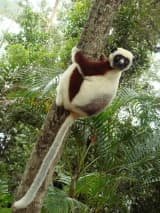 Coquerel's SifakaPropithecus coquereliAt 7 zoos · Critically Endangered
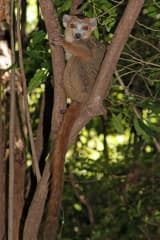 Crowned LemurEulemur coronatusAt 7 zoos · Endangered
 Mongoose LemurEulemur mongozAt 7 zoos · Critically Endangered
Primates that evolved alone on an island
Lemurs belong to the strepsirrhine branch of the primates, alongside lorises and galagos. They did not give rise to monkeys and apes; instead they evolved in isolation on Madagascar, and the island's harsh, highly seasonal climate drove a diversity of species that rivals any other primate group. Living lemurs range from 30 g (1.1 oz) mouse lemurs to the 9 kg (20 lb) indri. More than a dozen larger "giant lemurs", one as big as a gorilla, have died out since people reached the island.
Like other strepsirrhines, lemurs have a wet nose, rely less on vision than monkeys do and groom with a "toothcomb" of forward-facing lower teeth. Some species are nocturnal, most larger ones are diurnal, and a few are active in bursts by day and night. The mongoose lemur shifts between day and night activity with the seasons.
Ruffed lemurs, true lemurs and sifakas
The ruffed lemurs are big fruit-eaters of the eastern rainforests. The black-and-white ruffed lemur gets about 92% of its diet from fruit, and the red ruffed lemur, found only around the Masoala region, belongs to the only primates known to give birth to litters.
The true lemurs of the genus Eulemur, such as the brown lemur and the crowned lemur, live in groups of several adults of both sexes; crowned lemurs gather in groups of 5 to 15, most often 5 or 6. The ring-tailed lemur, with its black-and-white banded tail, is easy to pick out and is the living lemur best adapted to moving on the ground.
Sifakas belong to the indri family. The Coquerel's sifaka clings upright to trunks and leaps up to 11 m (35 ft) between trees; on the ground it bounds on two legs with its arms out for balance.
Scent, sunbathing and female rule
Scent carries much of lemur conversation. Lemurs mark with urine and with glands on the wrists, elbows, neck or genitals, and a scent mark can signal age, sex and breeding condition. Male ring-tailed lemurs rub their tails across the scent glands on their wrists and wave them at rivals in "stink fights". Ring-tailed lemurs are also often seen sunbathing, sitting upright with bellies turned to the sun.
Female dominance sets lemurs apart from most other primates. In Coquerel's sifaka, adult females eat first and take the best food. The rule is not universal: common brown lemurs show no clear female dominance.
The world's most endangered mammals
The IUCN considers lemurs the world's most endangered mammals: as of 2013, up to 90% of species faced extinction in the wild within 20 to 25 years. Slash-and-burn farming, illegal logging, hunting, poverty and political instability all drive the decline. About 87% of Madagascar's primate species are threatened, a higher share than in any other region. Both ruffed lemurs, the mongoose lemur and Coquerel's sifaka are listed as Critically Endangered. Local traditions known as fady help protect some lemurs and forests, and conservation groups increasingly work through community-based projects.
Common questions
Where do lemurs live in the wild?
Lemurs live in the wild only on Madagascar, an island off southeast Africa. Since humans arrived about 2,000 years ago they have been restricted to roughly 10% of the island, around 60,000 km² (23,000 sq mi).
Are lemurs monkeys?
No. Lemurs are strepsirrhine primates, related to lorises and galagos, and they evolved on Madagascar independently of monkeys and apes.
Are all lemurs endangered?
Not every species, but most are at risk. The IUCN considers lemurs the world's most endangered mammals, and as of 2013 up to 90% of lemur species faced the threat of extinction in the wild within 20 to 25 years.
What is the biggest lemur?
The largest living lemur is the indri, at about 9 kg (20 lb). The smallest are mouse lemurs, at around 30 g (1.1 oz).
Why are lemurs female-dominant?
No one is sure. After decades of research there is no consensus, but the leading view is that dominance helps females cope with the high cost of reproduction when food is scarce.
What do lemurs eat?
Most lemurs eat a wide variety of fruits and leaves, and figs dominate the fruit they eat. The smallest species also eat insects, while sifakas and other members of the indri family rely more on leaves.
What is a sifaka?
A sifaka is a lemur of the indri family that moves by clinging upright to tree trunks and leaping between them. On the ground, Coquerel's sifaka bounds on two legs.
Sources
Last reviewed