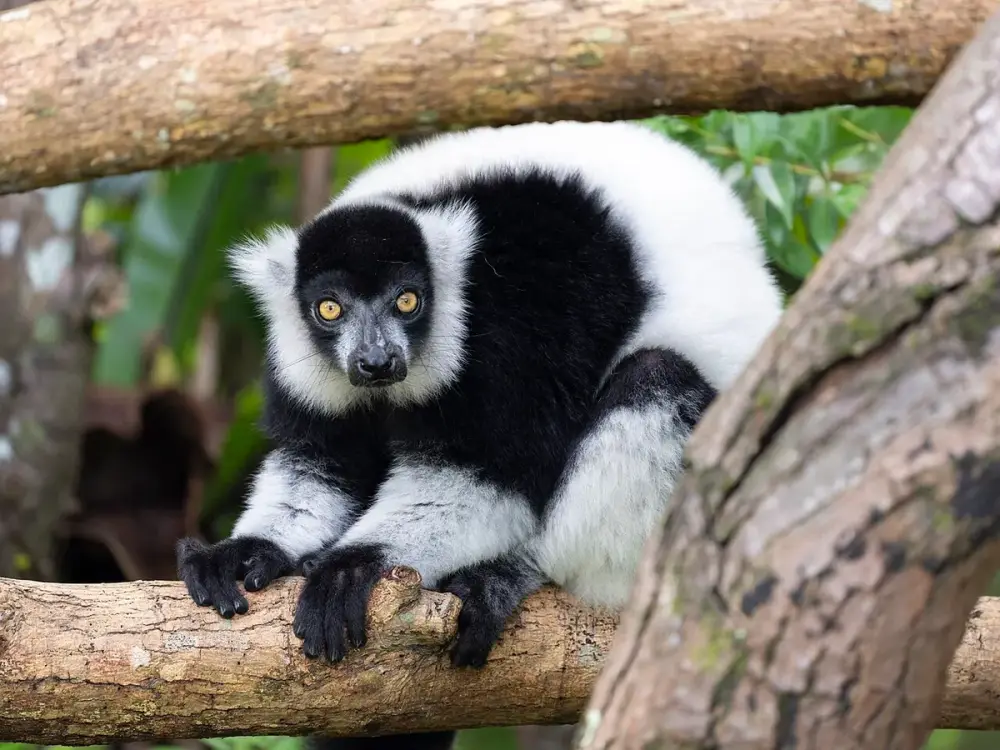
- Where to see one
- 37 U.S. zoos in our directory hold red ruffed lemur, confirmed against each zoo's own animal list.
- Native range
- Madagascar, restricted to the rainforests of the Masoala region in the northeast
- Size
- Body length about 21 in (53 cm) with a tail around 24 in (60 cm); weight 7.3–7.9 lb (3.3–3.6 kg)
- Lifespan
- 15–20 years in the wild; commonly 25 years in captivity, with one individual reaching 35
Conservation status
IUCN Red List category CR — step 5 of 7.
About the red ruffed lemur
The red ruffed lemur is one of two species in the genus Varecia, the ruffed lemurs, alongside the black-and-white ruffed lemur. Like every lemur, it's found only on Madagascar, and its range there is unusually narrow: it occurs solely in the rainforests of the Masoala Peninsula in the island's northeast. It's also one of Madagascar's largest primates and, together with its sister species, the largest member of the family Lemuridae.
Adults measure about 21 inches in body length with a tail adding roughly another 24 inches, and weigh between 7.3 and 7.9 pounds; females run slightly larger than males. The species has slender bodies, long legs, and a narrow snout, with small ears that its long fur often hides. Its soft, thick coat is rust-red across the head, back, and body, while the stomach, tail, feet, and the insides of the legs are black. A white patch marks the back of the neck, and some individuals show additional white on the feet or around the mouth; a few also carry a white or pink patch on the back of the limbs or digits and a similarly colored ring at the base of the tail.
Grooming is a major part of red ruffed lemur life, both self-directed and social. The lower incisors grow forward and slightly spaced to form a toothcomb, and a specialized claw on the second toe of the hind foot assists as well — together, these adaptations let the species keep its long fur clean with the same care it invests in social bonds within its group.
Behavior and diet
Diet
Primarily fruit, nectar, and pollen; leaves and seeds when fruit is scarce
Red ruffed lemurs are diurnal, most active in the morning and evening, and typically live in small, matriarchal groups of two to sixteen individuals, though gatherings of up to 32 have been recorded. Field studies also describe monogamous pairs in the species, suggesting its social structure is more flexible than a single fixed pattern. During the wet season, when food is abundant, groups will merge around a single food source and forage together; in the dry season they tend to split apart and search individually, which is unusual, since most other diurnal lemur species keep foraging in large groups year-round. Individuals stay in contact over long distances through loud, booming calls, and the Duke Lemur Center has recorded roughly twelve distinct calls in the species — notably, red ruffed lemurs and black-and-white ruffed lemurs understand each other's vocalizations despite living in different parts of Madagascar. Scent marking rounds out their communication.
Diet centers on fruit, especially figs, along with nectar and pollen; leaves and seeds fill in when fruit becomes harder to find. Reproduction follows a fixed seasonal pattern tied to Madagascar's dry and wet seasons: breeding happens toward the end of the dry season, from May to July, timed so that young arrive when food is more plentiful. After a notably short gestation of 102 days, a female may give birth to as many as six young, though litters of two or three are more typical — an unusual trait, since ruffed lemurs are the only primates known to have litters at all. Newborns are furred and can see but cannot move, so mothers keep them in elevated nests 33 to 66 feet above the forest floor, built from twigs, leaves, vines, and fur, until they're about seven weeks old. A mother can nurse up to six infants at once and, needing to move them individually before they can cling on their own, carries them one at a time; fathers stand guard at the nest in the days just after birth. Weaning happens at four months, but survival is precarious — an estimated 65% of young do not reach three months of age, often as a result of falls from the trees.
Range and habitat
Habitat
Rainforest
The red ruffed lemur's entire known range is confined to the rainforests of the Masoala region in northeastern Madagascar. The creation of Masoala National Park in 1997 extended formal protection to part of that range, but many red ruffed lemurs live outside the park's boundaries and remain at high risk there.
Conservation status
The IUCN Red List classifies the red ruffed lemur as Critically Endangered, and recent studies describe a wild population that continues to decline. Logging, the burning of habitat, cyclones, mining, hunting, and the illegal pet trade are named as the primary threats, with illegal logging for valuable tropical hardwoods such as rosewood — a practice linked to political instability — having intensified since 2009 and further reduced available forest. Natural predators, including large snakes, eagles, and the fossa, add further pressure.
The captive population stands at 590 animals, managed under a Species Survival Plan through which participating zoos coordinate breeding and care; wild-caught individuals have also been introduced into that captive program to guard against inbreeding.
Where to see red ruffed lemur in the U.S.
37 zoos across 21 states
Find the closest one
Rank the 29 zoos holding red ruffed lemur by how far they are from you. Your location is used in your browser to sort this list and is never sent to us.
8 more zoos hold red ruffed lemur but have no coordinates on file yet, so they aren't ranked here. They're in the full list below.
Alabama· 1
California· 3
Colorado· 1
District of Columbia· 1
Florida· 7
- Brevard ZooMelbourne$34.95–$36.95AZA
- Carson Springs Wildlife Conservation FoundationGainesvillefrom $45
- Central Florida Zoo and Botanical GardensSanford$21.95–$28.95AZA
- Lemur Conservation FoundationMyakka City—
- Naples ZooNaples—AZA
- Palm Beach ZooWest Palm Beachfrom $29.95AZA
- Santa Fe College Teaching ZooGainesville$10AZA
Georgia· 1
Idaho· 1
Kansas· 1
Louisiana· 1
Maryland· 1
Michigan· 2
Mississippi· 1
North Carolina· 3
Oregon· 1
Pennsylvania· 1
South Carolina· 1
Tennessee· 2
Texas· 4
Virginia· 2
Washington· 1
Wisconsin· 1
AZAThe Association of Zoos and Aquariums. Accredited members have passed an independent inspection of animal care and welfare, safety, conservation and education, repeated every five years. Many smaller facilities never apply, so “not accredited” isn't a verdict on its own. What accreditation means · How we check this
Built from each zoo's own published animal list.
Red Ruffed Lemur: common questions
Is the red ruffed lemur endangered?
Yes. It's classified as Critically Endangered by the IUCN, with a wild population that continues to decline due to logging, hunting, and habitat loss.
How big does a red ruffed lemur get?
About 21 inches in body length with a roughly 24-inch tail, and a weight of 7.3 to 7.9 pounds.
What does a red ruffed lemur eat?
Mostly fruit, especially figs, along with nectar and pollen, plus leaves and seeds when fruit is scarce.
How long do red ruffed lemurs live?
15 to 20 years in the wild; in captivity, 25 years is common, and one individual lived to 35.
Where do red ruffed lemurs live in the wild?
Only in the Masoala rainforests of northeastern Madagascar.
Which U.S. zoos have red ruffed lemurs?
Sixteen zoos in our directory list one, including the Denver Zoo, the Nashville Zoo at Grassmere, and the Riverbanks Zoo.