- Where to see one
- 6 U.S. zoos in our directory hold bonobo, confirmed against each zoo's own animal list.
- Native range
- Congo Basin of the Democratic Republic of the Congo, south of the Congo River
- Size
- 34–60 kg (75–132 lb); males average 45 kg (99 lb), females 33 kg (73 lb); about 119 cm (3.9 ft) tall standing (males)
- Lifespan
- About 40 years in captivity; unknown but almost certainly shorter in the wild
- Gestation
- About 240 days
- Population
- Estimated 29,500 to 50,000
Conservation status
Endangeredassessed 2016
IUCN Red List category EN — step 4 of 7.
The bonobo is the smallest species of great ape and, with the common chimpanzee, one of humans' closest living relatives. It lives only in a roughly 500,000 square kilometre area of the Congo Basin in the Democratic Republic of the Congo, south of the Congo River, in primary, secondary and seasonally flooded swamp forest. Bonobos eat mostly fruit. Their communities are unusual among apes for being matriarchal: a coalition of high-ranking females and males, typically headed by an old, experienced female, makes group decisions, and bonobos will share food even with unrelated strangers.
About the bonobo
The bonobo is a great ape from the rainforests of the Democratic Republic of the Congo and the smallest great ape species. Together with the common chimpanzee it makes up the genus Pan, and the two are humanity's closest living relatives. Bonobos live only south of the Congo River, in female-led communities.
Its scientific name is Pan paniscus, and it was once called the pygmy chimpanzee. That name is misleading. It dates to 1929, when it was based on an unusually small skull, but bonobos overlap broadly in size with chimpanzees, though big male chimpanzees can outweigh any bonobo. The name "bonobo" first appeared in 1954 and probably comes from a misspelling of Bolobo, a town on the Congo River, on a shipping crate.
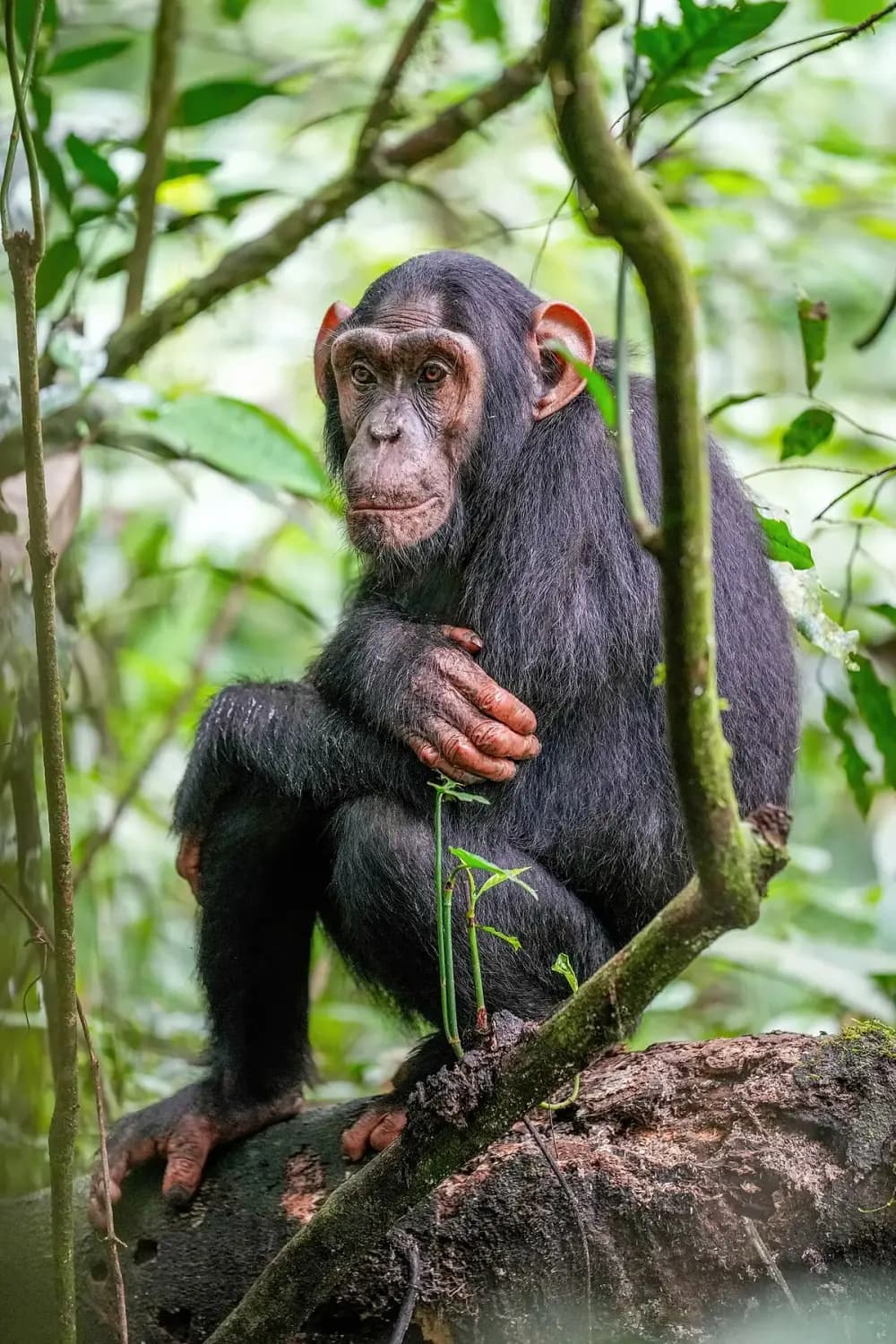
Bonobos are more slender than chimpanzees. They have a slim upper body, narrow shoulders, a thin neck and long legs. The head is relatively small, with lighter brow ridges, a black face, pink lips, small ears and wide nostrils. Long hair on the head often forms a neat parting, and adults keep a tuft of hair on the tail area that chimpanzees lose. Individual faces vary a great deal, an adaptation for recognizing one another.
Adults weigh 34–60 kg (75–132 lb), with males averaging 45 kg (99 lb) and females 33 kg (73 lb). Measured on all fours from nose to rump they are 70–83 cm (28–33 in) long, and males stand about 119 cm (3.9 ft) tall upright. Bonobos are both terrestrial and arboreal, and on the ground they mostly knuckle-walk on all fours.
Behavior and diet
Diet
Mostly fruit (about 57 percent), plus leaves, honey, eggs, small animals and invertebrates
Bonobos are omnivorous fruit-eaters. Fruit makes up about 57 percent of the diet, supplemented with leaves, honey, eggs, invertebrates and meat from small vertebrates such as flying squirrels and duikers. They also eat a truffle species, Hysterangium bonobo. Hunting habits vary between communities; in some, only females hunt and they prefer rodents, while in others both sexes hunt and target monkeys.
Social life is what makes bonobos famous. Communities of about 100 split into small parties to forage by day, then come back together to sleep in nests they build in trees. Females are at the center. Through strong alliances with one another, females are often co-dominant with males or dominant over them, and the top of the hierarchy is a coalition of high-ranking females and males, typically led by an old, experienced female. A male's rank largely reflects his mother's, and the mother-son bond often lasts for life. Adolescent females, rather than males, often leave their native community to join another.
Bonobos are not territorial. Neighboring communities usually get along, and a 2023 study of two groups in the DRC recorded 95 encounters featuring grooming, food sharing and joint defense against threats such as snakes. Bonobos also share food with unrelated strangers. Social and sexual contact is used to greet, bond, ease tension around food and make up after conflicts. Lethal violence is essentially unknown, unlike in chimpanzees.
That does not mean bonobos are gentle. Wild males are aggressive toward each other, about three times as often as male chimpanzees, though their squabbles are less intense, and fights can cause serious injuries. Bonobos have also seriously injured people.
They are intelligent animals. Bonobos pass the mirror self-recognition test, communicate mainly by voice, and use the same call to mean different things depending on context. Language-trained bonobos have learned to communicate using keyboards of symbols.
Females first give birth at 13 or 14 years old in the wild. Gestation lasts about 240 days, and mothers carry and nurse their young for about four years, giving birth on average every 4.6 years. Mothers provide all the parental care.
Range and habitat
Habitat
Primary and secondary rainforest, including seasonally flooded swamp forest
The bonobo lives in an area of about 500,000 km² (190,000 sq mi) in the Congo Basin of the Democratic Republic of the Congo in Central Africa. It inhabits primary and secondary forest, including swamp forest that floods seasonally. The Lopori Basin and Lomako River area is considered the bonobo heartland.
The Congo River defines its range. Bonobos are not strong swimmers, and the river possibly isolated their ancestors from those of chimpanzees, which live to the north. DNA evidence suggests the two species split roughly 860,000–890,000 years ago, and the river still keeps wild populations apart today.
Because of political instability and the shy nature of bonobos, relatively little field research has been done in the wild.
Bonobo vs chimpanzee
The bonobo and the common chimpanzee are closely related members of the genus Pan and were once classed as one species. Their genomes differ by only about 0.4 percent, but they differ in looks and behavior.
| Feature | Bonobo | Common chimpanzee |
|---|---|---|
| Scientific name | Pan paniscus | Pan troglodytes |
| Range | South of the Congo River, DRC only | North of the Congo River |
| Build | More slender, longer legs, smaller head | Bulkier; large males outweigh any bonobo |
| Face and hair | Dark face, pink lips, parted head hair | No neat parting; loses the tail tuft |
| Social structure | Female alliances dominate | Males form alliances |
| Lethal violence | Essentially absent | Not infrequent |
| Diet | Mainly fruit | Often highly omnivorous, hunting monkeys and antelope |
Conservation status
The bonobo is listed as Endangered on the IUCN Red List, with conservative population estimates of 29,500 to 50,000. There are no firm figures. Its main threats are habitat loss, human population growth and civil unrest, with commercial poaching for bushmeat by far the biggest danger. Hunting increased dramatically during the First and Second Congo Wars, when armed militias reached even remote protected areas.
Salonga National Park is the only national park in bonobo habitat, and surveys since 2000 indicate that bonobos, African forest elephants, okapi and other species there have been devastated by poachers. In contrast, some areas without park borders still support thriving wildlife because of local beliefs and taboos against killing bonobos.
Community-based conservation is a major focus. Since 2002, the Bonobo Peace Forest Project has worked with local communities to create a linked network of community-managed reserves, helping secure agreements to protect more than 130,000 km² (50,000 sq mi) of bonobo habitat.
Where to see bonobo in the U.S.
6 zoos across 6 states
Find the closest one
Rank the 6 zoos holding bonobo by how far they are from you. Your location is used in your browser to sort this list and is never sent to us.
California· 1
Florida· 1
Ohio· 1
Tennessee· 1
Texas· 1
Wisconsin· 1
AZAThe Association of Zoos and Aquariums. Accredited members have passed an independent inspection of animal care and welfare, safety, conservation and education, repeated every five years. Many smaller facilities never apply, so “not accredited” isn't a verdict on its own. What accreditation means · How we check this
Built from each zoo's own published animal list.
Bonobo: common questions
Are bonobos chimpanzees?
No. Bonobos are a separate species, Pan paniscus, though they share the genus Pan with the common chimpanzee and were once considered a chimpanzee subspecies.
Are bonobos dangerous?
They can be. Bonobos are more peaceful than chimpanzees and lethal violence is essentially absent, but males fight often and bonobos have seriously injured people.
How big do bonobos get?
Adults weigh 34–60 kg (75–132 lb). Males average 45 kg (99 lb) and stand about 119 cm (3.9 ft) tall upright; females average 33 kg (73 lb).
What do bonobos eat?
Mostly fruit, about 57 percent of the diet, plus leaves, honey, eggs, invertebrates and small animals such as flying squirrels and duikers.
Where do bonobos live?
Only in the Congo Basin of the Democratic Republic of the Congo, south of the Congo River, in rainforest and swamp forest.
How long do bonobos live?
About 40 years in captivity. Their lifespan in the wild is unknown but almost certainly shorter.
How many bonobos are left?
Estimates range from 29,500 to 50,000, though there are no firm figures. The species is Endangered.
How closely related are bonobos to humans?
Very closely. Along with the common chimpanzee, the bonobo is humanity's closest living relative.