
Rodents in U.S. zoos
Rodents are the mammal order Rodentia, defined by a single pair of continuously growing incisors in each jaw that must be worn down by gnawing. They make up about 40 percent of all mammal species and are native to every major landmass except Antarctica. Most weigh under 100 g, but the capybara reaches 66 kg (146 lb).
Most widely held
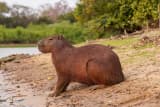 CapybaraHydrochoerus hydrochaerisAt 52 zoos · Least Concern
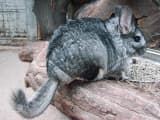 ChinchillaChinchilla lanigeraAt 39 zoos · Endangered
 North American PorcupineErethizon dorsatumAt 39 zoos · Least Concern
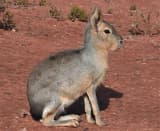 Patagonian MaraDolichotis patagonumAt 31 zoos · Near Threatened
 Black-tailed Prairie DogCynomys ludovicianusAt 29 zoos · Least Concern
 African Crested PorcupineHystrix cristataAt 27 zoos · Least Concern
 Prehensile-tailed PorcupineCoendou prehensilisAt 27 zoos · Least Concern
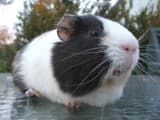 Guinea PigCavia porcellusAt 22 zoos
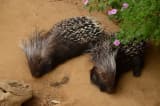 Cape PorcupineHystrix africaeaustralisAt 21 zoos · Least Concern
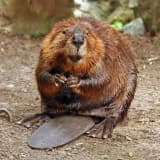 American BeaverCastor canadensisAt 20 zoos · Least Concern
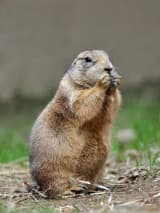 Prairie DogCynomysAt 20 zoos
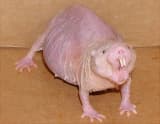 Naked Mole-ratHeterocephalus glaberAt 17 zoos · Least Concern
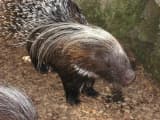 PorcupineHystricidaeAt 12 zoos
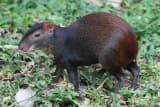 Red-rumped AgoutiDasyprocta leporinaAt 12 zoos · Least Concern
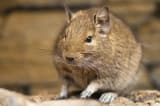 DeguOctodon degusAt 7 zoos · Least Concern
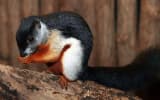 Prevost's SquirrelCallosciurus prevostiiAt 7 zoos · Least Concern
What makes a rodent
The name comes from the Latin rodens, "gnawing." Every rodent has one pair of ever-growing incisors in the upper jaw and one in the lower, used to gnaw food, dig burrows and defend itself. Enamel covers only the front of each incisor, so gnawing wears the back down faster and keeps a chisel-sharp edge. Rodents have no canine teeth, and a gap separates the incisors from the cheek teeth.
That body plan has been remarkably successful. Rodents account for about 40 percent of mammal species and live as climbers, burrowers, hoppers, swimmers and even gliders. Rabbits are often mistaken for rodents, but they are lagomorphs, with a second pair of upper incisors.
Giants, burrowers and builders
The capybara, native to every South American country except Chile, is the largest living rodent. It has slightly webbed feet and usually lives in groups of 10 to 20. The American beaver, North America's largest rodent, builds dams and lodges that reshape streams and create wetlands.
Some rodents are ecosystem engineers. The burrows of the black-tailed prairie dog aerate Great Plains soils, and prairie dogs have complex alarm-call systems. Underground in the Horn of Africa, the naked mole-rat lives in eusocial colonies with a single breeding queen, a system otherwise associated with insects.
Porcupines and other lookalikes
Porcupines show how differently rodents can turn out. The North American porcupine carries about 30,000 barbed quills. The prehensile-tailed porcupine of South America lives in trees and grips branches with its tail. The African crested porcupine, one of the largest rodents in the world at 13 to 27 kg (29 to 60 lb), is nocturnal and rarely climbs.
Other rodents look like something else entirely. The Patagonian mara of Argentina has hoof-like pads on its feet. Prevost's squirrel of Southeast Asia is a tree squirrel with striking black, white and reddish-orange fur. The chinchilla of the Andes has the densest fur of any land mammal.
Conservation and people
Rodents have been used by people for food, clothing, research and as pets, and a few, such as the brown rat and house mouse, are serious pests. Many species are widespread, but not all. The chinchilla is Endangered, with wild colonies now known only in Chile, and the Patagonian mara is Near Threatened on the IUCN Red List.
Common questions
What is the largest rodent?
The capybara of South America is the largest living rodent, reaching up to 66 kg (146 lb). In North America, the largest rodent is the American beaver.
Why do rodents' teeth keep growing?
Rodent incisors grow continuously throughout life, so the animal must keep wearing them down by gnawing. Enamel covers only the front of each incisor, so the softer back wears faster and leaves a sharp, chisel-like edge.
Are rabbits rodents?
No. Rabbits and hares are lagomorphs. Their incisors also grow continuously, but they have an extra pair of incisors in the upper jaw that rodents lack.
Are porcupines rodents?
Yes. Porcupines are rodents, and the North American porcupine is the second-largest rodent native to North America after the beaver.
Why are naked mole-rats so unusual?
Naked mole-rats are eusocial, like ants and termites. A colony is built around a single breeding queen and one to three breeding males, while the rest of the colony works as non-breeding helpers.
Do rodents live in groups?
Most rodent species are social or gregarious. Prairie dogs live in colonies called towns that can stretch for kilometers, while hamsters and red squirrels are more solitary.
Sources
Last reviewed