
Deer in U.S. zoos
Deer are hoofed, cud-chewing mammals of the family Cervidae, native to every continent except Antarctica and Australia. Males of almost every species grow and shed a new set of bony antlers each year, which separates deer from antelope and cattle with their permanent horns. The smallest, the northern pudu, stands only 32–35 cm (12.5–14 in) tall.
Most widely held
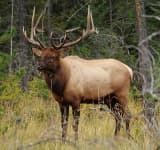 ElkCervus canadensisAt 36 zoos · Least Concern
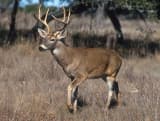 White-tailed DeerOdocoileus virginianusAt 30 zoos · Least Concern
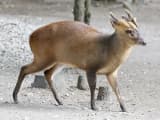 Reeve's MuntjacMuntiacus reevesiAt 24 zoos · Least Concern
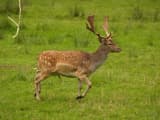 Fallow DeerDama damaAt 18 zoos · Least Concern
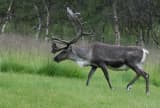 ReindeerRangifer tarandusAt 15 zoos · Vulnerable
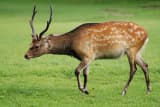 Sika DeerCervus nipponAt 9 zoos · Least Concern
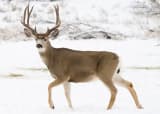 Mule DeerOdocoileus hemionusAt 8 zoos · Least Concern
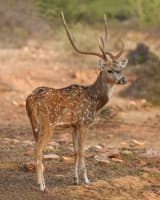 Axis DeerAxis axisAt 7 zoos · Least Concern
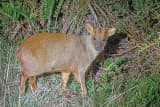 Southern PuduPudu pudaAt 7 zoos · Near Threatened
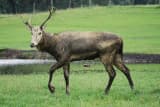 Père David's DeerElaphurus davidianusAt 6 zoos · Extinct in the Wild
What makes a deer
Deer are hoofed ruminants of the family Cervidae, split into two subfamilies: one that includes muntjacs, elk, red deer and fallow deer, and another that includes reindeer, white-tailed deer, roe deer and moose. Musk deer and chevrotains look similar but are separate families.
Their defining feature is antlers. Males of almost all species, plus female reindeer, grow a new set every year. Antlers start as soft "velvet" tissue and harden into bone, and males use them in combat. That annual cycle is the clearest way to tell deer from antelope, whose horns are permanent.
Where deer live
Deer are native to every continent except Antarctica and Australia, and Eurasia, especially Asia, holds the most species. Africa has just one native deer. Many species live in transitional areas between forest or thicket cover and open prairie or savanna, while others are adapted to swamps, mountains or tundra.
The reindeer of the Arctic and subarctic has large, crescent-shaped hooves that support it in snow and work as shovels when it digs for food. Père David's deer, from the marshes of eastern China, has large, wide-splaying hooves that click as it walks, much like a reindeer's. The tiny southern pudu of Chile and Argentina keeps to temperate rainforest with a dense understory.
Telling deer apart
Coat, antlers and size all help. The axis deer of the Indian subcontinent is covered in white spots, and sika deer are among the few deer that keep their spots into adulthood. Fallow deer bucks grow broad, palm-shaped antlers. The white-tailed deer raises the white underside of its tail when alarmed, while the elk is named "wapiti" for its pale rump. At the small end, the Reeves's muntjac, called the barking deer, stands about 0.5 m (1 ft 8 in) at the shoulder, and males carry tusks as well as short antlers.
Conservation picture
Many deer are common, and some, such as fallow deer, have been introduced far outside their native range. Others are in trouble. Père David's deer was hunted out of the wild in China and survived only in captivity; it is listed as Extinct in the Wild. The reindeer is Vulnerable and the southern pudu is Near Threatened on the IUCN Red List.
Common questions
What is the difference between antlers and horns?
Antlers are bony extensions of the skull that deer grow and shed every year, while the horns of antelope and cattle are bone covered in keratin that grow steadily and never fall off.
Do female deer have antlers?
Normally only in reindeer. Female reindeer are the only female deer that regularly grow antlers, although does of other species occasionally produce them, usually because of raised testosterone.
What is the smallest deer?
The northern pudu of South America is the smallest deer in the world, standing only 32–35 cm (12.5–14 in) at the shoulder. Its sister species, the southern pudu, is only slightly larger.
What is antler velvet?
Velvet is the soft, living tissue that covers antlers while they grow. As the antler mineralizes and its blood supply is cut off, it hardens into bone from the tip to the base.
Which deer have tusks?
Muntjacs, the tufted deer and the water deer do. Male Reeves's muntjacs carry tusk-like upper canines alongside short antlers, while male water deer have tusks and no antlers at all.
Are there deer in Africa?
Only one deer is native to Africa: the Barbary stag, a subspecies of red deer confined to the Atlas Mountains in the northwest of the continent.
Sources
Last reviewed