- Where to see one
- 8 U.S. zoos in our directory hold emperor tamarin, confirmed against each zoo's own animal list.
- Native range
- North Brazil (Acre and Amazonas states), southwest Amazon Basin, east Peru, north Bolivia
- Size
- Body 9–10 in (23–26 cm) long, plus a 13.8–16.3 in (35–41.5 cm) tail
- Weight
- About 18 oz (500 g)
About the emperor tamarin
The emperor tamarin is a species of tamarin monkey said to be named for its long white beard, which allegedly resembles that of the German emperor Wilhelm II. It lives in the north Brazilian states of Acre and Amazonas and across the southwest Amazon Basin, in east Peru and north Bolivia.
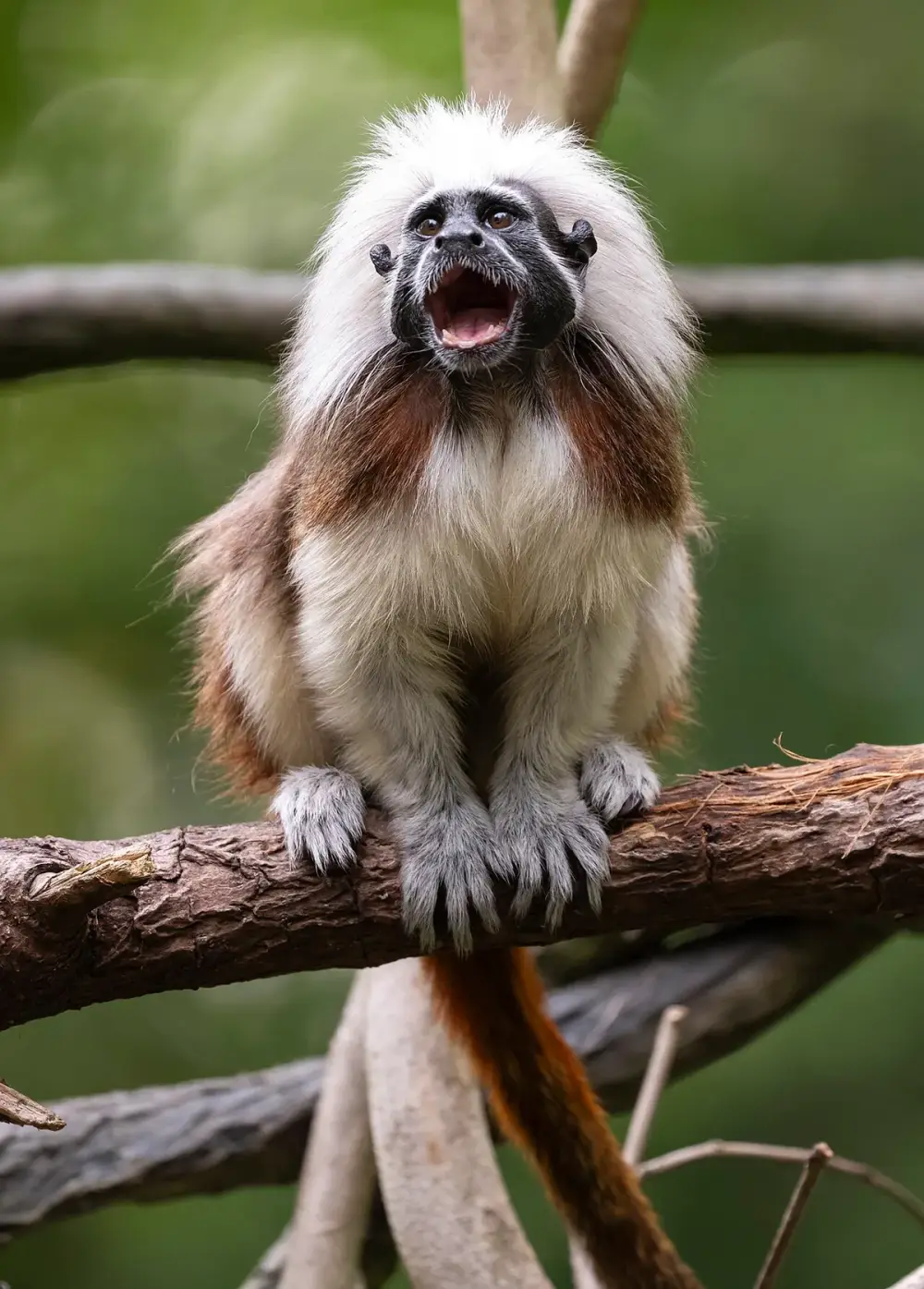
The animal's fur is predominantly grey with yellowish speckles across the chest, black hands and feet, and a brown tail. Its most distinctive feature is the long, white mustache-like beard that extends past both shoulders. An emperor tamarin's body reaches 9 to 10 in (23–26 cm) in length, with a tail measuring 13.8 to 16.3 in (35–41.5 cm), and it weighs approximately 18 oz (500 g), making it small even by the standards of other primates. Claws tip every digit except the big toe, which instead has a nail; the animal uses those claws to cling to tree branches as it moves through the canopy.
Two subspecies are recognized: the black-chinned emperor tamarin (Saguinus imperator imperator) and the bearded emperor tamarin (Saguinus imperator subgrisecens). The bearded subspecies shows more color variation on the chest, belly and arms and carries a more prominent white beard, while the black-chinned form has only faint black whiskers on the chin. Beyond these cosmetic differences, the two subspecies share the same basic body structure.
Behavior and diet
Diet
Fruits, flowers, plant gums and saps, insects and frogs
Emperor tamarins live in extended family groups of two to eight individuals, occasionally as many as eighteen, typically built around a single breeding female. These groups sometimes travel and forage alongside Weddell's saddle-back tamarins, spending up to a fifth of the day in these mixed-species troops; because emperor tamarins tend to stay higher than 10 meters (33 ft) in the canopy while saddle-backs stay lower, the two species largely divide up the same forest vertically. The larger emperor tamarins often follow the faster-moving saddle-backs to food sources and then use their size to displace them, a foraging strategy that gives both species extra vigilance against predators.
Diet is wide-ranging: fruits and flowers make up a large share, supplemented by plant gums and saps gouged from tree bark, along with animal prey such as insects and frogs depending on the forest type. Social structure follows a dominance hierarchy headed by the dominant female and her mate, with aggression between individuals more common within the same sex and age class — juvenile males with juvenile males, for instance.
Reproduction begins around 16 to 20 months of age, following a gestation of up to six months, and breeding is timed to food availability, with most births occurring in the wet season when resources are abundant. Rather than the once-assumed monogamy of tamarins, emperor tamarins actually have a polyandrous mating system in which one dominant female mates with multiple males, which appears to encourage broader paternal investment in the resulting offspring. High rates of twin births make that extra care important: helpers, either older female offspring that stayed in the group or the males closest to the dominant female, share the cost of carrying and protecting infants. Males in particular spend the most time with infants, carrying them while the female forages and reacting faster than females to infant distress calls. The riskiest period for young tamarins comes at 5 to 15 weeks old, when they begin exploring independently and are most likely to fall from the canopy.
Range and habitat
Habitat
Amazonian lowland and lower montane rainforest, including secondary forest
Emperor tamarins occur in Brazil, in the parts of Peru and Bolivia that make up the southwest Amazon Basin, and across a band bordered by the upper Purus and Juruá rivers, extending west to the Urubamba and Inajá rivers and south of the Tahuamanu River. They live mainly in Amazonian lowland and lower montane rainforest, environments kept consistently humid and tropical by regional flooding and abundant vegetation.
A large share of the population also lives in Amazonian secondary forest, which covers about 40 percent of the forest area within the species' range and provides the fast-growing tree cover the tamarins depend on. Rainfall patterns shape their diet through the year: flowering peaks in the dry season and tapers off in the wet season, shifting what food is available. The two recognized subspecies occupy somewhat different parts of this range, with the black-chinned form found near the left bank of the Rio Acre and the bearded form along the upper Juruá and Tahuamanu rivers.
Conservation status
The emperor tamarin is listed by the IUCN as Least Concern (LC), and no conservation programs are aimed specifically at the species. Even so, populations have been declining because of deforestation and human encroachment, which fragments the forest the tamarins depend on and isolates individual groups — a growing problem for arboreal primates across the neotropics generally.
Some protection exists indirectly: emperor tamarins are found within Manú National Park in Peru and the Manuripi-Heath Amazonian Wildlife National Reserve in Bolivia, though no protected areas overlap with the species' range in Brazil. Manú National Park permits subsistence hunting by resident indigenous communities, and while that hunting affects larger-bodied primates in the park, it appears to have minimal effect on emperor tamarin numbers — in fact, there's evidence that hunting has let emperor tamarins expand from the north bank of the Manú River onto the south bank as well. The park's ecotourism industry has grown in recent years, which raises some concern that improved infrastructure could eventually affect wildlife, even as it supports local communities.
Where to see emperor tamarin in the U.S.
8 zoos across 8 states
Find the closest one
Rank the 8 zoos holding emperor tamarin by how far they are from you. Your location is used in your browser to sort this list and is never sent to us.
Colorado· 1
District of Columbia· 1
Illinois· 1
Massachusetts· 1
Minnesota· 1
New York· 1
Pennsylvania· 1
Wisconsin· 1
AZAThe Association of Zoos and Aquariums. Accredited members have passed an independent inspection of animal care and welfare, safety, conservation and education, repeated every five years. Many smaller facilities never apply, so “not accredited” isn't a verdict on its own. What accreditation means · How we check this
Built from each zoo's own published animal list.
Emperor Tamarin: common questions
Is the emperor tamarin endangered?
No. It is listed as Least Concern by the IUCN, although deforestation and habitat fragmentation have caused local population declines.
How big does an emperor tamarin get?
Its body measures 9 to 10 in (23–26 cm), plus a tail of 13.8 to 16.3 in (35–41.5 cm), and it weighs about 18 oz (500 g).
What does an emperor tamarin eat?
Fruits, flowers, plant gums and saps, along with insects and frogs.
Where do emperor tamarins live in the wild?
In Amazonian rainforest across north Brazil, east Peru and north Bolivia, including in Manú National Park and the Manuripi-Heath Amazonian Wildlife National Reserve.
Which U.S. zoos have emperor tamarins?
Six zoos in the Feather & Fang directory list one, including the Cheyenne Mountain Zoo, Lincoln Park Zoo and Como Park Zoo and Conservatory.
Do emperor tamarins live in family groups?
Yes. They live in extended family groups of two to eight animals, usually led by one breeding female and her mate.