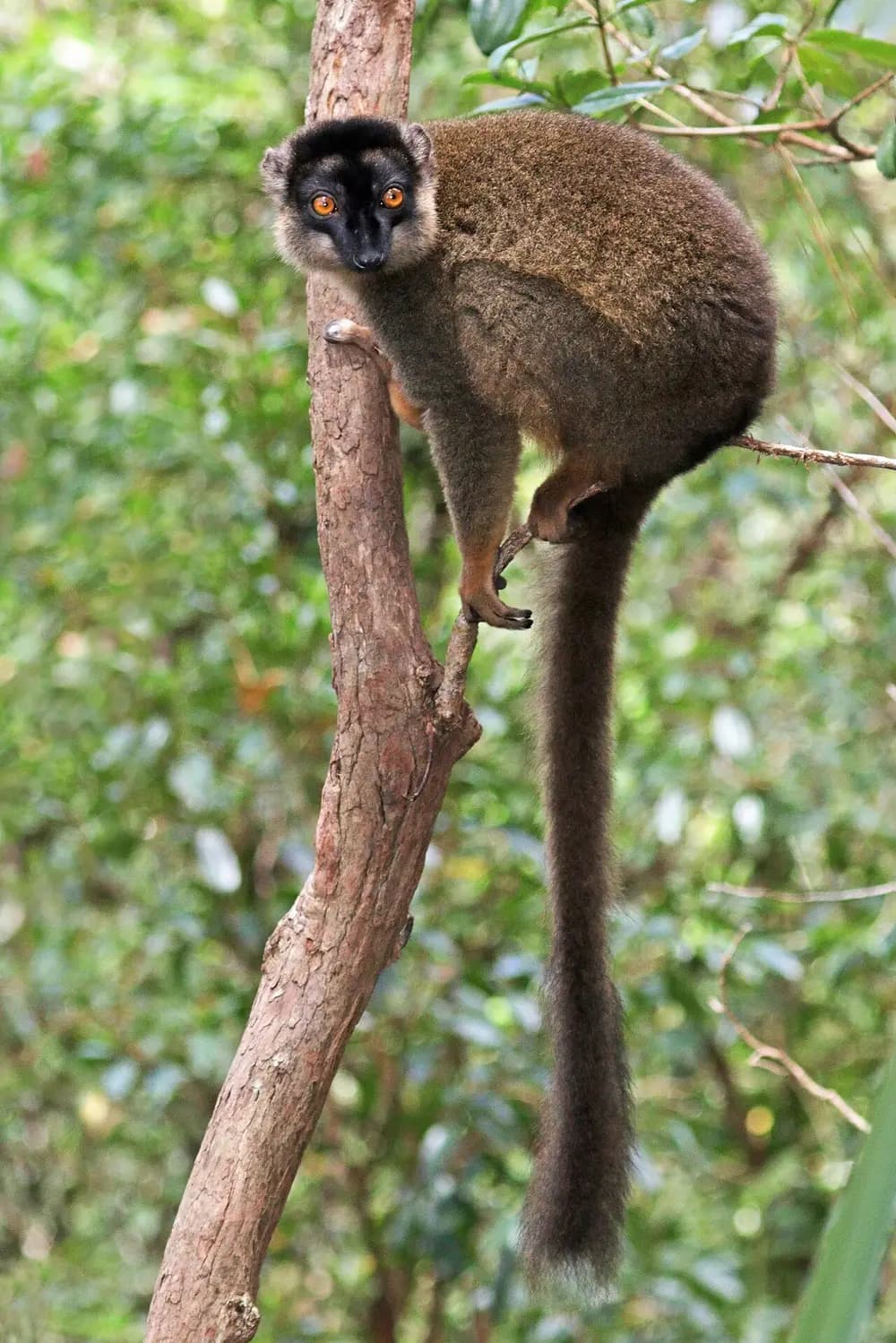
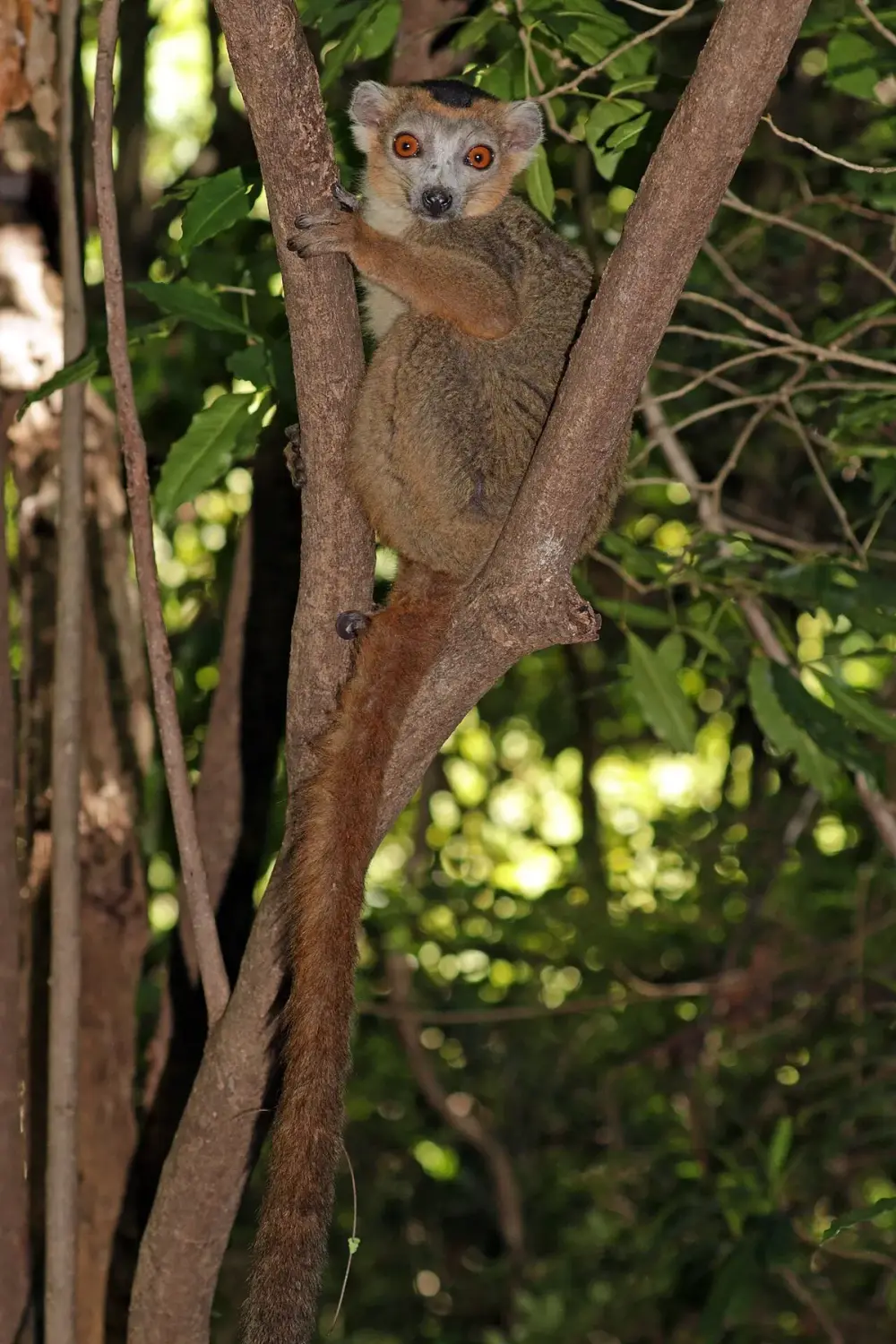
- Where to see one
- 7 U.S. zoos in our directory hold mongoose lemur, confirmed against each zoo's own animal list.
- Native range
- Northwest Madagascar; also the Comoro Islands of Mohéli and Anjouan, where it was introduced
- Size
- Head and body 30–46 cm (12–18 in), tail 41–64 cm (16–25 in); 2–3 kg (4.4–6.6 lb)
- Lifespan
- 18–20 years in the wild, up to 26 years in captivity
- Gestation
- About 128 days (roughly four months)
- Group size
- Usually a bonded pair with one to three offspring
Conservation status
Critically Endangeredassessed 2020
IUCN Red List category CR — step 5 of 7.
The mongoose lemur is a small, arboreal primate with a pointed face, long bushy tail, dark-brown upper parts and a pale belly. It lives in dry deciduous forests on Madagascar and in the humid forests of the Comoros, where it was introduced, making it one of only two lemurs found outside Madagascar. Small family groups, usually a bonded pair with one to three offspring, feed mainly on fruit, plus flowers, leaves and nectar, acting as pollinators and seed dispersers. Unusually among primates, it is active by day or by night depending on the season, shifting to nocturnal habits in the hot dry season.
About the mongoose lemur
The mongoose lemur is a small, tree-dwelling primate in the lemur family, Lemuridae, native to the dry deciduous forests of northwest Madagascar and introduced to the Comoro Islands. It is the smallest member of the genus Eulemur and lives in small family groups that feed mainly on fruit, flowers and nectar.
Its scientific name is Eulemur mongoz. It is one of only two lemur species found outside Madagascar, though its Comoros populations were introduced. The body measures 30 to 46 cm (12–18 in), with a long, bushy tail of 41 to 64 cm (16–25 in), and adults weigh 2 to 3 kg (4.4–6.6 lb). The face is pointed, the upper parts are dark brown to grey, the belly is pale, and the fur is woolly.
Males and females look different, and the beard is the giveaway. Both sexes are born with white beards, but at around six weeks old the males develop red beards and red cheeks. Adult males are grey with red fur on the sides of the body and face, and they have lighter faces than females. Females are a darker grey with white fur on the sides of the body and face. Males sometimes develop a bald patch on top of the head from rubbing while scent-marking territory.
Like other lemurs, mongoose lemurs have binocular vision. Their noses have a rhinarium, a projection that aids scent communication.
Behavior and diet
Diet
Mainly fruit, plus flowers, leaves and nectar; occasionally grubs and beetles
The mongoose lemur's daily schedule changes with the seasons, which is unusual among primates. In the wet season it is mostly active during the day. In the hotter dry season it shifts its activity to the night. The pattern also varies from one population to another, so the animal is best described as both diurnal and nocturnal, depending on the time of year.
Fruit is the main food. Flowers, leaves and nectar make up much of the rest, and grubs and beetles have been seen eaten too. In parts of the range the nectar of the non-native kapok tree, Ceiba pentandra, can make up nearly 80 percent of the diet during the dry season. By eating fruit and visiting flowers, mongoose lemurs act as both seed dispersers and pollinators. Infants start tasting solid food at about five weeks old, around the time they take their first steps, sampling whatever the adults are eating.
Mongoose lemurs live in the trees and can leap several meters from one tree to the next. A typical group has three or four members: a bonded adult pair and one to three offspring. Females are generally dominant over males and get first choice of food and mates. Groups keep small home ranges, mark them with scent and calls, and rarely meet one another, but encounters between groups are aggressive. Grooming holds the group together.
In some areas, mongoose lemurs appear to form stable, monogamous pair bonds; elsewhere they may be polygynous, as other members of the genus are. Communication is varied. They use facial expressions and body postures, vocalizations (especially when marking territory), scent marks, and touch, including grooming, play and the occasional scuffle. Both sexes reach sexual maturity at about two years of age.
Breeding is strictly seasonal. Females come into estrus for about a month between April and June, and young are born from August to October, just before the rainy season. Gestation lasts about 128 days. A single infant is the norm, though twins are not rare, and newborns weigh about 60 to 70 g (2.1–2.5 oz). Weaning comes at around 135 days. Offspring usually stay with their parents until about three years of age, and both sexes leave the group once mature, at about 2.5 to 3.5 years.
Wild mongoose lemurs live 18 to 20 years, and captive ones up to 26 years. Some relatives in the genus have lived even longer in captivity: Eulemur fulvus has reached 36 years, and a hybrid of E. fulvus and Eulemur macaco lived to 39.
Predation has not been well documented, but the fossa and birds of prey are likely predators.
Range and habitat
Habitat
Dry deciduous forest in Madagascar, humid forest in the Comoros
In Madagascar, the mongoose lemur lives in the northwest of the island, in dry forests dominated by deciduous trees. On the Comoro Islands of Mohéli and Anjouan, it lives in more humid forest. The Comoros populations are introduced, but they may matter for the species' future, since numbers there have been increasing.
In both places it is an arboreal animal, living in the trees.
Conservation status
The mongoose lemur is listed as Critically Endangered on the IUCN Red List (2020). Its numbers have fallen by about 80 percent over a period of 25 years. The species is also listed on CITES Appendix I.
The main threats are the destruction and fragmentation of its forests and hunting. Land in its range is being cleared for charcoal production and farmland. Mongoose lemurs are hunted for food and trapped for the pet trade, and some are killed because people believe they raid crops. Killing lemurs has been illegal since 1974, but many local people are unaware of the law.
The outlook is worse in Madagascar than in the Comoros, where the introduced population has been growing and could offer a route to conserving the species.
Where to see mongoose lemur in the U.S.
7 zoos across 5 states
Find the closest one
Rank the 6 zoos holding mongoose lemur by how far they are from you. Your location is used in your browser to sort this list and is never sent to us.
1 more zoo holds mongoose lemur but has no coordinates on file yet, so it isn't ranked here. It's in the full list below.
California· 1
Florida· 3
Missouri· 1
North Carolina· 1
Pennsylvania· 1
AZAThe Association of Zoos and Aquariums. Accredited members have passed an independent inspection of animal care and welfare, safety, conservation and education, repeated every five years. Many smaller facilities never apply, so “not accredited” isn't a verdict on its own. What accreditation means · How we check this
Built from each zoo's own published animal list.
Mongoose Lemur: common questions
Is the mongoose lemur endangered?
Yes. It is listed as Critically Endangered after a decline of about 80 percent over 25 years, driven by forest loss and hunting.
How big is a mongoose lemur?
The body is 30–46 cm (12–18 in) long with a 41–64 cm (16–25 in) tail, and adults weigh 2–3 kg (4.4–6.6 lb). It is the smallest species in its genus.
What do mongoose lemurs eat?
Mainly fruit, along with flowers, leaves and nectar. In the dry season, kapok nectar can make up nearly 80 percent of the diet in some areas.
How long do mongoose lemurs live?
About 18–20 years in the wild and up to 26 years in captivity.
How can you tell male and female mongoose lemurs apart?
By the beard. Males develop red beards and red cheeks at about six weeks old, while females keep white beards and white fur on the sides of the face.
Are mongoose lemurs nocturnal?
Sometimes. They are mostly active by day in the wet season and switch to night activity in the hotter dry season.
Where do mongoose lemurs live?
In dry deciduous forests of northwest Madagascar and in humid forests on the Comoro Islands of Mohéli and Anjouan, where they were introduced.
How are mongoose lemurs related to other lemurs?
They belong to the genus Eulemur, in the lemur family Lemuridae, and are the smallest of its species. The [brown lemur](/animals/brown-lemur/), Eulemur fulvus, is in the same genus. For the wider group, see [lemurs](/animals/lemur/).