
Bats in U.S. zoos
Bats are the mammal order Chiroptera and the only mammals capable of true, sustained flight, on wings made of skin stretched between long finger bones. With at least 1,500 known species, about a fifth of all mammals, they are second only to rodents. Many eat insects, others fruit or nectar, and vampire bats feed on blood.
Most widely held
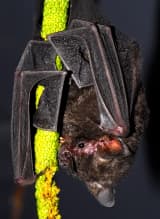 Seba's Short-tailed BatCarollia perspicillataAt 11 zoos · Least Concern
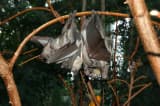 Straw-colored Fruit BatEidolon helvumAt 10 zoos · Near Threatened
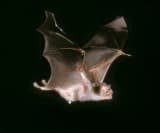 Vampire BatDesmodus rotundusAt 8 zoos · Least Concern
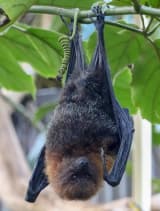 Rodrigues Flying FoxPteropus rodricensisAt 6 zoos · Endangered
What makes a bat
Bats fly on a thin membrane, the patagium, stretched over long, spread-out finger bones, and they are more agile in the air than most birds. When they are not flying, they hang upside down by their feet. Tendons hold the grip without effort, and most species are nocturnal, roosting by day in caves or other refuges.
Fruit bats and echolocators
Bats were traditionally split into megabats and microbats. Microbats use echolocation to navigate and hunt. Megabats, the fruit bats and flying foxes, mostly do not and rely on good eyesight, and their long snouts and ears give them a fox-like look. Not every megabat is larger than every microbat, and newer genetic work has reorganized the two groups.
The Rodrigues flying fox, from a single Indian Ocean island, roosts by day in camps that historically held more than 500 bats and feeds on fruit at night. The straw-colored fruit bat of sub-Saharan Africa finds food by sight and smell, and each year as many as 10 million gather in Zambia's Kasanka National Park, described as the largest mammal migration on the planet.
Small bats with big skills
Seba's short-tailed bat of Central and South America is a small, common leaf-nosed bat. It eats mostly fruit, but its echolocation calls form some of the most tightly focused sonar beams known in any bat. When fruit is scarce it turns to nectar and pollen, which may make it a pollinator.
The vampire bat of Mexico, Central and South America is one of the few bats that feeds on blood. It finds sleeping animals with echolocation, smell, hearing and eyesight, uses heat sensors in its nose to locate blood vessels, and can walk and hop on the ground. It has only 18 teeth, the fewest of any bat, while some small insect-eating bats have 38.
Conservation picture
Bats matter to ecosystems as pollinators, seed dispersers and insect controllers. The Rodrigues flying fox is listed as Endangered by the IUCN, but a captive breeding program established colonies around the world, and by 2017 its population trend was increasing. That kind of insurance population is one of the ways breeding programs support species with tiny wild ranges. The straw-colored fruit bat is Near Threatened.
Common questions
How many species of bats are there?
There are at least 1,500 known bat species, about 20 percent of all classified mammal species. Only rodents form a larger order of mammals.
What is the largest bat?
The largest bats are the flying foxes, led by the giant golden-crowned flying fox. The smallest is Kitti's hog-nosed bat, one of the smallest mammals alive.
Do all bats use echolocation?
No. Microbats echolocate to navigate and find prey, but megabats, the fruit bats and flying foxes, generally do not and rely on well-developed eyesight instead. Bats of the genus Rousettus are the exception, echolocating with tongue clicks.
Do vampire bats really drink blood?
Yes. The common vampire bat feeds on the blood of vertebrates, mostly mammals and especially livestock. An anticoagulant in its saliva, named draculin, keeps the blood flowing.
Why do bats hang upside down?
Hanging by the feet is how bats roost. Tendons let them hang with no effort, and their light bodies mean blood does not rush to their heads.
Why are bats important?
Bats pollinate flowers, disperse seeds and control insect populations. They are also natural reservoirs of some pathogens, such as rabies.
Sources
Last reviewed