- Where to see one
- 29 U.S. zoos in our directory hold chimpanzee, confirmed against each zoo's own animal list.
- Native range
- Forests and savannas of equatorial Africa
- Size
- Average standing height of 150 cm (4 ft 11 in); males average 40 kg (88 lb), females average 30 kg (66 lb) in the wild
About the chimpanzee
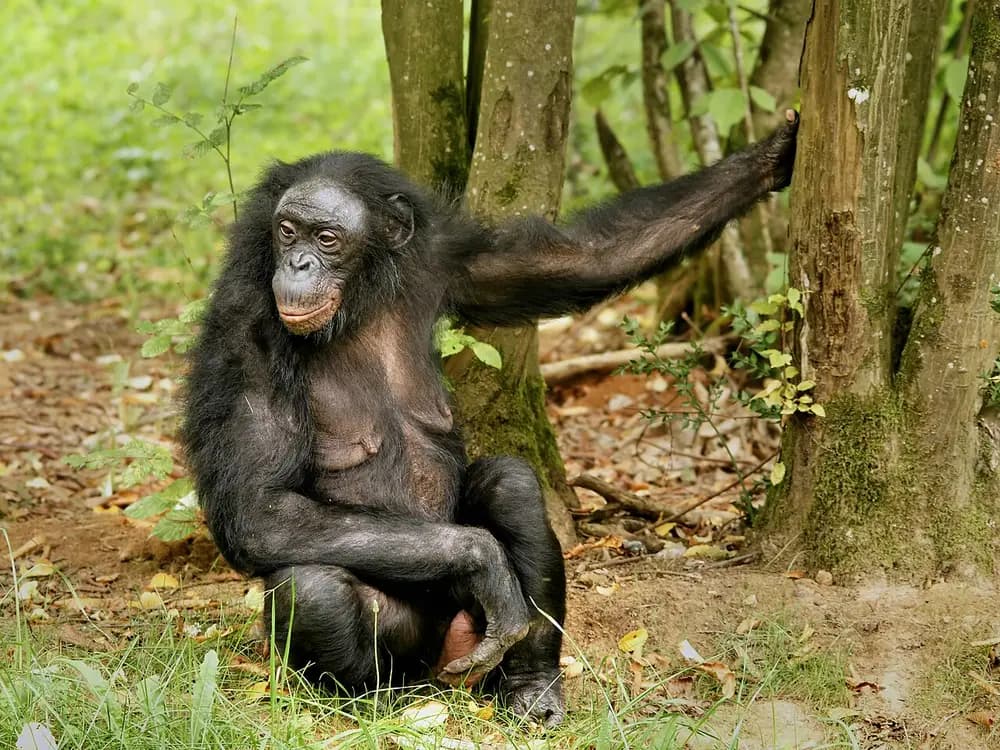
The chimpanzee is a medium-sized great ape found in the forests and savannas of equatorial Africa, with four confirmed subspecies and a fifth proposed. It shares the genus Pan with the bonobo, and evidence from fossils and DNA sequencing shows the two Pan species are humans' closest living relatives. The chimpanzee is bigger and more robust than the bonobo, covered in coarse black hair except on the face, ears, fingers, toes, palms, and soles, which are bare. Hair can also appear in shades of brown or ginger, and chimpanzees lose more of it as they age, sometimes developing bald patches along with white or gray hair.
Adult chimpanzees stand an average of 150 cm (4 ft 11 in). In the wild, males average 40 kg (88 lb) and females 30 kg (66 lb), though individuals in captivity have been recorded standing over 168 cm (5 ft 6 in) upright and weighing up to 136 kg (300 lb). The species has notably long arms — averaging 83 cm (2.72 ft) — relative to its legs, long fingers with short thumbs, flat fingernails, and an opposable big toe that lets it grasp with its feet. A chimpanzee's head is rounded or flattened, with a forward-projecting jaw, a pronounced brow ridge, forward-facing eyes, a small nose, and round, non-lobed ears. Unlike gorillas, chimpanzees lack a prominent sagittal crest and its associated neck and head musculature.
Chimpanzees move both on the ground and in trees. In the trees, they climb vertically and swing using their arms; on the ground, they walk both bipedally and quadrupedally, using a knuckle-walking gait that differs little in energy demand from bipedal movement. Their muscles are about 50 percent stronger per unit of weight than a human's, largely because they carry a higher proportion of fast-twitch muscle fiber, an adaptation suited to climbing and swinging. The chimpanzee brain is around 66 percent smaller than the human brain but contains structures equivalent to Broca's and Wernicke's areas, the regions that process language in humans, even though chimpanzee brain asymmetry favors perceptual and communicative skills rather than the higher cognitive functions favored in human brain asymmetry.
Behavior and diet
Diet
Primarily fruit, plus leaves, seeds, insects, and occasionally other mammals
Chimpanzees live in groups that can number up to 200 members, though individuals typically travel and forage in much smaller parties during the day. The species maintains a strict, male-dominated hierarchy, but disputes within it are generally settled without resorting to violence. Chimpanzees are active during the day: they spend around two hours feeding after waking, spend midday traveling and resting, forage again in the afternoon, then build nests in the trees each evening to sleep in overnight. A given sleeping nest is usually used for just one night, occasionally reused, and chimpanzees may sleep either alone or in groups.
The species is famous for tool use — nearly all studied chimpanzee populations have been recorded modifying sticks, rocks, grass, and leaves and using them to hunt or gather honey, termites, ants, nuts, and water. Some populations have even been observed making sharpened sticks to spear small mammals. Diet centers on fruit: a study in Uganda's Budongo Forest found chimpanzees spend nearly two-thirds of their feeding time on fruit, most of it ripe, alongside leaves, seeds, blossoms, stems, and bark, with the woody material appearing to serve a supplemental or medicinal role rather than functioning purely as backup food. Chimpanzees also eat honey, soil, clay, insects, birds and their eggs, and small to medium-sized mammals, including other primates — most often the Western red colobus when hunting in larger groups.
Gestation lasts eight months. A chimpanzee infant is weaned at around three years old but typically stays close to its mother for years afterward. The main threats chimpanzees face — habitat loss, poaching, and disease — bear directly on how these social and reproductive patterns play out across a shrinking range.
Range and habitat
Habitat
Rainforests, montane forest, swamp forest, savannas, and dry woodlands
Chimpanzees are adaptable, living across rainforests, montane forest, swamp forest, savannas, and dry woodlands throughout equatorial Africa. At Gombe, for instance, they use semideciduous and evergreen forest along with open woodland, while at Bossou they range across forests, savannas, and cultivated land. Four recognized subspecies occupy different parts of this range: the central chimpanzee across Cameroon, the Central African Republic, and neighboring countries; the western chimpanzee in Ivory Coast, Guinea, Liberia, and nearby nations; the Nigeria-Cameroon chimpanzee in forested parts of those two countries; and the eastern chimpanzee across a broad band from the Central African Republic to Tanzania and Zambia. Where their range overlaps with gorillas, the two apes generally avoid direct competition, feeding on somewhat different food sources even when both eat fruit.
Conservation status
The chimpanzee is listed as Endangered (EN) on the IUCN Red List, with an estimated 170,000 to 300,000 individuals remaining across its range. Habitat loss, poaching, and disease are named as the primary threats. Chimpanzees have a long, complicated relationship with people: they've appeared as comic figures in circus acts and stage shows, some have been kept as pets despite their strength and unpredictability making that risky, and hundreds have been used in laboratory research, particularly in the United States, including in efforts to teach the species sign language.
Where to see chimpanzee in the U.S.
29 zoos across 18 states
Find the closest one
Rank the 28 zoos holding chimpanzee by how far they are from you. Your location is used in your browser to sort this list and is never sent to us.
1 more zoo holds chimpanzee but has no coordinates on file yet, so it isn't ranked here. It's in the full list below.
California· 4
Florida· 4
Illinois· 1
Indiana· 1
Kansas· 3
Maryland· 1
Michigan· 1
Mississippi· 1
Missouri· 1
Nebraska· 1
New Mexico· 1
North Carolina· 1
Oklahoma· 2
Oregon· 1
Tennessee· 2
Texas· 2
Virginia· 1
West Virginia· 1
AZAThe Association of Zoos and Aquariums. Accredited members have passed an independent inspection of animal care and welfare, safety, conservation and education, repeated every five years. Many smaller facilities never apply, so “not accredited” isn't a verdict on its own. What accreditation means · How we check this
Built from each zoo's own published animal list.
Chimpanzee: common questions
Is the chimpanzee endangered?
Yes. The IUCN Red List classifies the chimpanzee as Endangered, with an estimated 170,000 to 300,000 individuals left in the wild.
How big does a chimpanzee get?
Adults stand about 150 cm (4 ft 11 in) on average. Wild males weigh around 40 kg (88 lb) and wild females around 30 kg (66 lb), though captive individuals can weigh considerably more.
What does a chimpanzee eat?
Mostly fruit, along with leaves, seeds, blossoms, stems, bark, insects, honey, and occasionally other mammals, including other primates when hunting in larger groups.
Where do chimpanzees live in the wild?
Across equatorial Africa, in habitats ranging from rainforest and swamp forest to savanna and dry woodland.
Which U.S. zoos have chimpanzees?
Our directory lists 16, including the San Diego Zoo, the Saint Louis Zoo, and the Houston Zoo.