- Where to see one
- 29 U.S. zoos in our directory hold golden lion tamarin, confirmed against each zoo's own animal list.
- Native range
- Atlantic coastal forests of Rio de Janeiro state, Brazil
- Size
- About 261 mm (10.3 in) in length, weighing around 620 g (1.37 lb)
Conservation status
IUCN Red List category EN — step 4 of 7.
Endangered (EN), as described in the text
About the golden lion tamarin
The golden lion tamarin, also known less commonly as the golden lion marmoset, is a small New World monkey in the family Callitrichidae. It is endemic to the Atlantic coastal forests of Brazil, with its entire geographic range confined to the state of Rio de Janeiro. A 2022–2023 census estimated about 4,800 individuals living in the species' current primary range in the non-coastal area of the São João and Macaé river basins, with smaller, unknown numbers surviving in limited coastal forest fragments and areas to the west. A captive population of roughly 490 individuals is maintained across 150 zoos worldwide, making this one of the more visible endangered primates in zoo collections.
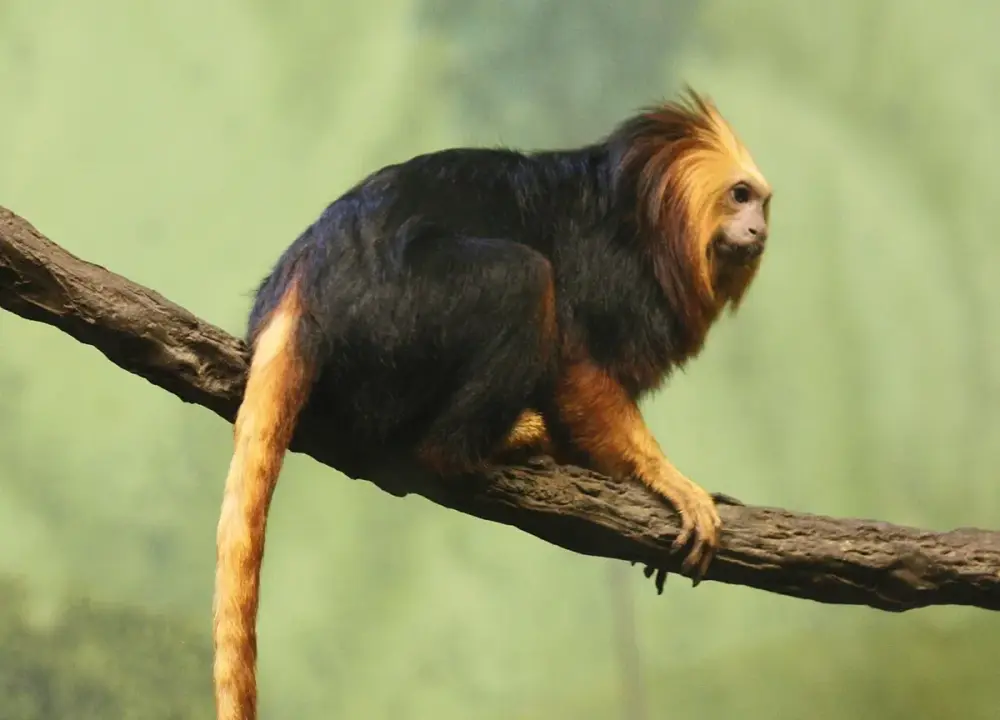
The species gets its name from its bright reddish-orange coat and the extra-long hairs around its face and ears, which form a distinctive mane; its face itself is dark and hairless. Curiously, that vivid orange fur does not owe its color to carotenoids, the pigments that typically produce orange coloring in nature. The golden lion tamarin is the largest of the callitrichid monkeys, at around 261 mm (10.3 in) in length and roughly 620 g (1.37 lb) in weight, with almost no size difference between males and females. Like all callitrichids, it has claw-like nails rather than the flat nails of other monkeys and apes, except on the big toe, which remains flat. On top of branches, golden lion tamarins walk, run, and bound quadrupedally in a distinctive pattern called "transaxial bounding," in which the hind limbs overstride the forelimbs and the feet grip the branch nearly perpendicular to the direction of travel; their claw-like nails also let them cling to and climb vertical tree trunks.
Most of the species' remaining habitat lies in fragments of forest within Rio de Janeiro state, including the Poço das Antas Biological Reserve and the União Biological Reserve, alongside other protected areas and privately owned land. Much of this habitat is dense broadleaf evergreen or seasonal deciduous and semideciduous forest, with tamarins nearer the coast found in a sandy-soil forest type known as "arboreal restinga." Golden lion tamarins mostly occupy low-elevation forest up to about 150 to 300 meters above sea level, though a 1990–1992 survey found groups above 500 meters, and more recent surveys in a newly identified western part of the range have recorded them above 700 meters.
Behavior and diet
Diet
Mostly fruit and small animal prey, plus nectar and tree gum
In the wild, golden lion tamarins eat mostly fruit and small animal prey, supplemented by smaller amounts of nectar and tree gum. Ripe fruit is the plant part consumed for more than 80 percent of the plant species eaten, and the tamarins swallow the seeds of most fruits they eat, making them effective seed dispersers; one multi-group study recorded 160 plant species in their diet, though just seven species accounted for 56 percent of feeding observations. Nectar, most often from the flowers of Symphonia globulifera, typically makes up only 6 to 10 percent of plant feeding, though some groups lean more heavily on it during the cool, dry season. Tree gum makes up an even smaller share, under 2 percent of feeding time, since golden lion tamarins lack the specialized teeth other marmoset genera use for gum-feeding.
Animal prey recorded in the wild diet includes frogs, amphibian egg masses, lizards, snakes, nestling birds and their eggs, snails, spiders, centipedes, grasshoppers, crickets, beetles and their larvae, cockroaches, ants, caterpillars, and insect-infested tree galls, with orthopteran insects such as grasshoppers and crickets the most commonly eaten prey in one study. Much of this prey is hidden in tree bark, rotten wood, tree holes, vine tangles, curled dead leaves, bromeliads, hollow bamboo, or leaf litter, and tamarins capture it through "extractive foraging on embedded foods" — inserting fingers, hands, or even a forearm into these hiding spots and grasping prey by touch. This foraging style, termed "micro-manipulation," accounted for 98 percent of observed prey captures in one study, and lion tamarins have notably longer, narrower hands than other callitrichids, an adaptation likely tied to this technique.
Golden lion tamarins are highly territorial, defending exclusive-use areas within larger home ranges that overlap with neighboring groups; one study found about 60 percent of a group's home range overlapped with neighbors. Territorial encounters involve chases, vocalizations, posturing, and occasionally brief physical contact. Groups spend more than half their time — 13 to 14 hours on average in one study — in overnight sleeping sites, most often natural tree holes, making them active for less than half the day. Confirmed predators include a boa constrictor, plus an ocelot and a feral dog in incidents involving reintroduced zoo-born tamarins. Separately, a sharp rise in predation at Poço das Antas Biological Reserve, most of it occurring overnight near sleeping sites, was strongly suspected to be the work of tayra, and researchers have suggested tree holes may offer better protection from predators than other options, such as bamboo clusters or vine tangles.
Range and habitat
Habitat
Dense broadleaf evergreen and seasonal deciduous forest, including sandy-soil "restinga" forest near the coast
The golden lion tamarin's entire range lies within the Brazilian state of Rio de Janeiro, where most of the original habitat has been lost to deforestation. Surviving populations are now confined to forest fragments, including the Poço das Antas and União Biological Reserves, other protected areas, and private land, largely in dense broadleaf evergreen or seasonal deciduous and semideciduous forest, with a sandy-soil "restinga" forest type used nearer the coast. The species generally occupies low-elevation forest up to 150 to 300 meters, although groups have been recorded above 500 and even 700 meters in more recently surveyed areas.
Population figures trace a striking recovery: estimates from the 1960s and 1970s ranged from only 100 to 600 individuals, and the first range-wide census, in 1990–1992, counted about 560 wild animals plus roughly 100 more from early reintroduction efforts. Since then, reintroduction of zoo-born animals, translocation of wild individuals from small, at-risk forest fragments, reforestation aimed at reconnecting separated habitat, and community-based conservation programs have driven substantial growth, with the most recent 2022–2023 census estimating about 4,800 individuals in the species' primary current range.
Conservation status
The golden lion tamarin is described as an endangered species. Its recovery from a low of a few hundred individuals decades ago to roughly 4,800 today reflects sustained conservation work: reintroducing zoo-born tamarins to the wild, translocating wild individuals out of small and vulnerable forest fragments, reforesting land to reconnect isolated habitat patches, and running community-based conservation and engagement programs. Even so, threats remain. A sharp rise in predation, strongly suspected to be the work of tayra, cut the population at the Poço das Antas Biological Reserve from about 350 to 220 individuals between 1995 and 2000, most of it occurring overnight near sleeping sites. Around 490 tamarins are also held across 150 zoos worldwide as a captive population.
Where to see golden lion tamarin in the U.S.
29 zoos across 21 states
Find the closest one
Rank the 29 zoos holding golden lion tamarin by how far they are from you. Your location is used in your browser to sort this list and is never sent to us.
California· 1
Colorado· 2
Connecticut· 1
District of Columbia· 1
Florida· 2
Georgia· 1
Idaho· 1
Illinois· 1
Indiana· 1
Kansas· 1
Louisiana· 1
Minnesota· 1
New York· 4
Ohio· 1
Pennsylvania· 3
Rhode Island· 1
South Carolina· 1
Texas· 2
Washington· 1
West Virginia· 1
Wisconsin· 1
AZAThe Association of Zoos and Aquariums. Accredited members have passed an independent inspection of animal care and welfare, safety, conservation and education, repeated every five years. Many smaller facilities never apply, so “not accredited” isn't a verdict on its own. What accreditation means · How we check this
Built from each zoo's own published animal list.
Golden Lion Tamarin: common questions
Is the golden lion tamarin endangered?
Yes, it is described as an endangered species, though intensive conservation work has helped its wild population grow to roughly 4,800 individuals.
How big does a golden lion tamarin get?
It measures about 261 mm (10.3 in) in length and weighs around 620 g (1.37 lb), with little difference in size between males and females.
What does a golden lion tamarin eat?
Mostly ripe fruit and small animal prey such as insects, frogs, and lizards, plus smaller amounts of nectar and tree gum.
Where do golden lion tamarins live in the wild?
Only in fragments of Atlantic coastal forest within Brazil's Rio de Janeiro state, mainly in the São João and Macaé river basins.
Which U.S. zoos have golden lion tamarins?
Our directory lists 13 zoos with golden lion tamarins, including Zoo Atlanta, the Houston Zoo, and the Philadelphia Zoo.