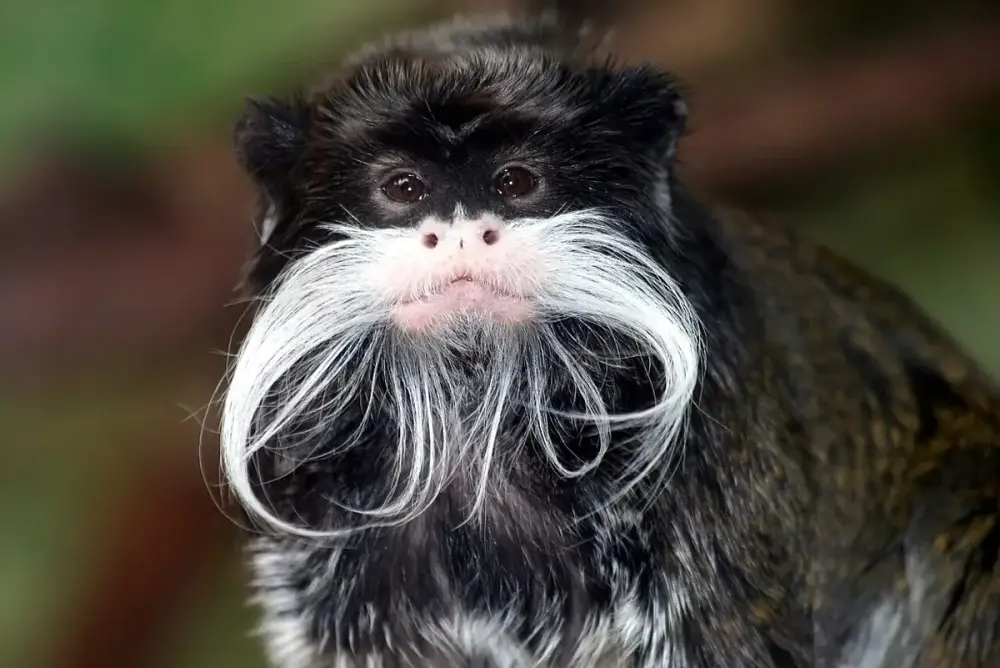
Cotton-top Tamarin
Saguinus oedipus
Also known as Cottontop Tamarin
- Where to see one
- 34 U.S. zoos in our directory hold cotton-top tamarin, confirmed against each zoo's own animal list.
- Native range
- a small area of northwestern Colombia
- Size
- average weight 432 g (15.2 oz); head-body length 20.8–25.9 cm (8.2–10.2 in); tail 33–41 cm (13–16 in)
- Lifespan
- averages 13 years in the wild; up to 24 years in captivity
Conservation status
IUCN Red List category CR — step 5 of 7.
About the cotton-top tamarin
The cotton-top tamarin is a small New World monkey weighing less than 0.5 kg (1.1 lb), which places it among the smallest primates in the world. It is instantly recognizable by the long, white sagittal crest of hair that runs from its forehead back over its shoulders, a feature that in German-speaking areas has earned it the name Lisztaffe, after the wild hairstyle of composer Franz Liszt. The face itself is black skin with fine white hair so sparse it appears almost bare, placing the species among what researchers call the "bare-faced" tamarins.
On average the cotton-top tamarin weighs 432 g (15.2 oz), with a head-and-body length of 20.8 to 25.9 cm (8.2 to 10.2 in) and a non-prehensile tail that runs slightly longer, at 33 to 41 cm (13 to 16 in). Males and females are similar in size, showing no meaningful sexual dimorphism. Like other members of its family, the marmosets and tamarins, it has sharp, claw-like nails called tegulae on most of its digits, which help it grip and move through trees, along with flat nails on its big toes more typical of other primates. Its back is brown, its underparts and limbs whitish-yellow, and its rump, inner thighs, and upper tail reddish-orange, with many individuals showing distinctive stripes or whorls of color on the throat.
The species is found only in a small part of northwestern Colombia, bounded by the Cauca and Magdalena Rivers to the south and east, the Atlantic coast to the north, and the Atrato River to the west. It lives in both primary and secondary forest, favoring the lower levels of the canopy but also foraging on the ground and in the understory. The cotton-top tamarin was first scientifically described by Carl Linnaeus in 1758, and its taxonomy has shifted over the decades; a 2022 study proposed reclassifying it into a new genus, Oedipomidas, though it remains generally known by its long-standing name, Saguinus oedipus.
Behavior and diet
Diet
fruit and animal material, including insects, plant exudates, and nectar
Cotton-top tamarins are diurnal and highly social, living in groups that typically number two to nine individuals but can reach as many as 13. Each group is led by a single dominant breeding pair, generally monogamous, that holds authority over the rest of the group; the dominant female uses pheromones to suppress breeding in other females, delaying their puberty and blocking their reproductive cycles unless an unrelated male joins the group and disrupts the pattern.
Because dominant females often give birth to twins rather than a single infant, raising young is too costly for the breeding pair alone, so the species relies heavily on cooperative breeding: parents, older siblings, and even unrelated adults that have joined the group all share in carrying, feeding, protecting, and grooming the infants. Fathers typically begin carrying newborns on the very day they are born and, in the first five days, spend about as much time on infant care as the mother does. This effort carries a real cost, with some paternal carriers losing 10 to 11% of their body weight over the course of caring for young, likely from reduced time available for foraging.
The diet is split roughly evenly between fruit and animal material, with the latter category covering insects, plant exudates such as gum and sap, nectar, and occasionally reptiles or amphibians. Because of its small body size and fast food passage rate, the species needs food that is both high-quality and high-energy, and it hunts insects using stealth, pouncing, chasing, and searching through leaves and holes. Tamarins also serve as seed dispersers for the tropical ecosystems they inhabit, since they tend to eat and pass smaller seeds that larger primates leave behind. Groups sleep together in trees with heavy foliage cover, leave the sleeping tree about an hour after dawn, and post a lookout while resting to watch for predators, which include raptors, mustelids, felids, and snakes.
Range and habitat
Habitat
tropical forest edges and secondary forests, from humid tropical to tropical dry forest
The cotton-top tamarin exists only in Colombia, within the narrow region between the Cauca and Magdalena Rivers, the Atlantic coast, and the Atrato River. Historically the entire area supported the species, but deforestation has destroyed 98% of its habitat, leaving cotton-top tamarins scattered across fragmented parks and reserves. A key remaining stronghold is Paramillo National Park, which covers 460,000 hectares (about 1,800 square miles) of primary and secondary forest.
Within that range, the species occupies both primary and secondary forest, spanning humid tropical forest in the south to tropical dry forest in the north. It is rarely found above 400 m (1,300 ft) in elevation, though it has been recorded as high as 1,500 m (4,900 ft). Rainfall across its range varies from 500 to 1,300 mm (20 to 51 in) a year, with a dry season from December to April and heavy rains between August and November that can flood the forest floor. The species has shown some ability to adapt to forest fragments and disturbed habitat, which has helped it persist even as the surrounding lowland forest has been reduced.
Conservation status
The cotton-top tamarin is classified as Critically Endangered (CR) and is one of the rarest primates in the world, with an estimated 6,000 individuals remaining in the wild. Habitat destruction is the primary ongoing threat: the lowland forest of northwestern Colombia that the species depends on has been reduced to roughly 5% of its historical area.
The species also carries a legacy of exploitation from the trapping era before international protections took hold. Up to 40,000 cotton-top tamarins are believed to have been captured and exported for biomedical research prior to 1976, when the Convention on International Trade in Endangered Species (CITES) granted the species its highest level of protection and banned all international commercial trade. That trade ban remains in place today, but with so little intact habitat left, ongoing deforestation is now the dominant pressure on the species' survival.
Where to see cotton-top tamarin in the U.S.
34 zoos across 22 states
Find the closest one
Rank the 32 zoos holding cotton-top tamarin by how far they are from you. Your location is used in your browser to sort this list and is never sent to us.
2 more zoos hold cotton-top tamarin but have no coordinates on file yet, so they aren't ranked here. They're in the full list below.
Alabama· 1
Arizona· 1
California· 2
Colorado· 1
District of Columbia· 1
Florida· 6
Idaho· 2
Illinois· 2
Iowa· 1
Kansas· 1
Louisiana· 1
Maryland· 1
Massachusetts· 2
Michigan· 2
Minnesota· 1
Nebraska· 1
New Jersey· 2
New York· 1
Ohio· 1
Tennessee· 2
West Virginia· 1
Wisconsin· 1
AZAThe Association of Zoos and Aquariums. Accredited members have passed an independent inspection of animal care and welfare, safety, conservation and education, repeated every five years. Many smaller facilities never apply, so “not accredited” isn't a verdict on its own. What accreditation means · How we check this
Built from each zoo's own published animal list.
Cotton-top Tamarin: common questions
Is the cotton-top tamarin endangered?
Yes. It is classified as Critically Endangered, with only about 6,000 individuals left in the wild.
How big does a cotton-top tamarin get?
It averages 432 g (15.2 oz) in weight, with a head-body length of 20.8 to 25.9 cm (8.2 to 10.2 in) plus a tail of 33 to 41 cm (13 to 16 in).
What does a cotton-top tamarin eat?
Roughly equal parts fruit and animal material, the latter including insects, plant gum and sap, nectar, and occasionally reptiles or amphibians.
How long do cotton-top tamarins live?
About 13 years on average in the wild, and up to 24 years in captivity.
Where do cotton-top tamarins live in the wild?
Only in a small area of northwestern Colombia, in tropical forest edges and secondary forest between the Cauca, Magdalena, and Atrato Rivers.
Which U.S. zoos have cotton-top tamarins?
Fourteen zoos in the Feather & Fang directory list cotton-top tamarins, including the Phoenix Zoo, Oakland Zoo, and Nashville Zoo at Grassmere.