- Where to see one
- 7 U.S. zoos in our directory hold golden-headed lion tamarin, confirmed against each zoo's own animal list.
- Native range
- Southern Bahia, Brazil
- Size
- Head and body 20–33.6 cm (7.9–13.2 in), tail 31.5–40 cm (12.4–15.7 in); weight 360–710 g (12.7–25 oz)
- Lifespan
- About 21 years in captivity
- Gestation
- 125–132 days
- Group size
- 2 to 11 animals, usually 4 to 7
Conservation status
Endangeredassessed 2008
IUCN Red List category EN — step 4 of 7.
The golden-headed lion tamarin is a small primate found only in lowland and premontane tropical forest fragments in the state of Bahia, Brazil, where it lives at heights of 3 to 10 metres. It prefers mature forest. Groups of 2 to 11 animals, averaging 4 to 7, share the care of young, with all members helping. The diet is wide, taking fruit, flowers, nectar and insects, plus spiders, snails, frogs, lizards, bird eggs and small snakes, which it searches for inside epiphytic bromeliads. Despite its small body, it defends a large home range, and in one study it spent about half its time in just 11% of that area.
About the golden-headed lion tamarin
The golden-headed lion tamarin is a small, mostly black monkey with a thick golden mane, one of four lion tamarin species in the genus Leontopithecus. It belongs to the family that includes marmosets, tamarins and capuchins, and lives only in fragments of Atlantic Forest in the state of Bahia, Brazil.
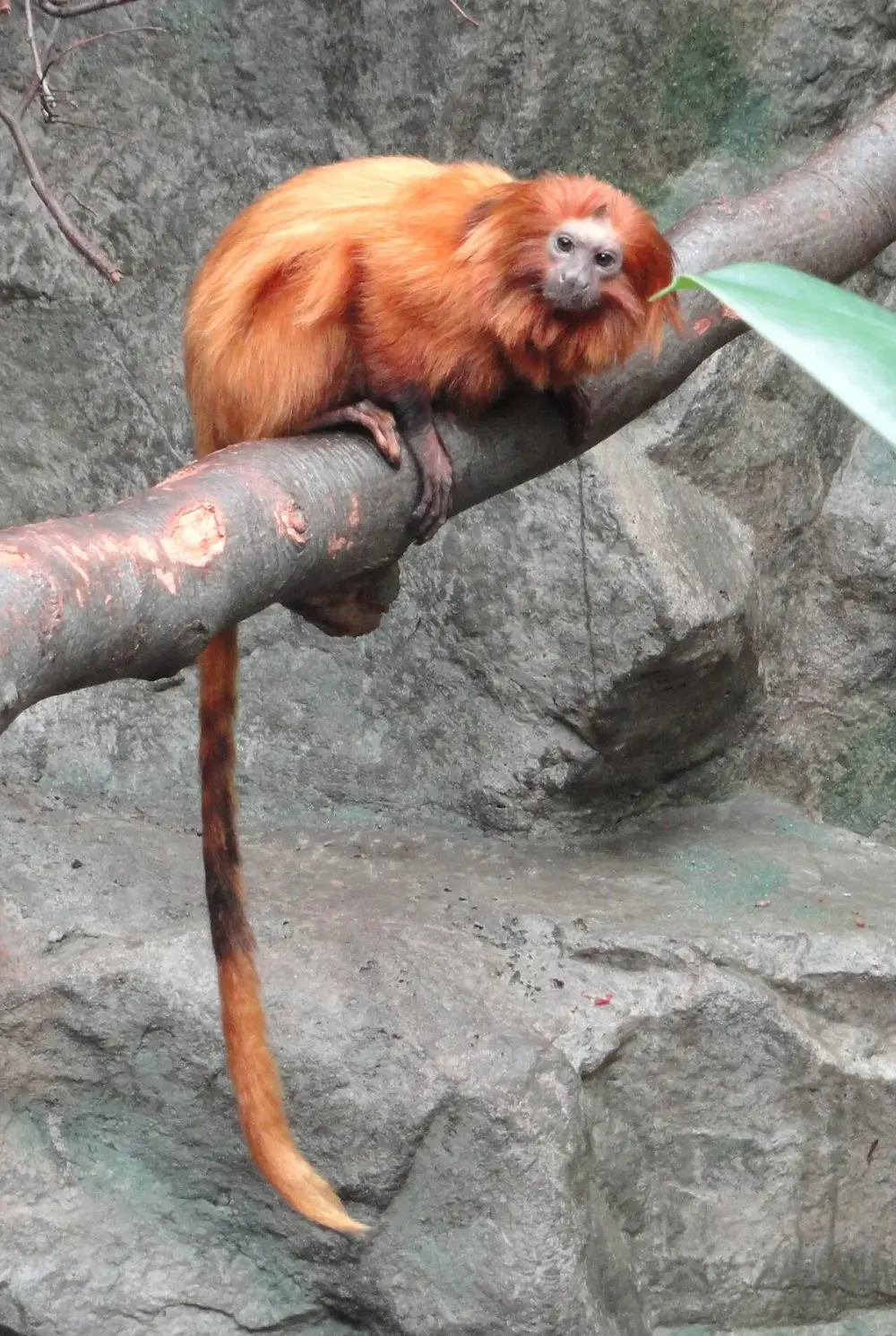
Scientifically it is Leontopithecus chrysomelas, and it is also called simply the golden-headed tamarin. The name describes it well. The coat is mostly black, set off by a thick, long golden mane, which gives the animal its lion-like look. Males and females look very much alike, with little difference in size or color between the sexes.
It is a small primate. The head and body measure 20–33.6 cm (7.9–13.2 in), and the tail is longer still at 31.5–40 cm (12.4–15.7 in). Adults weigh 360–710 g (12.7–25 oz). Like other tamarins, it has a small head and body but relatively large canine teeth.
Its closest relatives are the other three lion tamarins, including the golden lion tamarin, whose rapid decline first drew public attention to the group in the 1960s. More distant cousins in the same family include marmosets, capuchins and the other tamarins, such as the cotton-top tamarin.
Behavior and diet
Diet
Fruit, flowers, nectar, insects, spiders, snails, frogs, lizards, bird eggs and small snakes
Golden-headed lion tamarins are diurnal and almost entirely arboreal. They spend most of their time 3–10 m (10–33 ft) above the forest floor and do not come down even to sleep, bedding down at night in tree holes, tangles of vines or clumps of epiphytes.
They live in small family groups of 2 to 11 animals, most often 4 to 7. A typical group is a breeding pair plus their offspring from earlier litters, though some groups contain two adult males and one female. Mating appears to be monogamous in some groups and polyandrous, one female with more than one male, in others. Parenting is shared: both males and females care for the young, and the whole group helps with juveniles.
The diet is broad. Tamarins eat fruit, flowers, nectar and plant matter, plus insects, insect larvae, spiders, snails, frogs, lizards, bird eggs, small snakes and even small birds. They usually eat fruit shortly after waking, when its sugars give quick energy for the morning's hunting. Prey is found mostly by searching inside epiphytic bromeliads. Where bromeliads are scarce, the monkeys probe tree crevices and holes, the spaces between palm fronds, and leaf litter. They rarely eat tree gum, because their preferred foods are available year-round in a stable rainforest.
For such a small animal, the golden-headed lion tamarin uses a lot of space. Home ranges run from 40 to 320 hectares (about 100 to 790 acres), averaging 123 hectares (304 acres), yet a group may spend about half its time in just 11 percent of that area. Meetings with neighboring groups are rare, but when they happen they are aggressive, with long calls, chases and fights. Adults of the same sex are especially hostile to one another.
The tamarins have a varied vocal repertoire. Trills are used when an animal is on its own, clucks while foraging, long calls when on alert, and whines when two individuals make contact. They also communicate by scent.
Breeding is seasonal, mostly during the warm, wet months from September through March. Gestation lasts 125–132 days. Females mature at about 18 months and males at about 24 months.
Range and habitat
Habitat
Lowland and premontane Atlantic Forest, 3–10 m (10–33 ft) above the ground
The species is found only in Brazil, in the lowland and premontane tropical forest fragments of southern Bahia. Its preferred habitat is mature forest, but habitat destruction means it now also lives in degraded patches.
Much of this region was once cabruca, a traditional system of growing cocoa in the shade of old forest trees. The farmers removed the understory and replaced it with cocoa but left the big trees standing, so the tamarins could still forage and sleep there. Many plantation owners have complained that the tamarins damage their crop. In 1989 a fungus devastated the cocoa harvest, farmers abandoned their plants, and much of the remaining old growth was cut for timber, cattle pasture and other crops.
Conservation status
The golden-headed lion tamarin is listed as Endangered on the IUCN Red List. It was first categorized as Endangered in 1982. Brazil's Atlantic Forest is one of the most endangered ecosystems on Earth, and the forest of Bahia has been reduced to about 2 percent of its original extent by farming, ranching, mining and urban growth. That fragmentation is the main cause of the tamarin's decline. Illegal live capture has added to the pressure: from 1983 to 1994, large numbers were exported to Japan and Belgium for the exotic pet trade, and some were later returned to Brazil.
In 1980 the Brazilian government created the Una Biological Reserve for this species. The reserve has grown slowly as more land is acquired, and its population is the largest one, living in the most intact forest. An older account, drawing on references from the 1980s, put the entire wild population at only about 200 animals. Scientists now believe that around 6,000 golden-headed lion tamarins live in the wild.
All four lion tamarin species are managed through combined programs of research, captive breeding, reintroduction and translocation, habitat restoration and education. Between 1985 and 1991, Brazil's environment agency, IBAMA, set up four international recovery and management committees, one for each species. A landowner education program launched in the early 1990s brought conservation activities to more than 70 percent of farms neighboring the reserve, teaching sustainable agriculture that protects tamarin habitat.
Where to see golden-headed lion tamarin in the U.S.
7 zoos across 7 states
Find the closest one
Rank the 7 zoos holding golden-headed lion tamarin by how far they are from you. Your location is used in your browser to sort this list and is never sent to us.
California· 1
District of Columbia· 1
Florida· 1
Maine· 1
Massachusetts· 1
Ohio· 1
Texas· 1
AZAThe Association of Zoos and Aquariums. Accredited members have passed an independent inspection of animal care and welfare, safety, conservation and education, repeated every five years. Many smaller facilities never apply, so “not accredited” isn't a verdict on its own. What accreditation means · How we check this
Built from each zoo's own published animal list.
Golden-headed Lion Tamarin: common questions
Is the golden-headed lion tamarin endangered?
Yes. It is listed as Endangered, a category it was first given in 1982, mainly because its Atlantic Forest home in Bahia, Brazil, has been almost entirely cleared and fragmented.
How big is a golden-headed lion tamarin?
Small. The head and body measure 20–33.6 cm (7.9–13.2 in), the tail adds 31.5–40 cm (12.4–15.7 in), and adults weigh 360–710 g (12.7–25 oz).
What do golden-headed lion tamarins eat?
Fruit, flowers and nectar, plus insects, spiders, snails, frogs, lizards, bird eggs and small snakes. They search for much of their animal prey inside bromeliads.
Where do golden-headed lion tamarins live?
Only in southern Bahia, Brazil, in fragments of lowland and premontane Atlantic Forest, usually 3–10 m (10–33 ft) up in the trees.
How long do golden-headed lion tamarins live?
About 21 years in captivity.
How many golden-headed lion tamarins are left in the wild?
About 6,000, by the estimate scientists give today. The largest population lives in the Una Biological Reserve.
Do golden-headed lion tamarins live in families?
Yes. They live in groups of 2 to 11, usually a breeding pair with their offspring, and every group member helps care for the young.