- Where to see one
- 7 U.S. zoos in our directory hold crowned lemur, confirmed against each zoo's own animal list.
- Native range
- The far northern tip of Madagascar
- Size
- Head and body 31–36 cm (12–14 in); tail 42–51 cm (17–20 in); about 2 kg (4.4 lb)
- Lifespan
- About 20 years
- Gestation
- About 125 days; one or two young
- Group size
- 5 to 15, usually 5 or 6
Conservation status
Endangeredassessed 2020
IUCN Red List category EN — step 4 of 7.
Endangered (EN); CITES Appendix I
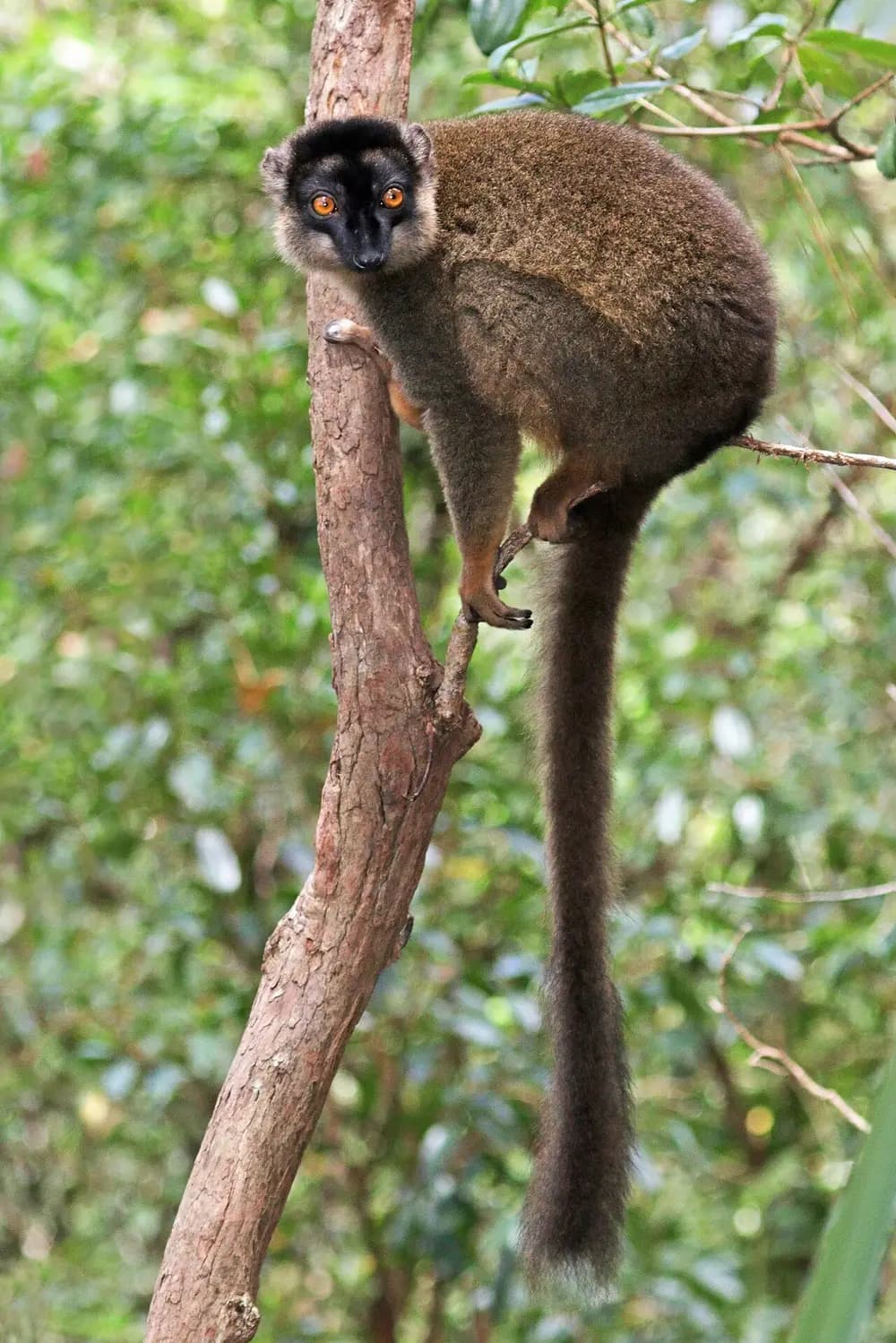
The crowned lemur is a lemur endemic to the dry deciduous forests of the northern tip of Madagascar, with populations in the Ankarana Special Reserve, Montagne d'Ambre National Park and the Andrafiamena forest. It is named for the brown-orange crown on its head. Females have a gray body with an orange crown, while males are a darker reddish brown crowned with black and orange. It eats mostly flowers, fruit and leaves, and lives in closely knit, female-led social groups. Mainly active by day, it also feeds at night. Its long, non-prehensile tail is used for balance when jumping between branches and for communication.
About the crowned lemur
The crowned lemur is a small, fruit-eating primate found only at the northern tip of Madagascar. It is one of the true lemurs in the genus Eulemur, a relative of the brown lemur and the mongoose lemur, and is named for the orange, crown-shaped patch of fur on its head.
It is about the size of a small house cat. Head and body measure 31–36 cm (12–14 in), the tail adds another 42–51 cm (17–20 in), and adults weigh about 2 kg (4.4 lb). The long tail can't grip branches. Instead, it works as a counterweight for balance when the lemur jumps from branch to branch, and it is also used in communication. In both sexes the tail darkens toward the tip.
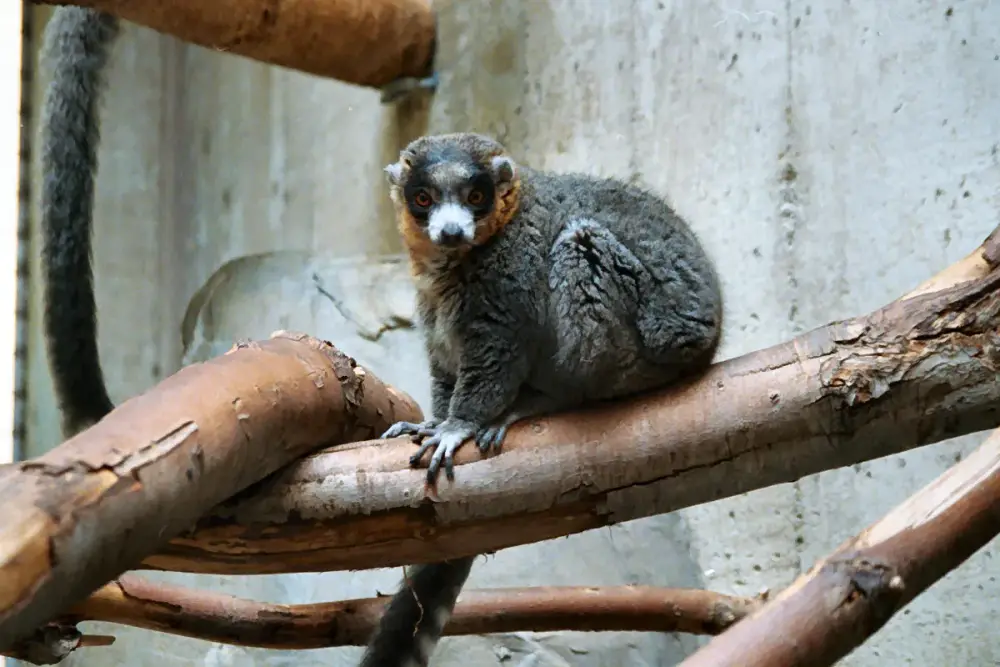
The two sexes look different. Males are a darker reddish brown to brownish gray, with dark tails, gray faces, black noses and a crown of black and orange. Females are lighter and grayer, with white bellies and an orange crown. The difference is subtle enough that it is called "slight" sexual dimorphism, and males are not larger than females.
Like other members of the family Lemuridae, Eulemur coronatus has long, slender limbs, a slightly long snout and a fairly small brain. Its lower incisors and canines, six teeth in all, form a "tooth comb" used in grooming, a feature shared by all lemurs. It also has binocular vision and thumbs that can be partly opposed. Crowned lemurs were once treated as a subspecies of the mongoose lemur, but they are now recognized as a separate species with a range of their own.
Behavior and diet
Diet
Mostly fruit, plus leaves, flowers, pollen and occasional insects
Crowned lemurs are mainly diurnal, active from sunrise to sunset, though they often rest through midday for up to four hours. They also have bouts of feeding at night, and groups travel after dark.
They live in social groups of 5 to 15, most often 5 or 6, with several adults of each sex. Groups may be smaller in more humid places such as Montagne d'Ambre. Foraging often happens in smaller subgroups, which keep in touch with special calls, and encounters between separate groups are rare.
Females run the group. They are dominant over males, which gives them first choice of food and of mates. Grooming builds and maintains social bonds, and the lemurs also communicate with scent marking, body postures, facial expressions and calls.
What crowned lemurs eat
Fruit is the main food. Crowned lemurs spend most of their time above the ground in the trees but will climb down to collect fallen fruit. They also eat flowers and leaves, with leaves turning up in the wet season, and now and then pollen and insects. In the dry season they search out waterholes, often hidden deep inside caves, to drink. Because they eat so much fruit, they may be important seed dispersers, and their feeding on flowers may help pollinate plants.
Crossing the tsingy
In the Ankarana Reserve, crowned lemurs do something no other lemur there is known to do. Each morning they cross the tsingy, a field of eroded, razor-sharp limestone pinnacles, on their way out to feed in the forest. Just before sunset they cross back to the safer forest growing in the canyons in the middle of the rock fields, where they spend the night.
Reproduction
Mating takes place in late May and June. After a gestation of about 125 days, births come between mid-September and October, often timed with the first rains. Births tend to come earlier in wetter, richer areas and later in drier forests where fruit is scarce. Single babies and twins are about equally common.
For the first three weeks the infant clings to its mother's belly, later riding on her back as well. Females nurse their young until they are five to six months old, and no role for males in raising young has been documented. Crowned lemurs reach sexual maturity at about 20 months and can breed every year. They live about 20 years, and members of the genus have reached 36 years in captivity.
Predators
The predators listed for the species are all birds: Madagascar fish eagles, Frances's sparrowhawks, Madagascar kestrels, Madagascar banded kestrels, Madagascar scops owls and pied crows. Ground predators such as the fossa are also thought likely to hunt them.
Range and habitat
Habitat
Dry deciduous forest and mid-altitude rainforest, from sea level to 1,400 m (4,600 ft)
The crowned lemur lives only in northern Madagascar. Its range runs from Cap d'Ambre, the island's northernmost point, south to the Mahavavy River on the west and reaches east to the Manambato River north of Sambava. Like all lemurs, it is found nowhere else in the world.
Within that small area it uses tropical dry forest, as in the Ankarana Reserve, and mid-altitude rainforest on Montagne d'Ambre, from sea level up to 1,400 m (4,600 ft). On the slopes of Montagne d'Ambre it becomes scarcer at higher elevations, possibly because of the greater humidity there. In Ankarana it is found more often in the canopy forest than along edges or in degraded forest. Most of the population lives in the Ankarana Special Reserve, with others in Montagne d'Ambre National Park and the forest of Andrafiamena.
Crowned lemur vs Sanford's brown lemur
The crowned lemur shares its forests with Sanford's brown lemur (Eulemur sanfordi), and the two can be found in the same trees. They can be told apart by coat color and head markings.
| Feature | Crowned lemur | Sanford's brown lemur |
|---|---|---|
| Scientific name | Eulemur coronatus | Eulemur sanfordi |
| Head marking | Orange V-shaped crown on the forehead | No crown |
| Body color | Reddish brown (males) or gray (females) | More gray and brown |
| Male face | Gray face, black nose, no ruff | White ruffs around the ears and cheeks |
Conservation status
The crowned lemur is listed as Endangered on the IUCN Red List, assessed in 2020, and is on CITES Appendix I. It is also listed as Endangered under the U.S. Endangered Species Act. In 2004 the wild population was estimated at between 1,000 and 10,000 animals.
Habitat destruction is the main threat. The species is largely confined to four protected areas: the Forest d'Ambre, Montagne d'Ambre National Park, and the Analamera and Ankarana special reserves. These once formed a continuous band of forest that lemurs could move through, but logging, burning and grazing have broken it into isolated patches. Hunting for meat is increasing, and crowned lemurs are also taken as pets. Conservation work focuses on better management of the four reserves and on education in local communities.
Where to see crowned lemur in the U.S.
7 zoos across 6 states
Find the closest one
Rank the 7 zoos holding crowned lemur by how far they are from you. Your location is used in your browser to sort this list and is never sent to us.
California· 2
Delaware· 1
Florida· 1
Georgia· 1
Michigan· 1
North Carolina· 1
AZAThe Association of Zoos and Aquariums. Accredited members have passed an independent inspection of animal care and welfare, safety, conservation and education, repeated every five years. Many smaller facilities never apply, so “not accredited” isn't a verdict on its own. What accreditation means · How we check this
Built from each zoo's own published animal list.
Crowned Lemur: common questions
What does a crowned lemur look like?
It is a cat-sized lemur with a long, furry tail and an orange crown-shaped patch on its head. Males are reddish brown with a black-and-orange crown, and females are gray with an orange crown.
How big is a crowned lemur?
About 31–36 cm (12–14 in) in head and body, with a 42–51 cm (17–20 in) tail. Adults weigh about 2 kg (4.4 lb).
What do crowned lemurs eat?
Mostly fruit. They also eat leaves, flowers, pollen and the occasional insect, and drink from cave waterholes in the dry season.
Where do crowned lemurs live?
Only at the northern tip of Madagascar, mostly in the Ankarana Special Reserve, Montagne d'Ambre National Park and the forest of Andrafiamena.
Are crowned lemurs endangered?
Yes. They are listed as Endangered, mainly because their forest has been broken into isolated patches by logging, burning and grazing, and hunting is increasing.
How long do crowned lemurs live?
About 20 years. Members of the same genus have lived up to 36 years in captivity.
Do crowned lemurs live in groups?
Yes. Groups usually have 5 or 6 members and can reach 15, and females are dominant over males.