- Where to see one
- 69 U.S. zoos in our directory hold goat, confirmed against each zoo's own animal list.
- Native range
- Domesticated from the wild goat (Capra aegagrus) of Southwest Asia and Eastern Europe
- Size
- 20 to 27 kg (44 to 60 lb) for does of smaller breeds up to more than 140 kg (310 lb) for bucks of larger breeds; miniature breeds stand 41 to 58 cm (16 to 23 in) at the shoulder
- Lifespan
- 15 to 18 years, with one reported case reaching 24
Conservation status
Not Evaluated
This species has not been assessed for the IUCN Red List, so it sits outside the threat scale entirely.
Not Evaluated (NE); domestic animals are not assessed on the IUCN Red List
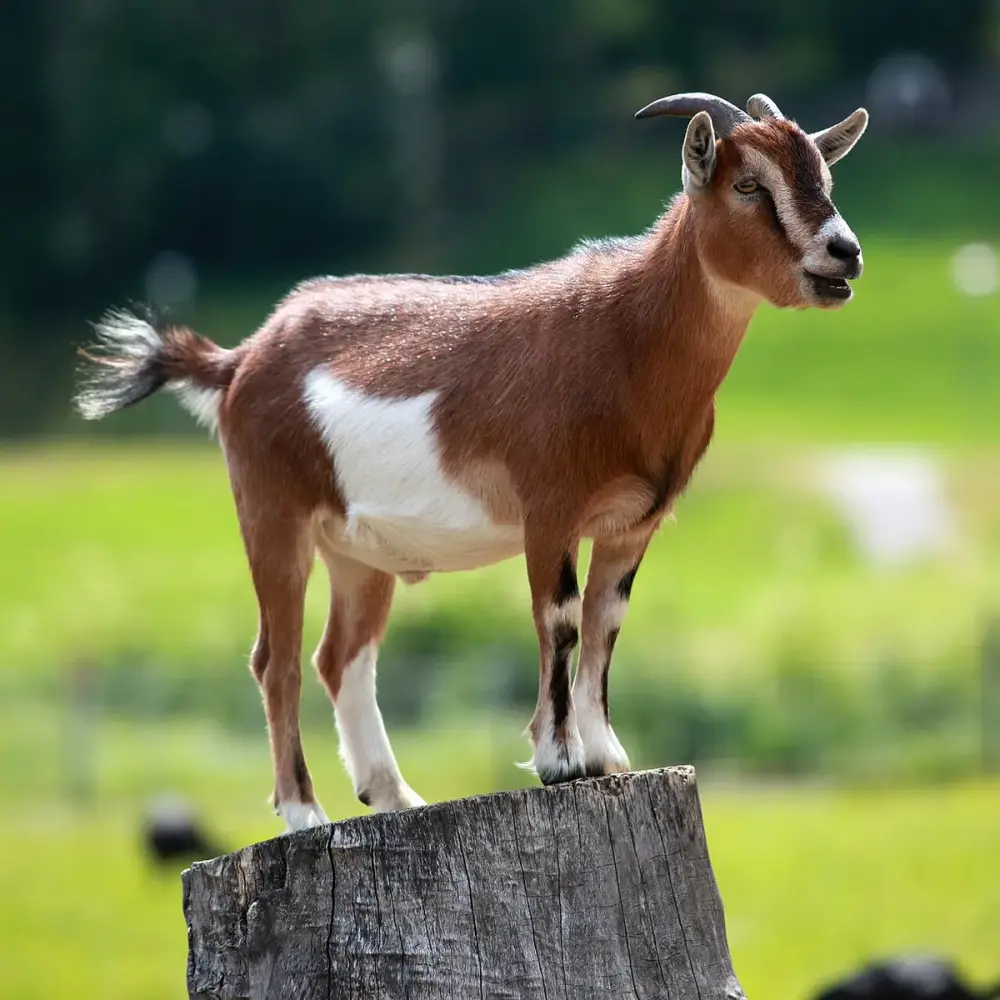
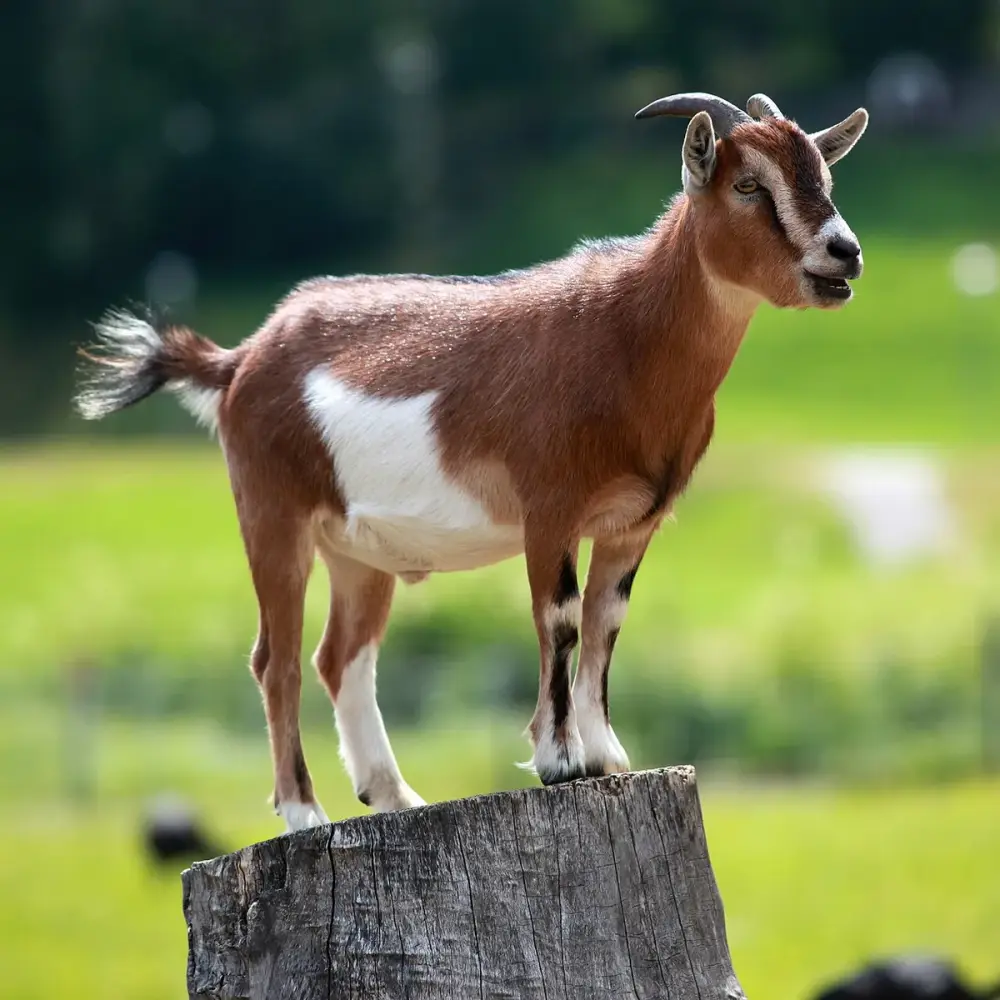
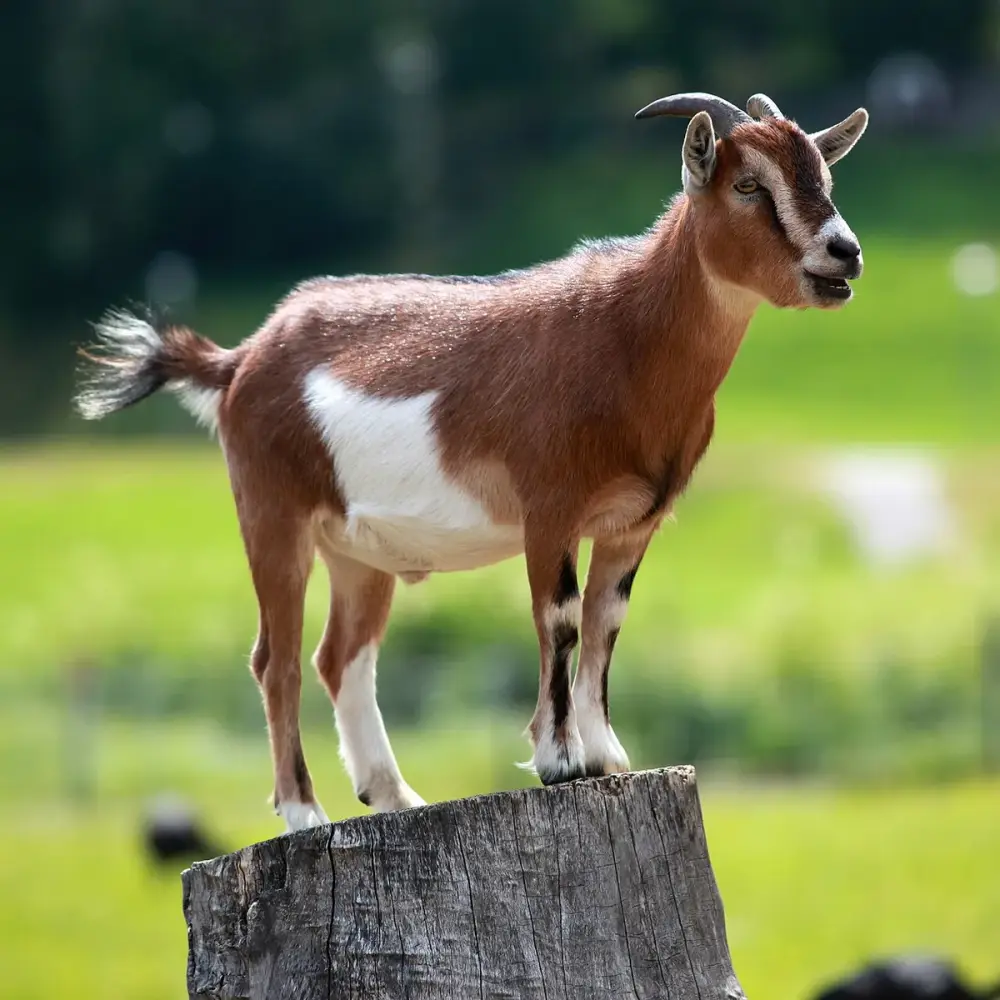
The domestic goat is a goat-antelope kept mostly as livestock, descended from the wild goat of Southwest Asia and Eastern Europe. It belongs to the family Bovidae, is closely related to the sheep, and is a ruminant with a four-chambered stomach. Goats are browsers rather than grazers, and their curiosity leads them to chew on and taste almost anything that resembles plant matter. Agile and surefooted, they balance in precarious places and are notorious for testing fences until they escape. Raised for milk, meat, wool and skins, goats were among the first animals to be domesticated.
About the goat
The goat, or domestic goat, is a species of goat-antelope kept as livestock across nearly every inhabited continent. It belongs to the family Bovidae, which makes it a close relative of sheep, though the two are separate species that rarely interbreed and never produce fertile offspring. Goats were domesticated from the wild goat of Southwest Asia and Eastern Europe, with genetic and archaeological evidence pointing to the bezoar ibex of the Zagros Mountains as the likely ancestor of most domestic goats alive today. The earliest known domesticated goat remains, found at Ganj Dareh in Iran, date to around 10,000 years ago, making the goat one of the very first animals humans brought under their care.
Physically, goats vary enormously by breed. Weight ranges from around 20 to 27 kg (44 to 60 lb) in does of smaller breeds up to more than 140 kg (310 lb) in bucks of larger breeds such as the Boer, with miniature breeds like the African Pygmy standing only 41 to 58 cm (16 to 23 in) at the shoulder as adults. Most goats grow two horns made of living bone wrapped in keratin, used for defense, dominance, territoriality, and regulating body temperature; true polled (hornless) lines are hard to establish because the genes for horns and for sex are closely linked. Both males and females can grow a beard, and many breeds carry a pair of dangling wattles on the neck. Their eyes have horizontal, slit-shaped pupils, giving them a wide field of view for spotting predators, and goats have no tear ducts.
As ruminants, goats digest food through a four-chambered stomach made up of the rumen, reticulum, omasum, and abomasum, the same basic system found in cattle and sheep. Females have an udder with two teats, compared to the four teats of cattle (the Boer goat is a notable exception, sometimes carrying up to eight). Goats are also the only ruminant known to regularly climb trees.
Behavior and diet
Diet
Browser; eats a very wide range of plant matter
Goats are naturally curious and unusually agile, able to climb and balance in places few other livestock would attempt. That curiosity is also why they have a reputation for testing fences and escaping pens: given any weakness in an enclosure, a goat will typically find it. Some studies rank their intelligence on par with dogs, and a 2016 study found that goats look to humans for help when faced with a problem they cannot solve alone. Socially, goats herd more loosely than sheep: when grazing without pressure from a handler, they spread out across a field rather than feeding side by side, and nursing does tend to leave their kids separated rather than clustered together. Goats are also more likely than sheep to turn and face an intruder, and bucks are more prone to charging or butting at people.
As browsers rather than grazers, goats are reputed to eat almost anything, testing cardboard, clothing, and paper along with the plant matter that makes up their real diet. A newborn kid digests milk much like a single-stomached animal, bypassing the rumen entirely until it starts eating solid food, at which point the rumen quickly grows in size and capacity. Breeding season (rut) arrives in fall for bucks of Swiss and northern breeds, marked by a drop in appetite, obsessive interest in does, lip-curling, and scent-marking; equatorial breeds may show only a mild seasonal dip in fertility. Gestation runs about 150 days, most commonly producing twins, with single and triplet births also common. After birthing — called kidding — the doe typically eats the placenta, which supplies nutrients, helps stop bleeding, and, as in wild herbivores such as deer, reduces the scent that could attract predators to the birth site. Milk production, or freshening, generally begins at kidding, with dairy does producing between 680 and 1,810 kg (1,500 to 4,000 lb) of milk over a 305-day lactation.
Range and habitat
Habitat
Kept worldwide as livestock, in systems ranging from open-range herding to penned husbandry
Goats have no single native range today; their story is one of domestication and global spread rather than a wild homeland. The species traces back to the wild goat of Southwest Asia and Eastern Europe, with the bezoar ibex of the Zagros Mountains — once more widespread across Anatolia — considered the probable original ancestor. From that starting point roughly 10,000 years ago, goats moved with people into essentially every region that keeps livestock, from arid pastoral systems in the Middle East and Africa, where they are often run in mixed flocks with sheep, to cut-and-carry systems in Nigeria and parts of Latin America, where the animals are penned and fed cut grasses or maize. Given the chance, goats also readily revert to a feral state, and self-sustaining feral populations exist in Australia, New Zealand, Great Britain, and the Galápagos, sometimes reaching numbers — an estimated 2.6 million in Australia in the mid-1990s — large enough to damage native vegetation where predators or water are scarce.
Conservation status
The domestic goat is Not Evaluated (NE) on the IUCN Red List. Domestic animals aren't assessed on the Red List, which covers wild species, and the goat is far from scarce: in 2022 the world's goat population passed 1.1 billion, with roughly 150 million in India alone.
Goats are hardy animals, but they are prone to respiratory disease, foot rot, internal parasites and pregnancy toxicosis, as well as foot-and-mouth disease. They can also carry diseases that spread to people, such as tuberculosis, brucellosis and Q fever, so good health care protects keepers as well as the herd.
Where to see goat in the U.S.
69 zoos across 29 states
Find the closest one
Rank the 42 zoos holding goat by how far they are from you. Your location is used in your browser to sort this list and is never sent to us.
27 more zoos hold goat but have no coordinates on file yet, so they aren't ranked here. They're in the full list below.
Alabama· 1
Arizona· 3
California· 4
Colorado· 2
Delaware· 2
District of Columbia· 1
Florida· 9
Georgia· 1
Illinois· 3
Iowa· 2
Kansas· 1
Kentucky· 3
Louisiana· 1
Michigan· 3
Minnesota· 2
Montana· 1
New Jersey· 1
New York· 3
North Carolina· 3
Ohio· 1
Pennsylvania· 1
South Carolina· 1
South Dakota· 1
Tennessee· 4
Texas· 2
Virginia· 2
Washington· 1
West Virginia· 1
Wisconsin· 9
- Bear Den Zoo and Petting FarmWaterford$13
- Concord ZooConcordFree
- Doc’s ZooBonduelFree
- FAWN-DOE-ROSA Wildlife Educational ParkSaint Croix Falls—
- Lincoln Park ZooManitowocFree
- Northeastern Wisconsin ZooGreen Bay$14.50AZA
- Ochsner Park ZooBarabooFree
- Wisconsin Deer ParkWisconsin Dells$18
- Wisconsin Rapids Municipal ZooWisconsin RapidsFree
AZAThe Association of Zoos and Aquariums. Accredited members have passed an independent inspection of animal care and welfare, safety, conservation and education, repeated every five years. Many smaller facilities never apply, so “not accredited” isn't a verdict on its own. What accreditation means · How we check this
Built from each zoo's own published animal list.
Goat: common questions
Is the goat endangered?
No. The domestic goat is a widely kept livestock animal, with more than 1.1 billion worldwide in 2022, and domestic animals are not assessed on the IUCN Red List.
How big does a goat get?
It depends heavily on breed: does of smaller breeds weigh around 20 to 27 kg (44 to 60 lb), while bucks of larger breeds such as the Boer can top 140 kg (310 lb), and miniature breeds stand only 41 to 58 cm (16 to 23 in) at the shoulder.
What does a goat eat?
Goats are browsers that will chew on nearly any plant matter, and many will also test nonfood items like cardboard or paper to see if they're edible.
How long do goats live?
Life expectancy is generally 15 to 18 years, though one goat has been reported to reach 24.
Where do goats live in the wild?
Goats have no true wild range of their own; they were domesticated from the wild goat of Southwest Asia and Eastern Europe, likely descending from the bezoar ibex of the Zagros Mountains, and feral populations now exist in places such as Australia, New Zealand, and the Galápagos.
Which U.S. zoos have goats?
Twenty U.S. zoos list goats, including the Cheyenne Mountain Zoo in Colorado Springs, the Houston Zoo, and the Detroit Zoo.