- Where to see one
- 12 U.S. zoos in our directory hold nubian goat, confirmed against each zoo's own animal list.
- Native range
- Descended from the wild goat (Capra aegagrus) of Southwest Asia and Eastern Europe
- Lifespan
- 15 to 18 years, with one reported case of a goat reaching 24
Conservation status
Not Evaluated
This species has not been assessed for the IUCN Red List, so it sits outside the threat scale entirely.
Not Evaluated (NE); domestic animals are not assessed on the IUCN Red List
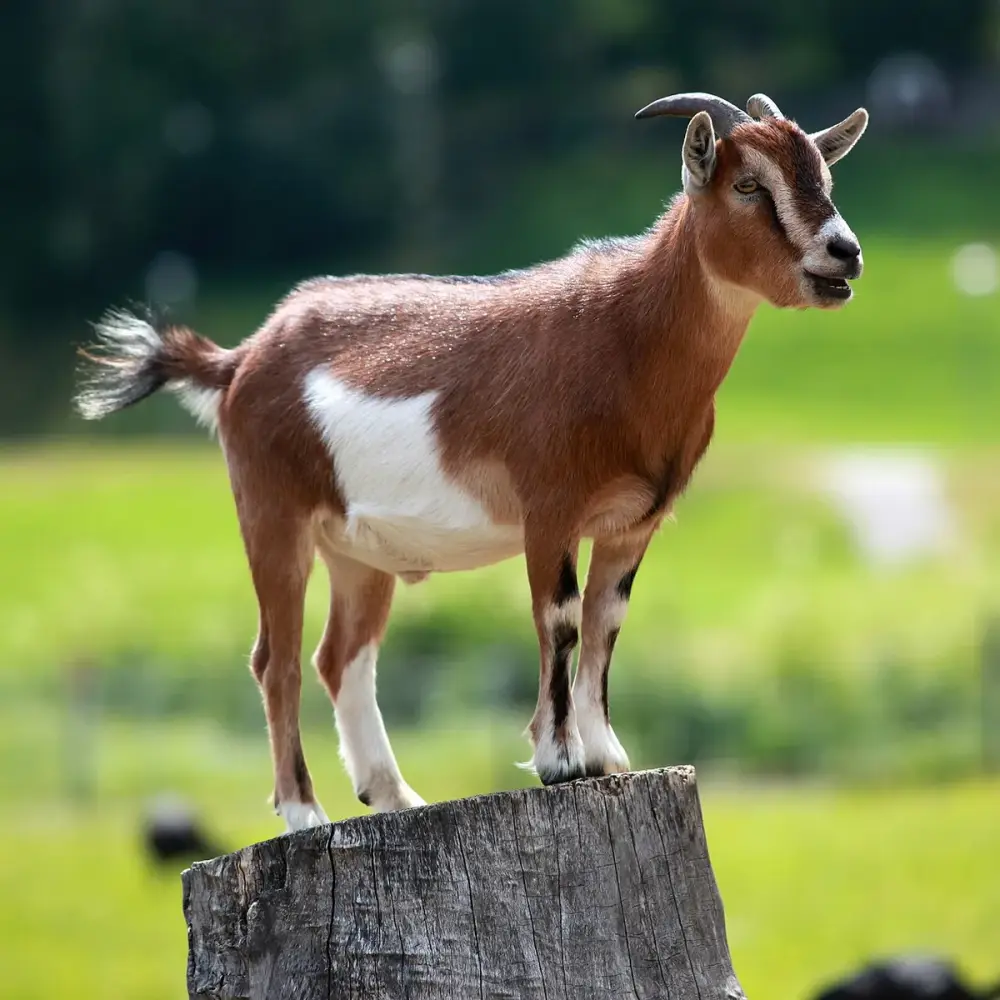
About the Nubian goat
The Nubian goat is a breed of the domestic goat (Capra hircus), a species kept worldwide as livestock and domesticated from the wild goat of Southwest Asia and Eastern Europe. The goat is a member of the family Bovidae and a close relative of the sheep, and was one of the first animals humans ever domesticated — around 10,000 years ago in what is now Iran. Genetic analysis backs up the archaeological record in pointing to the wild bezoar ibex, once widespread across Anatolia and today found in the Zagros Mountains, as the likely ancestor of most domestic goats. The earliest known domesticated goat remains, dated to about 10,000 years before present, come from Ganj Dareh in Iran, with further early evidence from sites such as Jericho, Choga Mami, Djeitun, and Çayönü placing domestication in Western Asia between 8,000 and 9,000 years ago.
Goat size varies enormously by breed: bucks of large breeds such as the Boer can top 310 lb (140 kg), while does of smaller breeds may weigh only 44 to 60 lb (20–27 kg), and miniature breeds like the African Pygmy stand just 16 to 23 in (41–58 cm) at the shoulder as adults. Most goats grow a pair of horns, made of living bone wrapped in keratin, used for defense, dominance, territorial signaling, and regulating body temperature; because the genes for horns and for sex are linked, goats have not been reliably bred to be polled (hornless) the way cattle have. Both sexes may grow beards, and some types — most often dairy goats — may have a dangling wattle on each side of the neck. Their horizontal, slit-shaped pupils give them a wide field of view to watch for predators on either side without being dazzled by overhead sunlight, and unlike humans they have no tear ducts. As ruminants, goats have a four-chambered stomach — the rumen, reticulum, omasum, and abomasum — and, like other ruminants, are even-toed ungulates with two sets of 30 chromosomes.
Behavior and diet
Diet
Browsing herbivore
Goats are notably curious and agile, able to climb and balance in precarious places, which makes them the only ruminant known to climb trees regularly. That same curiosity, paired with a talent for testing fences, gives them a reputation for escaping enclosures whenever a weak point exists; some studies rank their intelligence on par with dogs. As browsers rather than grazers, goats will chew on and taste almost anything resembling plant matter — including cardboard, clothing, and paper — to judge whether it is worth eating. When grazing as a group, goats spread out across a field rather than clustering the way sheep do, and nursing does keep their kids apart ("lying out") instead of grouped together. A 2016 study found that goats look to humans for help when facing an unfamiliar challenge, much as domesticated dogs and horses do.
Goats reach puberty between three and 15 months old, depending on breed and nutrition, though many breeders wait until a doe reaches 70 percent of her adult weight before breeding her. Bucks of Swiss and northern breeds come into rut in fall alongside the does' heat cycles, showing reduced appetite, obsessive interest in does, lip-curling (flehmen), and scent-marking from glands at the base of the horns. Gestation lasts about 150 days, and twins are the most common outcome, though single births, triplets, and occasionally larger litters occur. Just before kidding, a doe typically shows a sunken area near the tail and hip, heavier breathing, restlessness, and increased affection toward her keeper; she often eats the afterbirth, which supplies nutrients, helps stop bleeding, and — as in wild herbivores such as deer — reduces the birth scent that could attract predators. Milk production, or "freshening," usually begins at kidding, and a good dairy doe produces roughly 6 lb (3 kg) of milk a day during a typical 305-day lactation, with dairy breeds overall yielding between 1,500 and 4,000 lb (680–1,810 kg) per lactation.
Range and habitat
Goats were domesticated from the wild goat in Southwest Asia and Eastern Europe and have since spread worldwide as livestock, with more than 1.1 billion goats alive as of 2022, about 150 million of them in India. Husbandry practices vary widely by region: in parts of Africa and the Middle East, goats are commonly run alongside sheep because the two species favor different forage plants, while in Ethiopia four distinct systems exist — goats kept with annual crops, with perennial crops, alongside cattle, or under nomadic pastoral herding in arid areas. In Nigeria and parts of Latin America, some goats roam freely around the homestead while others are penned and fed cut greenery. Goats also readily revert to a feral state when given the chance, and feral populations are established in Australia, New Zealand, Great Britain, the Galápagos, and elsewhere; an estimated 2.6 million feral goats lived in Australia by the mid-1990s, in some places damaging native scrub and trees.
Conservation status
The Nubian goat is Not Evaluated (NE) on the IUCN Red List. Domestic animals aren't assessed on the Red List, and the goat is one of the most widely kept livestock species on Earth. Life expectancy for goats generally runs 15 to 18 years, with one individual reported to have reached 24, though complications during kidding can shorten a doe's life expectancy to 10 or 11 years, and the stress of rut can lower a buck's to 8 to 10 years. Goats are hardy but can be affected by a range of conditions, including pneumonia and other respiratory disease, foot rot, internal parasites, and pregnancy toxicosis, and they can transmit zoonotic diseases such as tuberculosis, brucellosis, Q fever, and rabies to people.
Where to see nubian goat in the U.S.
12 zoos across 11 states
Find the closest one
Rank the 12 zoos holding nubian goat by how far they are from you. Your location is used in your browser to sort this list and is never sent to us.
California· 1
Georgia· 1
Idaho· 1
Illinois· 1
Massachusetts· 2
North Carolina· 1
Ohio· 1
Oklahoma· 1
Rhode Island· 1
South Carolina· 1
Wisconsin· 1
AZAThe Association of Zoos and Aquariums. Accredited members have passed an independent inspection of animal care and welfare, safety, conservation and education, repeated every five years. Many smaller facilities never apply, so “not accredited” isn't a verdict on its own. What accreditation means · How we check this
Built from each zoo's own published animal list.
Nubian Goat: common questions
Is the Nubian goat endangered?
No. The Nubian is a domestic goat breed, and domestic animals are not assessed on the IUCN Red List.
How big does a Nubian goat get?
Size in domestic goats varies by breed, from large bucks over 310 lb (140 kg) down to does of 44 to 60 lb (20–27 kg).
What does a Nubian goat eat?
Goats are browsing herbivores that will sample almost any plant material, and dairy breeds are typically fed to support milk production.
How long do Nubian goats live?
Goats generally live 15 to 18 years, with at least one reported case of a goat reaching 24.
Which U.S. zoos have Nubian goats?
9 U.S. zoos list the Nubian goat, including Zoo Atlanta, the Cincinnati Zoo and Botanical Garden, and Riverbanks Zoo.