- Where to see one
- 37 U.S. zoos in our directory hold nigerian dwarf goat, confirmed against each zoo's own animal list.
- Native range
- A modern American breed developed from West African Dwarf goats imported to the U.S.
- Size
- Average weight about 35 kg (75 lb); maximum height about 60 cm (24 in) for males, slightly less for females
- Lifespan
- 8 to 12 years
Conservation status
Not Evaluated
This species has not been assessed for the IUCN Red List, so it sits outside the threat scale entirely.
Not Evaluated (NE) by the IUCN as a domestic breed; reported as "not at risk" internationally as of 2024
About the Nigerian Dwarf goat
The Nigerian Dwarf is a modern American breed of dwarf goat, developed from goats of the West African Dwarf group that were imported from Africa to the United States between roughly 1930 and 1960 for exhibition in zoos. Like the American Pygmy Goat, which shares the same West African ancestry, the Nigerian Dwarf doesn't resemble the stocky build of its West African forebears — breeders instead shaped it to look like a miniature dairy goat, with the proportions of a much larger dairy breed scaled down.
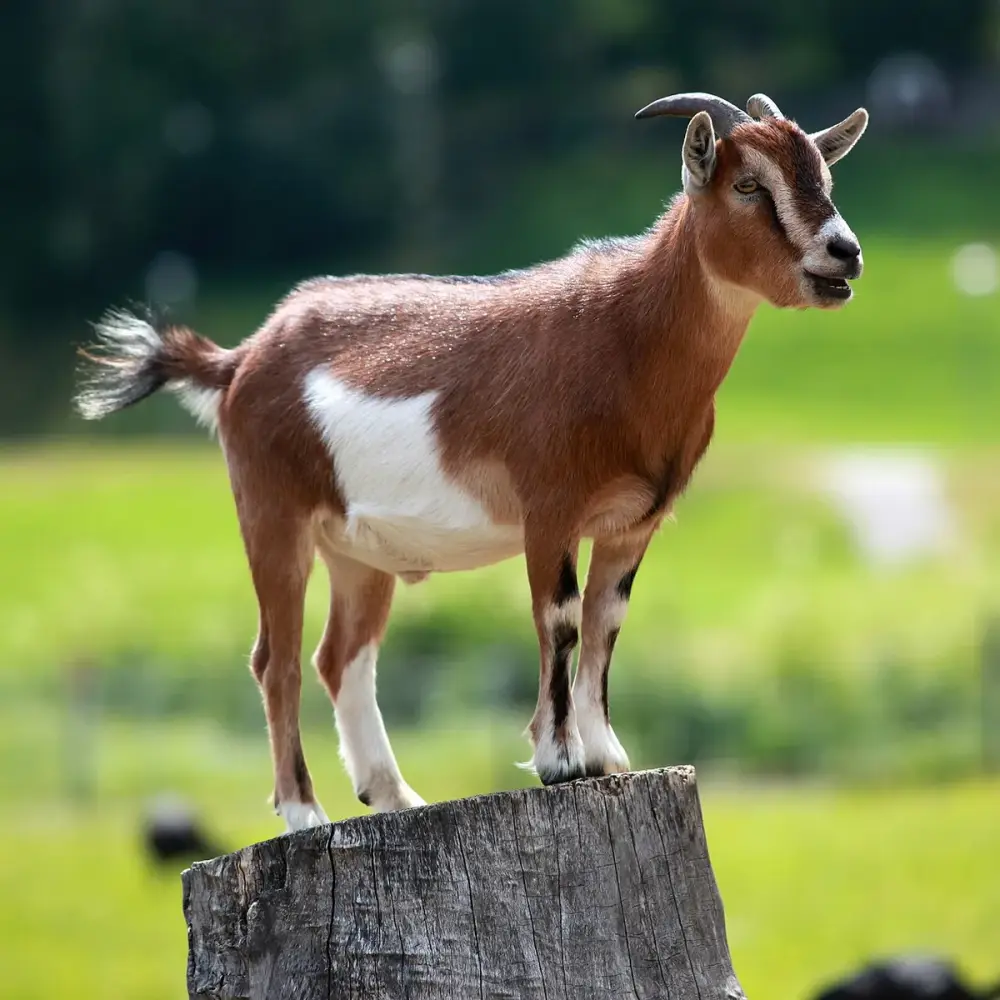
Physically, the Nigerian Dwarf is small but well-proportioned, averaging about 35 kg (75 lb) in weight, with a maximum height around 60 cm (24 in) at the shoulder for males and slightly less for females. It may be horned or naturally hornless, has a fine, fairly short coat that can come in any color or combination of colors — gold, chocolate, and black are common, often with white markings — and its facial profile can be either concave or straight, with upright ears.
The breed is notably precocious: young goats can be bred early, males from around three months of age and females from seven or eight months. Gestation runs 145 to 153 days, and the twinning rate is high, with triplet and even quadruplet births not uncommon.
Behavior and diet
The record doesn't describe the Nigerian Dwarf's day-to-day behavior or social structure in detail. What it does establish is the breed's dual purpose: it was originally developed and selected for show and companionship, with breeders prioritizing appearance and docility, and was only later found to be well suited to small-scale dairy production, after which some breeding lines were selected specifically for dairy traits.
As a dairy animal, the Nigerian Dwarf performs well for its size. Average milk yield for dairy-line stock is about 340 kg (750 lb) per year, though one recorded lactation in 2018 reached 993 kg (2,190 lb) over 305 days — nearly three times the breed average. A typical lactation lasts about ten months. The milk itself is notably rich, averaging 6.5% butterfat and 3.9% protein, qualities that make it well suited to cheesemaking and butter production. Dairy-line animals also tend to run somewhat larger than goats bred purely for show or as companions.
Reproductively, the breed's early maturity and high twinning rate mean a single doe can produce offspring relatively quickly and often in multiples.
Range and habitat
Habitat
Domesticated; kept as show, companion, and dairy stock
The Nigerian Dwarf is a domesticated breed with no wild native range of its own; it was developed entirely within the United States from West African Dwarf stock imported for zoo exhibition in the mid-20th century. A herd-book for the breed was established in 1980, and numbers grew quickly afterward — by 2002, nearly 7,000 animals were registered, and the breed gained formal recognition from the American Dairy Goat Association in 2005.
By 2023, the total Nigerian Dwarf population in the United States stood at just under 40,000, with smaller populations of 1,000 to 2,000 head reported in both Australia and Canada. In the 1990s, the breed also contributed to the creation of the Nigora, a cross between the Nigerian Dwarf and Angora and other mohair breeds developed for fiber production.
Conservation status
As a domestic goat breed, the Nigerian Dwarf is Not Evaluated (NE) on the IUCN Red List, which does not assess domestic animals. The Livestock Conservancy once listed the Nigerian Dwarf on its heritage breeds watchlist under the status "recovering," reflecting a period when the breed's numbers were being rebuilt, but it was removed from that list in 2013 as its population grew. As of 2024, its international conservation status was reported as "not at risk."
The breed's trajectory has been one of increasing security rather than decline: from an initial small founder population in the mid-20th century, through formal registry and dairy-association recognition, to a population approaching 40,000 in the U.S. by 2023.
Where to see nigerian dwarf goat in the U.S.
37 zoos across 26 states
Find the closest one
Rank the 32 zoos holding nigerian dwarf goat by how far they are from you. Your location is used in your browser to sort this list and is never sent to us.
5 more zoos hold nigerian dwarf goat but have no coordinates on file yet, so they aren't ranked here. They're in the full list below.
California· 2
Connecticut· 1
Florida· 3
Georgia· 1
Idaho· 1
Illinois· 1
Indiana· 3
Iowa· 1
Louisiana· 1
Maryland· 2
Massachusetts· 3
Michigan· 1
Minnesota· 1
Mississippi· 1
New York· 1
Ohio· 2
Oklahoma· 1
Oregon· 1
Pennsylvania· 1
Rhode Island· 1
South Dakota· 1
Tennessee· 1
Texas· 2
Virginia· 1
Washington· 1
Wisconsin· 2
AZAThe Association of Zoos and Aquariums. Accredited members have passed an independent inspection of animal care and welfare, safety, conservation and education, repeated every five years. Many smaller facilities never apply, so “not accredited” isn't a verdict on its own. What accreditation means · How we check this
Built from each zoo's own published animal list.
Nigerian Dwarf Goat: common questions
Is the Nigerian Dwarf goat endangered?
No. It was once listed as "recovering" on a heritage breeds watchlist but was removed from that list in 2013, and its international conservation status as of 2024 was reported as "not at risk."
How big does a Nigerian Dwarf goat get?
It averages about 35 kg (75 lb), with a maximum height around 60 cm (24 in) at the shoulder for males and slightly less for females.
How long do Nigerian Dwarf goats live?
Life expectancy is 8 to 12 years.
Where did the Nigerian Dwarf goat come from?
It's a modern American breed, developed from West African Dwarf goats imported to the U.S. for zoo exhibition between about 1930 and 1960, then bred to resemble a miniature dairy goat.
Do Nigerian Dwarf goats produce milk?
Yes. Dairy-line does average about 340 kg (750 lb) of milk a year, with milk that's notably high in butterfat (6.5%) and protein (3.9%), good for cheese and butter.
Which U.S. zoos have Nigerian Dwarf goats?
Twenty-one U.S. zoos list this breed, including the Los Angeles Zoo, Zoo Atlanta, and the Oregon Zoo.