- Where to see one
- 41 U.S. zoos in our directory hold red fox, confirmed against each zoo's own animal list.
- Native range
- North America, Europe, Asia, and parts of North Africa; introduced to Australia
- Size
- 14–20 in (35–50 cm) at the shoulder; body 18–35 in (45–90 cm) long, plus a tail of 11.8–21.9 in (30–55.5 cm); weight 4.9–30.9 lb (2.2–14 kg)
- Lifespan
- About 5 years
About the red fox
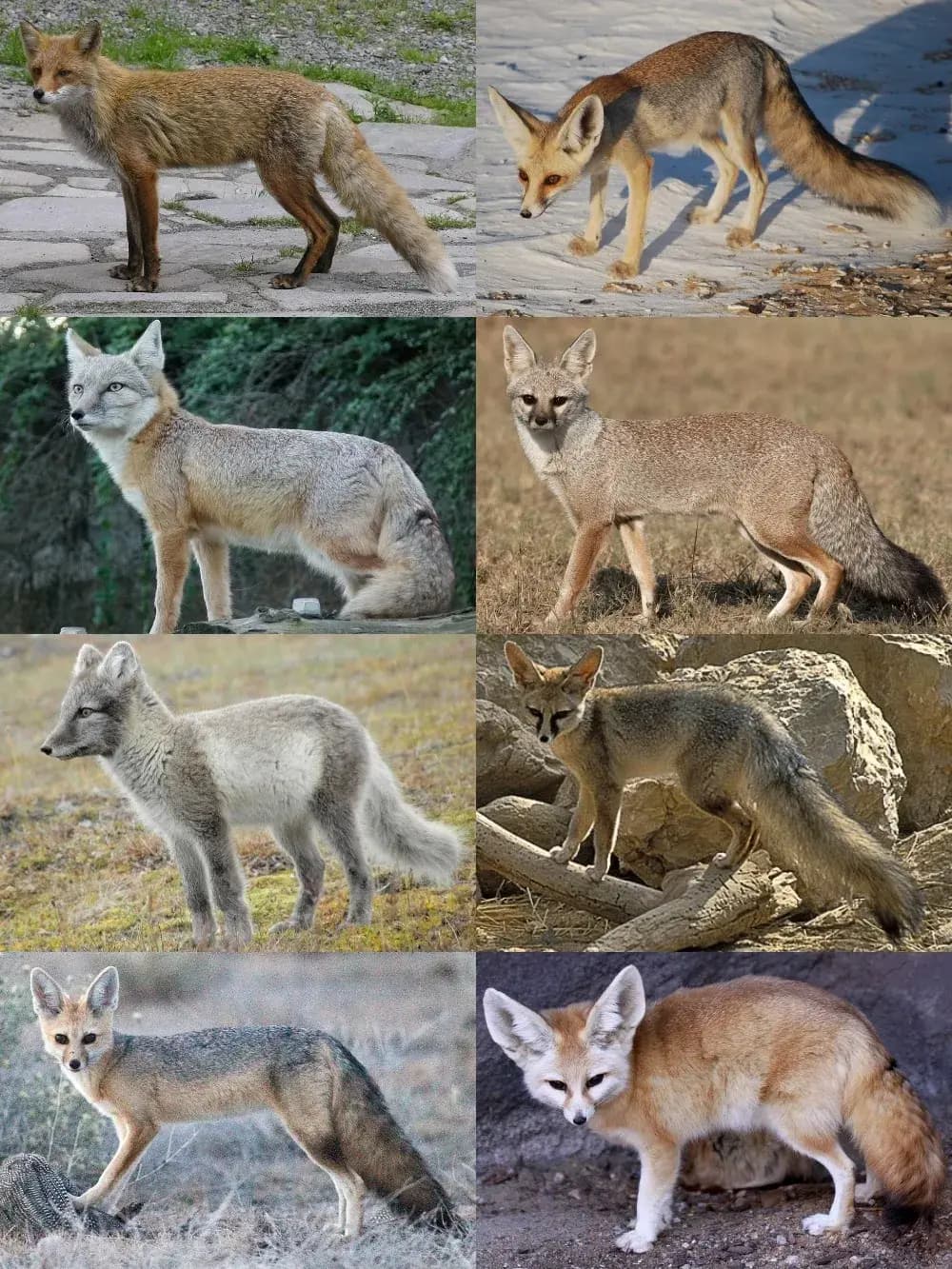
The red fox is the largest of the true foxes and, by range, the most widely distributed member of the entire order Carnivora. It occupies nearly the whole Northern Hemisphere, including most of North America, Europe, and Asia, plus parts of North Africa, and it has also been introduced to Australia, where it now preys on native small and medium-sized rodents and marsupials. Forty-five subspecies are currently recognized, split broadly into two groups: large, brightly colored northern foxes and smaller, longer-limbed southern grey desert foxes found across parts of Asia and North Africa.
The species originated in Eurasia during the Middle Pleistocene, at least 400,000 years ago, and colonized North America before 130,000 years ago, arriving in two separate waves tied to past glaciations. Genetic mapping shows that red foxes in North America have been isolated from their Old World relatives for more than 400,000 years, which has led some researchers to argue the two populations may deserve separate species status. In North America, two distinct refuge populations survived the last glaciation: a northern group centered in Alaska and western Canada, and a smaller-bodied montane group scattered through the Rocky Mountains, Cascades, and Sierra Nevada.
Physically, the red fox has an elongated body, relatively short legs, and a bushy tail that is longer than half its body length and reaches the ground when the animal stands. Its pupils are oval and vertical, and its forepaws carry five digits while the hind feet have only four, with no dewclaws. Despite the name, coloring varies: alongside the familiar reddish-rust coat with a white-tipped tail, black chin, and white throat, red foxes also produce silver/black (melanistic) and "cross" (partially melanistic) color morphs, and albinos occur rarely in the wild. Winter fur is dense, soft, and long, especially in northern populations, while southern forms carry shorter, coarser coats. A red fox is capable of clearing fences over 6 feet high and swims well, and it has acute hearing.
Behavior and diet
Diet
Small rodents, rabbits, squirrels, game birds, reptiles, invertebrates, young ungulates, fruit, and vegetables
Red foxes typically live in pairs or small family groups: a mated pair and their young, or occasionally a male with several related females. Young from the mated pair often stay on to help care for the next litter of kits.
Diet centers on small rodents, though red foxes also take rabbits, squirrels, game birds, reptiles, invertebrates, and young ungulates, and they round out their meals with fruit and vegetables when available. It has colonized many suburban and urban areas and, despite killing smaller predators including other fox species, remains too small to pose any real threat to humans. It is, in turn, vulnerable to larger predators such as golden eagles, Eurasian eagle-owls, long-tailed weasels, striped skunks, and American mink, among others.
The red fox has long been hunted both as a pest and for its fur, and it remains among the most economically important fur-bearing animals in the world. It also carries deep roots in human folklore and mythology across the cultures that share its range. The domestication of the red fox is also underway in Russia, and has resulted in the domesticated silver fox.
Range and habitat
Habitat
Adapts to forests, farmland, mountains, and increasingly cities and suburbs
The red fox's native range spans nearly the entire Northern Hemisphere: most of North America, Europe, and Asia, along with parts of North Africa. Its range has only grown alongside human settlement, and the species has been introduced to Australia, where its predation on native small and medium-sized rodents and marsupials has made it one of the animals listed among the world's 100 worst invasive species.
In North America, red foxes colonized the continent in two separate waves during past glacial periods, and fossil evidence places them across sites in Arkansas, California, Colorado, Idaho, Missouri, New Mexico, Ohio, Tennessee, Texas, Virginia, and Wyoming during the last ice age. As the climate warmed, their range contracted northward, and only recently have they reclaimed much of their former territory in the U.S. as human-driven landscape change has opened up new habitat. Eastern American red foxes have since spread through inland California, from Southern California north through the San Joaquin Valley and into the San Francisco Bay Area, including urban San Francisco itself, though the species remains more common in California's northern, wilder terrain than in its more developed south.
Conservation status
The red fox is listed as Least Concern (LC) on the IUCN Red List, reflecting its enormous range and large population. The species has benefited from human habitation, colonizing many suburban and urban areas.
The main pressure on red foxes historically has come from hunting and trapping for the fur trade, given their status as among the most important fur-bearing species harvested worldwide.
Where to see red fox in the U.S.
41 zoos across 20 states
Find the closest one
Rank the 34 zoos holding red fox by how far they are from you. Your location is used in your browser to sort this list and is never sent to us.
7 more zoos hold red fox but have no coordinates on file yet, so they aren't ranked here. They're in the full list below.
Arizona· 3
California· 5
Delaware· 1
Florida· 4
Georgia· 2
Idaho· 1
Illinois· 2
Indiana· 2
Kansas· 1
Louisiana· 2
Massachusetts· 1
Minnesota· 2
Missouri· 1
New Hampshire· 1
New York· 2
Pennsylvania· 1
Texas· 2
Utah· 1
Virginia· 4
Wisconsin· 3
AZAThe Association of Zoos and Aquariums. Accredited members have passed an independent inspection of animal care and welfare, safety, conservation and education, repeated every five years. Many smaller facilities never apply, so “not accredited” isn't a verdict on its own. What accreditation means · How we check this
Built from each zoo's own published animal list.
Red Fox: common questions
Is the red fox endangered?
No. It is listed as Least Concern by the IUCN, thanks to its huge range and large population across the Northern Hemisphere.
How big does a red fox get?
Adults stand about 14–20 inches at the shoulder and measure 18–35 inches in body length, with a bushy tail adding another 11.8–21.9 inches. Weights run from about 4.9 to 30.9 pounds, with males typically heavier than females.
What does a red fox eat?
Mostly small rodents, along with rabbits, squirrels, game birds, reptiles, invertebrates, young ungulates, and some fruit and vegetables.
How long do red foxes live?
Around 5 years, based on the species' recorded life expectancy.
Where do red foxes live in the wild?
Across nearly the entire Northern Hemisphere — most of North America, Europe, and Asia, plus parts of North Africa — and, following introduction, in Australia.
Which U.S. zoos have red foxes?
Ten zoos in our directory list a red fox, including Zoo Idaho, the Staten Island Zoo, and the Virginia Zoological Park.