- Where to see one
- 38 U.S. zoos in our directory hold fennec fox, confirmed against each zoo's own animal list.
- Native range
- Deserts of North Africa, from Western Sahara and Mauritania to the Sinai Peninsula
- Size
- Females 34.5–39.5 cm (13.6–15.6 in) head-to-body with a 23–25 cm (9.1–9.8 in) tail, weighing 1–1.9 kg (2.2–4.2 lb); males slightly larger
- Lifespan
- Up to 14 years in captivity, about 10 years in the wild
About the fennec fox
The fennec fox is the smallest species of fox and the smallest member of the dog family, Canidae, native to the deserts of North Africa from Western Sahara and Mauritania across to the Sinai Peninsula. Its defining feature is immediately obvious: ears that are enormous relative to its body, giving it the greatest ear-to-body ratio of any canid. Those ears do double duty, radiating body heat away in extreme desert temperatures and picking up the faint sounds of prey moving underground. The ears are densely furred inside, with reddish stripes along the back and whitish, darker-edged rims.
Females measure 34.5 to 39.5 cm (13.6 to 15.6 in) in head-to-body length, with a 23 to 25 cm (9.1 to 9.8 in) tail and ears 9 to 9.5 cm (3.5 to 3.7 in) long, weighing 1 to 1.9 kg (2.2 to 4.2 lb). Males are slightly larger, running 39 to 39.5 cm (15.4 to 15.6 in) head-to-body with similarly sized tails, ears around 10 cm (3.9 in), and a weight of at least 1.3 kg (2.9 lb). The coat is sand-colored, which reflects sunlight by day and helps retain warmth at night, with a black-tipped tail and dark streaks running from the inner eye down either side of a slender muzzle. Even the paws are adapted to the environment: dense fur on the pads makes walking across hot sand easier.
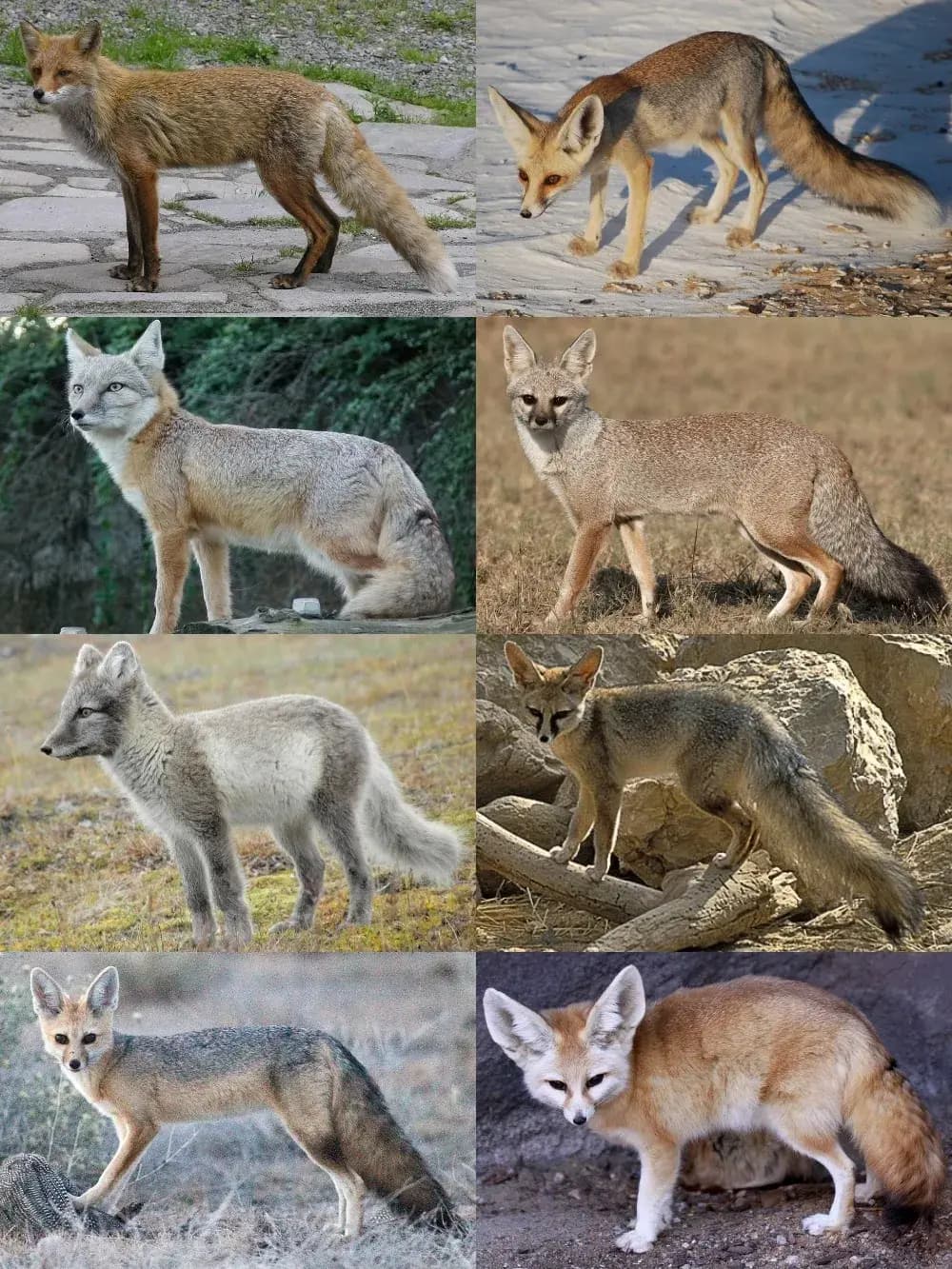
Beyond its ears and coat, the fennec fox carries a set of internal adaptations to desert life. It has large, dense kidneys with a compact medulla that help it conserve water, and it can survive on the moisture content of its food alone, drinking water only when it's available. Its closest living relative, based on DNA evidence, is Blanford's fox, one of eight so-called "desert fox" species within the genus Vulpes that have independently evolved similar traits — sandy coats, large ears, and specialized kidneys — for life in arid country.
Behavior and diet
Diet
Omnivorous — insects, small mammals, birds and eggs, fruit, leaves, roots, and tubers
Fennec foxes are primarily nocturnal, becoming most active during the cooler nighttime hours, which helps them avoid the harshest daytime heat and cuts down on water loss from panting. They dig extensive dens in sand, choosing open areas or spots sheltered by plants with stable dunes; in more compacted soil, a den can sprawl across 120 m² (1,300 sq ft) with as many as 15 separate entrances, and neighboring families sometimes connect or cluster their dens together. In softer, looser sand, dens are simpler, often just a single entrance leading to one chamber.
The species is omnivorous, hunting alone and digging in sand for small rodents, lizards such as geckos and skinks, small birds and their eggs, and insects, while also eating fruit, leaves, roots, and tubers. Some individuals have been observed burying surplus prey to eat later, and foraging near human settlements. A study of scat samples collected in the Algerian Sahara turned up more than 400 insects along with plant fragments, date palm fruit, and the remains of birds, mammals, squamates, and other insects — a snapshot of just how broad the diet can be.
Fennec foxes mate for life. Captive animals reach sexual maturity at around nine months and typically mate between January and April; females are in estrus for about 24 hours and usually breed once a year. Gestation runs 50 to 52 days, occasionally as long as 63. Litters of one to four pups are born between March and June, arriving with their eyes closed, which open after 8 to 11 days; both parents care for the young, weaning them at 61 to 70 days and continuing to look after them until they are roughly 16 to 17 weeks old. Family members communicate through barking, purring, yapping, and squeaking, and pups often remain with the family even after a new litter arrives. In captivity, fennec foxes display playful behavior, especially when young.
Range and habitat
Habitat
Sand dunes and treeless, sparsely vegetated desert
The fennec fox ranges across the Sahara, from Morocco and Mauritania in the west to northern Sudan and Egypt's Sinai Peninsula in the east. It lives in small sand dunes and vast, largely treeless areas of sand with sparse vegetation such as grasses, sedges, and small shrubs. Rainfall across this range is minimal and uneven — under 100 mm annually in the northern part of the range, compared with around 300 mm in the south.
Its territory overlaps with other desert canids, including the golden jackal and Rüppell's fox, but the fennec fox tends to occupy the areas with the most extreme climate and has adapted to build burrows in grainier, looser sand than its competitors typically use — an edge that helps it hold its own in a crowded desert food web.
Conservation status
The fennec fox is classified as Least Concern on the IUCN Red List, an assessment made in 2015. It is listed under CITES Appendix II and is protected by law in Morocco, Western Sahara, Algeria, Tunisia, and Egypt, where it has been documented in several protected areas. Precise population numbers are not known and are instead estimated from how often the species is sighted, but those estimates suggest it is not currently at risk of extinction.
Even so, the species faces real pressure. It is commonly trapped in North Africa for exhibition or sale, including as an exotic pet, and the expansion of permanent human settlements in southern Morocco has already pushed it out of some areas and confined it to marginal habitat elsewhere. Roadwork, seismic surveys, mining, oil fields, and general commercial and residential expansion across its range are all cited as additional threats. Conservation efforts include maintaining populations in zoos and other captive settings, alongside educational programs meant to support those efforts.
Where to see fennec fox in the U.S.
38 zoos across 24 states
Find the closest one
Rank the 26 zoos holding fennec fox by how far they are from you. Your location is used in your browser to sort this list and is never sent to us.
12 more zoos hold fennec fox but have no coordinates on file yet, so they aren't ranked here. They're in the full list below.
Arizona· 1
California· 4
Delaware· 1
District of Columbia· 1
Florida· 1
Georgia· 1
Hawaii· 1
Idaho· 1
Illinois· 3
Indiana· 1
Kansas· 1
Maine· 1
Massachusetts· 4
Michigan· 1
Mississippi· 2
Missouri· 1
New Jersey· 1
New York· 3
North Carolina· 3
Ohio· 1
Oklahoma· 1
Tennessee· 2
Texas· 1
Wisconsin· 1
AZAThe Association of Zoos and Aquariums. Accredited members have passed an independent inspection of animal care and welfare, safety, conservation and education, repeated every five years. Many smaller facilities never apply, so “not accredited” isn't a verdict on its own. What accreditation means · How we check this
Built from each zoo's own published animal list.
Fennec Fox: common questions
Is the fennec fox endangered?
No. It is classified as Least Concern by the IUCN, though it faces pressures from trapping for the exotic pet trade and habitat loss from expanding human settlement.
How big does a fennec fox get?
It's the smallest fox species. Females run 34.5–39.5 cm (13.6–15.6 in) head-to-body and weigh 1–1.9 kg (2.2–4.2 lb); males are slightly larger.
What does a fennec fox eat?
It's an omnivore, eating small rodents, lizards, birds and their eggs, insects, fruit, leaves, roots, and tubers.
How long do fennec foxes live?
Up to 14 years in captivity and about 10 years in the wild, according to recorded lifespans.
Where do fennec foxes live in the wild?
Across the deserts of North Africa, from Western Sahara and Mauritania to Egypt's Sinai Peninsula, in sand dunes and sparsely vegetated desert.
Which U.S. zoos have fennec foxes?
Ten zoos in our directory list the species, including the Phoenix Zoo in Arizona, the San Diego Zoo in California, and the Honolulu Zoo in Hawaii.