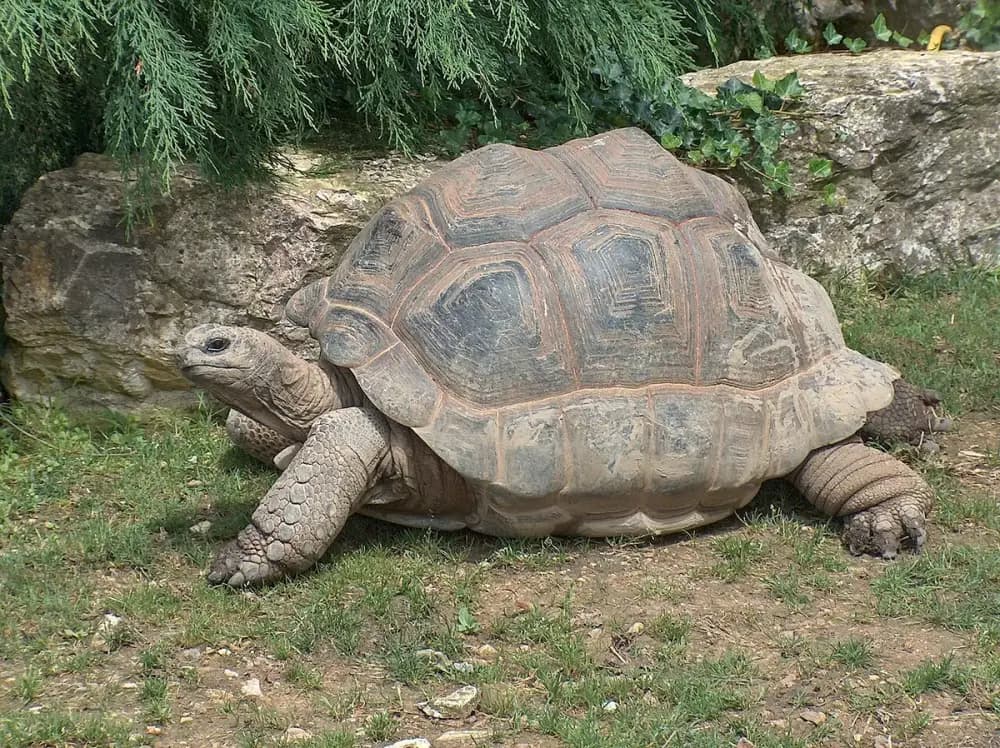
- Where to see one
- 34 U.S. zoos in our directory hold eastern box turtle, confirmed against each zoo's own animal list.
- Native range
- Eastern United States, from southern Maine and Michigan's Upper Peninsula south to northern Florida and west to eastern Kansas, Oklahoma, and Texas
- Size
- 4.5 to 8 in (11 to 20 cm) long
- Lifespan
- Can live over 100 years in captivity
Conservation status
Not Evaluated
This species has not been assessed for the IUCN Red List, so it sits outside the threat scale entirely.
Vulnerable (IUCN downgraded from near threatened in 2011)
About the eastern box turtle
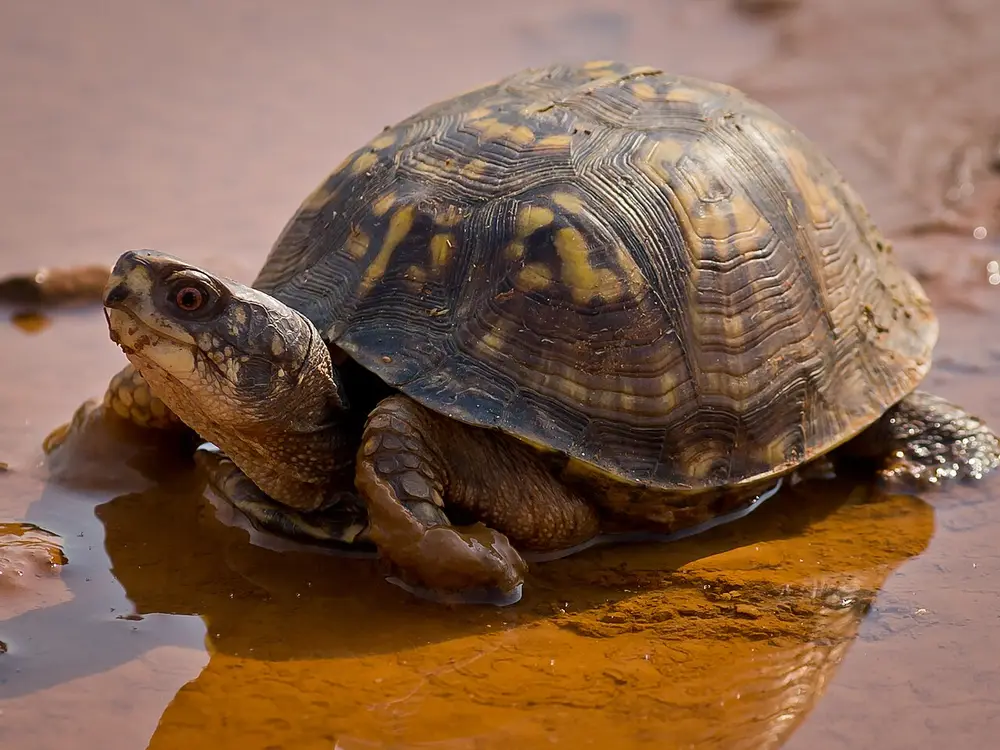
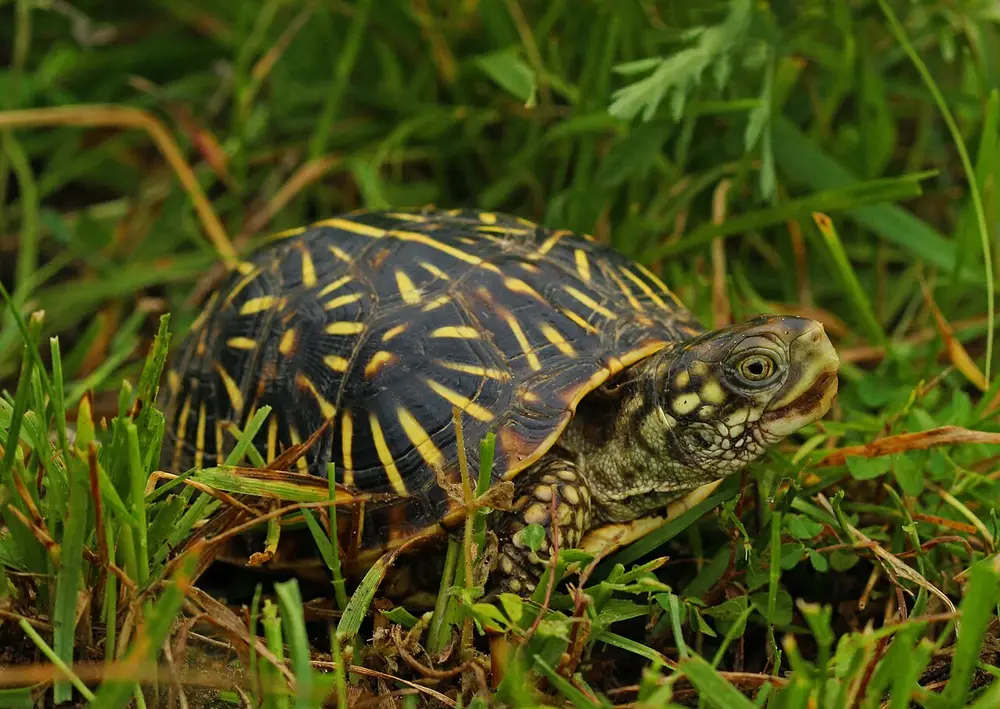
The eastern box turtle is a subspecies of the common box turtle, native to the eastern United States, and one of a group of hinge-shelled turtles known simply as box turtles. Although it belongs to the pond turtle family Emydidae, it is largely terrestrial rather than aquatic. It has a high, domelike carapace, usually brownish or black with a yellowish or orangish pattern of lines, spots, or blotches, and a middorsal keel that smooths out as the turtle ages. Skin coloring is similarly variable, typically brown or black with yellow, orange, red, or white markings that closely mimic the color of a winter tulip poplar leaf. In some isolated populations, males show blue patches on the cheeks, throat, and front legs, and males can usually be told apart from females by their red irises, versus brown in females.
The turtle's defining feature is its hinged plastron, which allows the shell to close completely. The female's plastron is flat, while the male's is concave, letting him fit over the back of the female's carapace during mating; the front and back sections of the plastron are joined by a flexible hinge that lets the turtle seal itself in when threatened. The shell is bone covered by living, vascularized tissue and a keratin layer, permanently fused to the turtle's rib cage rather than removable, and it can slowly regenerate when damaged as new keratin forms beneath the injury. Unlike aquatic turtles, box turtle scutes are never shed — they keep growing and forming growth rings throughout the animal's life. Adults measure 4.5 to 8 in (11 to 20 cm) long, have five toes on each front foot and typically four on each hind foot, and show a few other sex differences: females have longer, straighter rear claws, while males have longer, thicker tails.
Behavior and diet
Diet
Omnivore — earthworms, snails, slugs, insects, grasses, fruit, mushrooms, and carrion
As ectotherms, eastern box turtles regulate their body temperature by seeking shade or water when hot and basking spots when cool, which helps drive their metabolism for foraging and digestion. They are most active in the morning and burrow into leaf litter, brush, or soil in what are called "resting forms," used both for temperature regulation and hydration; they will also take shallow baths in streams or puddles and, in hot weather, may bury themselves in mud for days. Turtles placed in water too deep to touch bottom risk drowning. During winter, they burrow into the soil and stay dormant until temperatures rise again.
The species shows striking site fidelity, sometimes staying in the same home range for more than 32 years — unusually long for a reptile — and rarely traveling more than 1.5 miles (2.5 km) from that home territory. Turtles that are relocated will often try to find their way back, and their home ranges after relocation can be up to three times larger than those of resident turtles nearby; turtles in more isolated habitats tend to move less overall.
Eastern box turtles are opportunistic omnivores whose diet shifts with individual taste, temperature, light, and surroundings, since their appetite isn't driven by metabolism the way a warm-blooded animal's is — instead, they can simply retreat into their shells and stop eating until conditions improve. Commonly accepted foods include earthworms, snails, slugs, grubs, beetles, caterpillars, grasses, weeds, fallen fruit, berries, mushrooms, flowers, duckweed, and carrion; young turtles are mostly carnivorous, while adults lean herbivorous, though diet varies little by season. Breeding can occur across late spring, summer, and early fall, with egg laying most common in May and June during frequent rain. After a three-phase courtship and mating, the female digs a shallow nest over two to six hours and lays one to nine leathery, creamy-white eggs about 3 cm (1.2 in) long, sometimes producing one to five clutches a year; incubation runs 50 to 70 days on average, and hatchlings may emerge in fall or overwinter to hatch the following spring. Females can store sperm and lay fertile eggs up to four years after mating, though reproductive success overall is low.
Range and habitat
Habitat
Deciduous or mixed forest with a moist, well-drained floor; also grasslands and pastures
Eastern box turtles are found only in North America, mainly the eastern United States, ranging as far north as southern Maine and the southern and eastern Michigan Upper Peninsula, south to northern Florida, and west to eastern Kansas, Oklahoma, and Texas. In the north of their range they are rarely found above 1,000 ft (305 m) in elevation, while in the south they can occur up to 6,000 ft (1,830 m). The species is considered uncommon to rare in the Great Lakes region and is listed as a species of concern in Ohio, Michigan, and Indiana, though populations persist in areas without heavily traveled roads.
They favor an enriched habitat over a barren one, preferring deciduous or mixed forest with a moderately moist, well-drained floor, and bottomland forest over hillsides or ridges; a mature hardwood forest in eastern Tennessee was estimated to hold 7.6 to 9.2 adult turtles per acre. They can also be found in open grasslands, pastures, or sheltering under fallen logs and moist leaves.
Conservation status
In 2011, the IUCN downgraded the eastern box turtle's conservation status from near threatened to vulnerable, citing "a widespread persistent and ongoing gradual decline" of the species estimated at more than 32 percent over three generations. Habitat loss, degradation, and fragmentation from urbanization are the primary drivers of that decline. Slow to mature, long-lived, and producing relatively few offspring each year, box turtles are especially vulnerable to human-caused mortality, particularly from vehicle collisions and mowing equipment, and their habit of sheltering in leaf litter makes them susceptible to both wildfires and human-set fires. Disease is a further threat: ranaviruses have been documented in eastern box turtles in Illinois since 2014.
Collection for the pet trade also pressures wild populations — thousands are taken from the wild each year, though captive-bred individuals are encouraged over wild-caught ones. The species is protected across most of its range, though many states still permit capture for personal use, and captive breeding has not scaled up enough to meet market demand.
Where to see eastern box turtle in the U.S.
34 zoos across 23 states
Find the closest one
Rank the 31 zoos holding eastern box turtle by how far they are from you. Your location is used in your browser to sort this list and is never sent to us.
3 more zoos hold eastern box turtle but have no coordinates on file yet, so they aren't ranked here. They're in the full list below.
Alabama· 1
California· 1
Colorado· 1
Connecticut· 1
Delaware· 2
Georgia· 1
Illinois· 1
Indiana· 1
Louisiana· 2
Maryland· 2
Massachusetts· 5
Michigan· 1
Minnesota· 1
Mississippi· 1
New Jersey· 1
New York· 4
North Carolina· 1
Ohio· 1
Oklahoma· 1
Oregon· 1
Pennsylvania· 1
Texas· 1
Virginia· 2
AZAThe Association of Zoos and Aquariums. Accredited members have passed an independent inspection of animal care and welfare, safety, conservation and education, repeated every five years. Many smaller facilities never apply, so “not accredited” isn't a verdict on its own. What accreditation means · How we check this
Built from each zoo's own published animal list.
Eastern Box Turtle: common questions
Is the eastern box turtle endangered?
It's listed as Vulnerable by the IUCN, downgraded from near threatened in 2011 due to a decline exceeding 32 percent over three generations.
How big does an eastern box turtle get?
Adults range from 4.5 to 8 in (11 to 20 cm) long.
What does an eastern box turtle eat?
It's an omnivore, eating earthworms, snails, slugs, insects, grasses, fruit, mushrooms, and carrion; young turtles favor animal matter while adults lean more herbivorous.
How long do eastern box turtles live?
They can live over 100 years in captivity, though wild lifespans tend to be shorter due to disease and predation.
Where do eastern box turtles live in the wild?
Across the eastern United States, from southern Maine and Michigan's Upper Peninsula south to northern Florida and west to Kansas, Oklahoma, and Texas.
Which U.S. zoos have eastern box turtles?
Twenty zoos in our directory, including the Alabama Gulf Coast Zoo, Oakland Zoo in California, and Cheyenne Mountain Zoo in Colorado.