- Where to see one
- 10 U.S. zoos in our directory hold ornate box turtle, confirmed against each zoo's own animal list.
- Native range
- Central and southwestern United States, between the Rocky Mountains and the Mississippi River, and northern Mexico
- Size
- Shell about 9.5 to 15 cm (3.7 to 5.9 in) long, averaging 12 cm (4.7 in); 198 to 538 g (7 to 19 oz)
- Lifespan
- Usually 30 to 37 years in the wild; the oldest known wild turtle was over 40
- Clutch size
- One to eight eggs, averaging about three
- Other name
- Western box turtle
Conservation status
Near Threatenedassessed 2011
IUCN Red List category NT — step 2 of 7.
The ornate box turtle, sometimes called the western box turtle, is a North American box turtle and one of two box turtle species recognised in the United States. It has two subspecies: the ornate box turtle, found in the central United States from western Indiana to eastern Texas and Louisiana and in northeastern New Mexico, and the desert box turtle, found in the driest areas of western Texas, New Mexico, Arizona and northern Mexico. The shell is slightly flattened and less domed than in other box turtles, and is black or dark brown with yellow striping. Both subspecies dig deep burrows to escape the heat and reach higher humidity. Predators include coyotes, skunks, ravens, crows, raccoons and foxes.
About the ornate box turtle
The ornate box turtle, also called the western box turtle, is a small land turtle of the central and southwestern United States and northern Mexico. It is one of two box turtle species found in the U.S., the other being the eastern box turtle. It lives mainly in grasslands and prairies and spends much of its life in underground burrows.
Its scientific name is Terrapene ornata. Two subspecies are recognized: the ornate box turtle proper, T. o. ornata, described in 1857, and the desert box turtle, T. o. luteola, described in 1952. Like other box turtles, it has a hinged lower shell, or plastron, that it can close for protection.
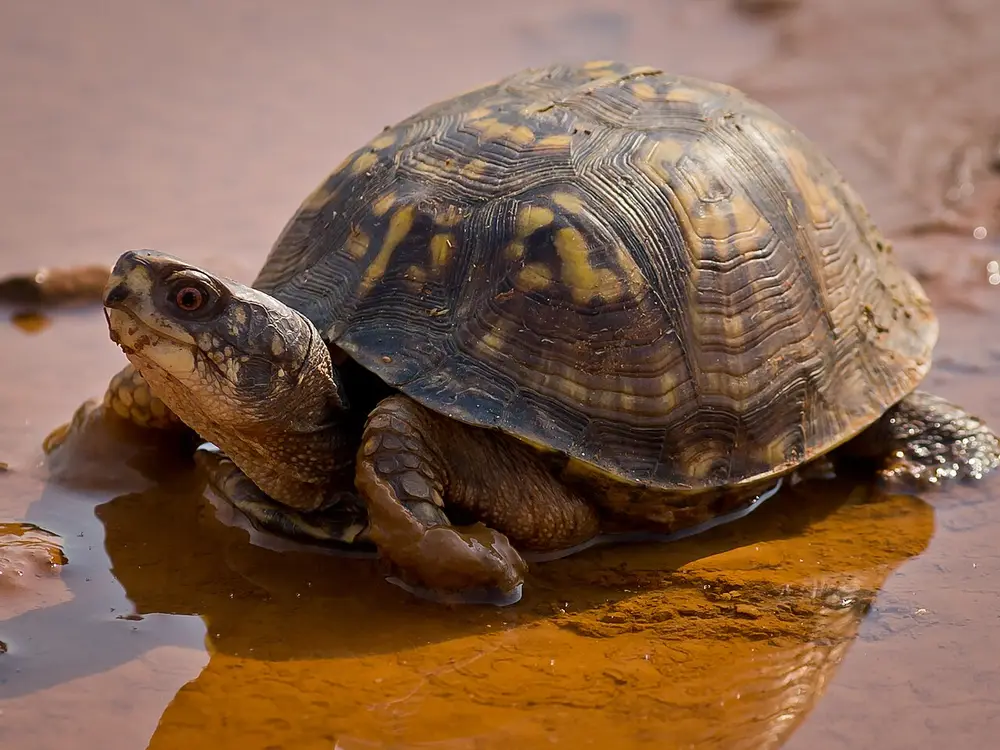
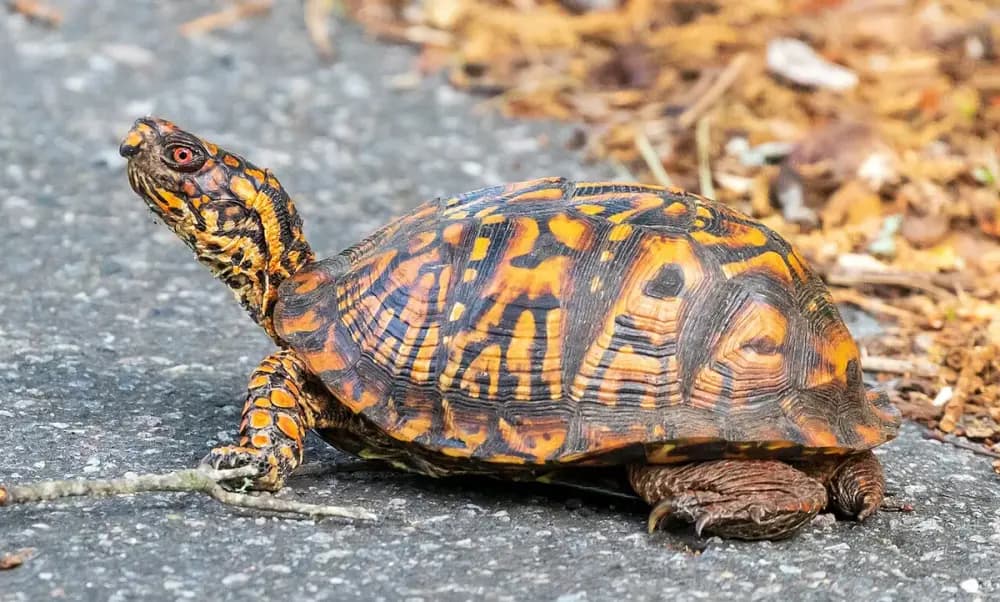
The shell is less domed than in other box turtles and looks slightly flattened on top. It is mostly dark brown or black, marked with thick yellow lines around each of the shell plates. The head, legs and tail are dark as well, and all adults have yellow spots on the head. The desert box turtle tends to have more yellow striping than the ornate subspecies.
Adults weigh 198 to 538 g (7 to 19 oz), with an average around 398 g (14 oz). The upper shell, or carapace, is 9.5 to 15 cm (3.7 to 5.9 in) long, averaging about 12 cm (4.7 in). Females are slightly larger than males. Growth rings on the shell plates reflect the turtle's age, and the turtle reaches its full size at about 13 years old.
Males and females are colored differently. Males usually have bright red eyes and a greenish head, while females have brown or black eyes and heads. The brighter colors may help males win mates.
Behavior and diet
Diet
Omnivore; earthworms, grasshoppers, beetles, slugs, fruit and plants
Ornate box turtles are land turtles, but they spend most of their lives underground. To escape heat and cold, they dig shallow burrows called forms, usually 20 to 50 cm (8 to 20 in) deep, at an angle along ditch banks or under plants. In winter they dig deeper, 50 cm to 1.8 m (20 in to 6 ft) down, and hibernate.
They are crepuscular and come out to bask, to dry off, to get rid of parasites and to feed. Summer rain showers often bring them above ground to look for food. They prefer body temperatures of about 21 to 25 °C (70 to 77 °F).
These turtles are loners. They interact mainly during the breeding season, when males may bite and shell-bump each other. Each turtle keeps to a small home range and often hibernates within about 1 m (3 ft) of the previous year's spot.
The ornate box turtle is an omnivore, and its diet shifts with what is available. Its most common foods are earthworms, grasshoppers, beetles, slugs, fruit and plants, with animal food eaten about twice as often as plants. Favorite plant foods include mulberries, dandelion flowers and prickly pear cactus. It also eats small fish and carrion. Young turtles eat a larger share of insects than adults.
Its senses are well tuned to food. It can tell moving insects from still ones and, in experiments, chose red-colored food over other colors even with no scent involved.
When threatened, a box turtle usually freezes, pulling its head and legs inside and clamping its shell shut. It may also dig in, retreat into water or, less often, fight back. Wild turtles often carry scars and cracked shells from attacks.
Their small size and slow pace make them easy targets, especially for eggs and juveniles. Known predators include coyotes, striped skunks, raccoons, Virginia opossums, American minks, red foxes, Chihuahuan ravens, American crows, eastern copperheads and domestic dogs. The desert box turtle is more likely to close up in its shell, while the ornate subspecies is bolder, sometimes stretching out its head and legs to look bigger.
Mating takes place from spring through summer, roughly late April to July. A female may mate with several males and store sperm for later use. Courting males follow and nudge females, and during mating a male may squirt water from his nostrils across her shell.
Females mature at about eight years old and males at about five. Nests are dug in sandy soil about 10 cm (4 in) deep, mostly in July. A female lays one or two clutches a year of one to eight eggs, each about 10 g (0.35 oz). Incubation lasts about 50 days.
The temperature of the nest decides the sex of the young. Eggs kept at 29 °C (84 °F) or warmer generally hatch as females, and those below 28 °C (82 °F) as males. There is no parental care after the eggs are laid, and many hatchlings do not survive.
Range and habitat
Habitat
Grassland and prairie, sand dunes and dry scrub with cactus, yucca and mesquite
The ornate box turtle lives in the central and southwestern United States between the Rocky Mountains and the Mississippi River, reaching north to Wisconsin and South Dakota, and south into northern Mexico. The ornate subspecies is found from western Indiana to eastern Texas and Louisiana and into northeastern New Mexico, and is most common in Kansas, Nebraska, Oklahoma and Texas.
The desert box turtle lives in the driest habitat of any box turtle. It is found in western Texas, New Mexico, Arizona and neighboring parts of northern Mexico, including Chihuahua and Sonora.
Both subspecies live mainly in open grassland and sand dunes, often among cactus, yucca, creosote bush and mesquite. Even in dry country they dig deep burrows to escape the heat and reach more humid soil.
Ornate box turtle vs eastern box turtle
The ornate box turtle and the eastern box turtle are the two box turtle species of the United States. Both can close their shells tightly, but they differ in shape and in how their species is divided.
| Feature | Ornate box turtle | Eastern box turtle |
|---|---|---|
| Scientific name | Terrapene ornata | Terrapene carolina |
| Shell shape | Less domed, slightly flattened | More domed |
| Subspecies | Two (ornate and desert box turtles) | Six, two of them found only in Mexico |
Conservation status
The ornate box turtle is listed as Near Threatened on the IUCN Red List, in an assessment published in 2011, and it is included in CITES Appendix II. In Indiana it is listed as a state endangered species, and several U.S. states protect it by law.
Cars are one of the leading causes of death, since the turtles' home ranges often overlap with roads. Because each turtle is so faithful to its home range, the loss of prairie to housing and cropland hits populations hard. Farm machinery, lawn mowers, predators and collection for the pet trade add to the toll. Slow maturity and heavy losses of young make recovery slow.
The species became the official state reptile of Kansas in 1986.
Where to see ornate box turtle in the U.S.
10 zoos across 5 states
Find the closest one
Rank the 9 zoos holding ornate box turtle by how far they are from you. Your location is used in your browser to sort this list and is never sent to us.
1 more zoo holds ornate box turtle but has no coordinates on file yet, so it isn't ranked here. It's in the full list below.
Colorado· 2
Illinois· 1
Kansas· 3
Kentucky· 1
Wisconsin· 3
AZAThe Association of Zoos and Aquariums. Accredited members have passed an independent inspection of animal care and welfare, safety, conservation and education, repeated every five years. Many smaller facilities never apply, so “not accredited” isn't a verdict on its own. What accreditation means · How we check this
Built from each zoo's own published animal list.
Ornate Box Turtle: common questions
How big do ornate box turtles get?
Their shells are usually 9.5 to 15 cm (3.7 to 5.9 in) long, averaging about 12 cm (4.7 in), and adults weigh 198 to 538 g (7 to 19 oz). Females are slightly larger than males.
How long do ornate box turtles live?
Usually 30 to 37 years in the wild, and the oldest known wild turtle was over 40. Wild-caught turtles often die quickly if suddenly moved into captivity.
What do ornate box turtles eat?
Earthworms, grasshoppers, beetles, slugs, fruit and plants such as mulberries, dandelions and prickly pear cactus. They also eat carrion and small fish.
Where do ornate box turtles live?
In grasslands, prairies and dry scrub of the central and southwestern U.S., from Wisconsin and South Dakota south to Texas, Arizona and northern Mexico.
Do ornate box turtles bite?
Yes, they may bite people when they feel threatened, though their usual defense is to close up inside their shell and stay still.
How can you tell a male ornate box turtle from a female?
Males usually have bright red eyes and a greenish head, while females have brown or black eyes and heads. Females are slightly larger.
Are ornate box turtles endangered?
They are listed as Near Threatened by the IUCN and are endangered in Indiana. Road deaths, habitat loss and the pet trade are the main threats.