- Where to see one
- 29 U.S. zoos in our directory hold chuckwalla, confirmed against each zoo's own animal list.
- Native range
- Sonoran and Mojave Deserts, southwestern U.S. and northwestern Mexico
- Size
- Up to 20 in (51 cm) long; up to 0.9 kg (2.0 lb)
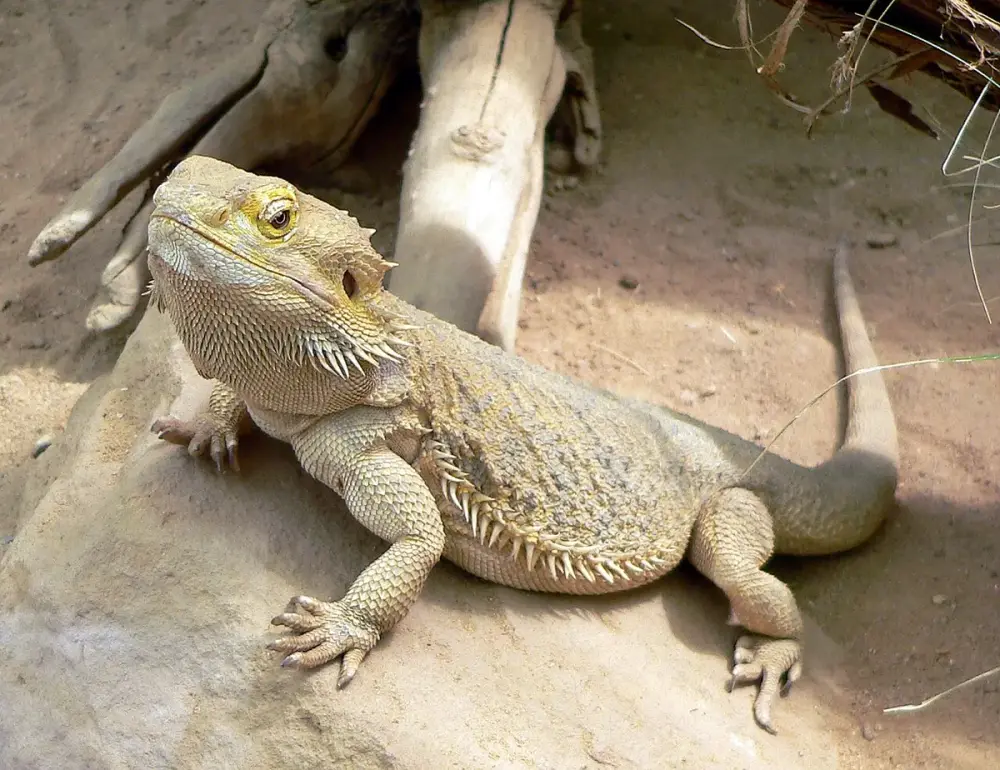
The common chuckwalla is a large, flat-bodied lizard of the Sonoran and Mojave Deserts in the south-western United States and north-western Mexico, ranging from eastern California, Utah and Nevada south to Baja California and Sonora. It reaches a total length of 20 in (51 cm) and a weight of 2.0 lb (0.9 kg), with a large rounded belly and a blunt-tipped tail. Adult males are black on the head, shoulders and pelvis with a light tan, brown-speckled midbody, while females are brownish with dark red spots. Mainly herbivorous, it eats creosote bush flowers, leaves and fruit, and occasionally insects. When threatened, it wedges itself into a rock crevice by inflating its lungs.
About the chuckwalla
The common chuckwalla, also called the northern chuckwalla, is a large, flat-bodied lizard in the family Iguanidae. It has a rounded belly and a wide-based, blunt-tipped tail, and reaches a total length of up to 20 inches (51 centimeters) and a weight of up to 0.9 kilograms (2.0 pounds). Small scales cover most of the body, with larger scales protecting the ear openings.
Coloration varies by location, age, and sex. Adult males have black heads, shoulders, and pelvic regions with a light tan midbody speckled in brown, while adult females are brownish with scattered dark red spots. Juveniles carry four or five broad bands across the body and three or four on the tail, patterns that fade in adult males but persist to some degree in females.
The species inhabits the Sonoran and Mojave Deserts of the southwestern United States and northwestern Mexico, ranging from eastern California, Utah, and Nevada south to Baja California and Sonora. Taxonomically, the species has a tangled history: U.S. populations were long called Sauromalus obesus, a name still common in field guides, but a 1998 review concluded the U.S. and Mexican forms belonged to a single species, and in 2004 the International Commission on Zoological Nomenclature ruled that Sauromalus ater — first described in 1856, two years before S. obesus — took priority. Five subspecies are currently recognized: S. a. ater, S. a. shawi, S. a. multiforaminatus, S. a. townsendi, and S. a. tumidus.
The generic name Sauromalus combines Greek words meaning "lizard" and, roughly, "flat," describing the animal's flattened build, while the specific name ater is Latin for "black" or "dark." The common name itself comes from the Shoshone word tcaxxwal, or the related Cahuilla form caxwal, used by Indigenous peoples of southeastern California long before English-speaking naturalists adopted it.
Behavior and diet
Diet
Primarily plants (herbivorous), occasionally insects
Chuckwallas are harmless to humans and typically flee from threats. When cornered, a chuckwalla wedges itself into a rock crevice and inflates its lungs using a gular pump, distending its body until it is jammed tightly in place and difficult to extract. Males are seasonally and conditionally territorial: where resources are abundant, a size-based hierarchy forms with one large male dominating smaller rivals, and chuckwallas use color, push-ups, head-bobbing, and mouth-gaping to communicate and defend territory.
The species is diurnal and ectothermic, spending much of the morning basking, with different postures by season — lying flattened against sun-warmed rock in spring, sitting or "stilting" in summer heat. Chuckwallas are active at temperatures up to 102°F (39°C) and brumate during cooler months, emerging in February.
Primarily herbivorous, chuckwallas eat creosote bush flowers, leaves, and fruit, preferring annual forbs and grasses but turning to the leaves of perennial shrubs when needed; they occasionally eat insects. Individuals in areas with greater plant diversity tend to grow larger. Mating occurs from April to July, with females laying 5 to 16 eggs between June and August; the eggs hatch in late September.
Range and habitat
Habitat
Rocky desert terrain with crevices
The chuckwalla's range spans the Sonoran and Mojave Deserts of the southwestern United States and northwestern Mexico, from eastern California, Utah, and Nevada south through Baja California and Sonora. It favors rocky desert habitat where crevices offer shelter from predators and extreme heat, a feature central to its main defense strategy of wedging itself in place when threatened.
Conservation status
The chuckwalla is classified as Least Concern by the IUCN. Historically, the species was a food source for Native Americans in the Death Valley region, who hunted chuckwallas hiding in rock crevices by puncturing their lungs with a bone-barbed hook to deflate them and make extraction possible.
Where to see chuckwalla in the U.S.
29 zoos across 17 states
Find the closest one
Rank the 28 zoos holding chuckwalla by how far they are from you. Your location is used in your browser to sort this list and is never sent to us.
1 more zoo holds chuckwalla but has no coordinates on file yet, so it isn't ranked here. It's in the full list below.
Arizona· 1
California· 7
Colorado· 2
Florida· 1
Indiana· 1
Kansas· 2
Kentucky· 1
Massachusetts· 2
Michigan· 1
New Jersey· 1
New Mexico· 1
New York· 2
North Carolina· 1
Ohio· 1
Oklahoma· 1
Pennsylvania· 2
Wisconsin· 2
AZAThe Association of Zoos and Aquariums. Accredited members have passed an independent inspection of animal care and welfare, safety, conservation and education, repeated every five years. Many smaller facilities never apply, so “not accredited” isn't a verdict on its own. What accreditation means · How we check this
Built from each zoo's own published animal list.
Chuckwalla: common questions
Is the chuckwalla endangered?
No. The chuckwalla is listed as Least Concern by the IUCN.
How big does a chuckwalla get?
It reaches a total length of up to 20 inches (51 centimeters) and a weight of up to 0.9 kilograms (2.0 pounds).
What does a chuckwalla eat?
It is mostly herbivorous, eating creosote bush flowers, leaves, and fruit, along with occasional insects.
How does a chuckwalla defend itself?
When threatened, it wedges into a rock crevice and inflates its lungs so its body swells and jams tightly in place, making it hard to pull out.
Where do chuckwallas live in the wild?
They live in the Sonoran and Mojave Deserts of the southwestern United States and northwestern Mexico, from eastern California, Utah, and Nevada south to Baja California and Sonora.
Which U.S. zoos have chuckwallas?
Sixteen zoos in our directory list them, including the Los Angeles Zoo, Cheyenne Mountain Zoo, and North Carolina Zoo.