- Where to see one
- 32 U.S. zoos in our directory hold amur tiger, confirmed against each zoo's own animal list.
- Native range
- Northeast China, the Russian Far East, and possibly North Korea
- Size
- males average 195 cm (77 in) in head-and-body length and weigh around 176.4 kg (389 lb) on average; females average 174 cm (69 in) and about 117.9 kg (260 lb)
Conservation status
Endangeredassessed 2022
IUCN Red List category EN — step 4 of 7.
The tiger as a species is Endangered (EN), assessed 2022; the Amur population is recovering
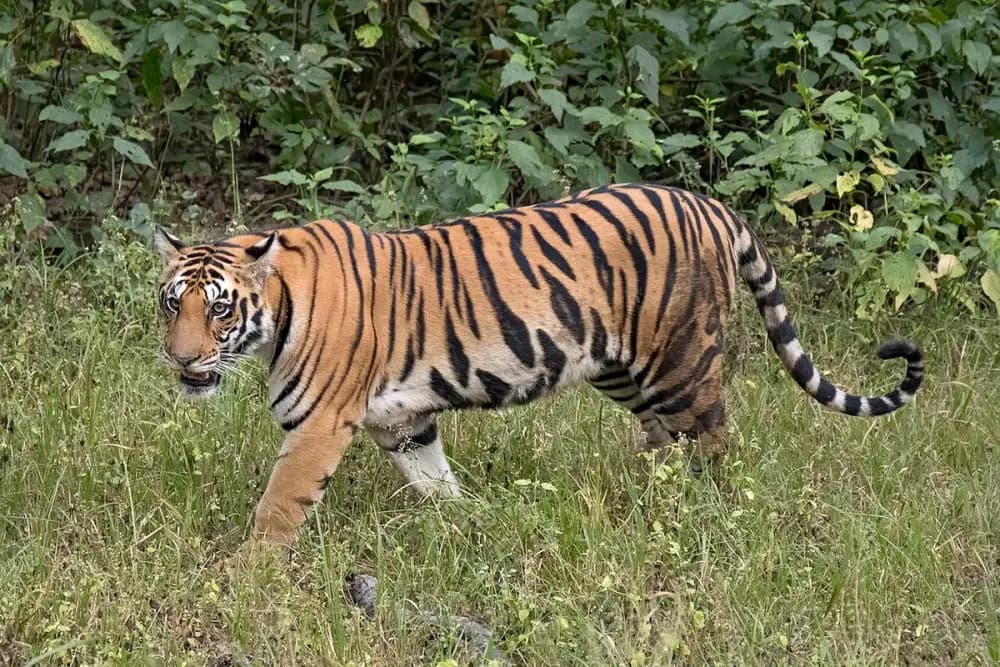
The Amur tiger is the northernmost tiger population, surviving in the temperate and boreal forest of the Russian Far East and a small area of north-eastern China. It is generally the largest of the tigers, with a heavier build, paler and less densely packed striping, and a thick winter coat with a pronounced ruff around the neck. Individual home ranges are vast — far larger than those of tropical tigers — because prey density in northern forest is low; a single male may range across hundreds of square miles, hunting red deer, wild boar and smaller game. The population was reduced to a few dozen animals by the middle of the twentieth century and has since partially recovered under sustained anti-poaching enforcement and habitat protection, though it remains dependent on that protection and vulnerable to poaching and prey depletion.
About the Amur tiger
The Amur tiger, also called the Siberian tiger, is a population of the tiger subspecies Panthera tigris tigris native to Northeast China, the Russian Far East, and possibly North Korea. It once ranged across the entire Korean Peninsula but was eradicated there during the period of Japanese rule between 1910 and 1945. Today it survives mainly in the Sikhote-Alin mountain region in the southwest of Primorsky Krai. Depending on the region where a given animal was recorded, it has also gone by the names Amur tiger, Manchurian tiger, Korean tiger, and Ussurian tiger.
Genetically, the Amur tiger is the closest living relative of the now-extinct Caspian tiger; researchers believe a shared ancestor colonized Central Asia from eastern China via the Gansu–Silk Road corridor before spreading east into the Russian Far East. In 2017, the Cat Specialist Group revised tiger taxonomy to recognize all mainland Asian tiger populations, including this one, as Panthera tigris tigris.
Physically, the Amur tiger is reddish-rusty to rusty-yellow with narrow black transverse stripes, an extended, supple body, relatively short legs, and a long tail. Its winter coat is notably pale, thick, and shaggy — among the densest of any tiger population — with fur on the neck and head so long it nearly covers the ears; the summer coat is coarser and brighter in color. The skull is broad and powerful around the canines, with prominent ridges in old males that can be more massive than those seen in the largest Bengal tiger skulls.
Behavior and diet
Diet
Manchurian wapiti, Siberian roe deer, wild boar, and sika deer
Detailed behavioral records are limited, but the Amur tiger's range overlaps a distinct mix of prey species. Manchurian wapiti, Siberian roe deer, and wild boar are the most common ungulates across the Sikhote-Alin mountains, though they become rarer at higher elevations in spruce-fir forest. Sika deer, another prey species, are restricted to the southern part of the range. The tiger's habitat itself is a mosaic shaped by the merging of the East Asian temperate broadleaf and mixed forest zone with taiga, and its key habitat consists of structurally complex Korean pine forests.
The Amur tiger is generally considered the largest tiger population. Historical and contemporary body-weight data, compiled by an international group of zoologists in 2005, show that wild males have gotten smaller over time: the historical average wild male weighed 215.3 kg (475 lb), while the average contemporary wild male weighs 176.4 kg (389 lb), with an asymptotic upper limit around 222.3 kg (490 lb). Wild females averaged 137.5 kg (303 lb) historically versus 117.9 kg (260 lb) today. Researchers attribute the decline partly to reduced prey abundance from illegal hunting, and to the fact that measured individuals were often sick, injured, or caught in conflict with people.
Measurements from the Siberian Tiger Project put average head-and-body length at 195 cm (77 in) for males and 174 cm (69 in) for females, with average tail lengths of 99 cm (39 in) and 91 cm (36 in) respectively. The longest male on record measured 309 cm (122 in) in total length, including a 101 cm (40 in) tail and a chest girth of 127 cm (50 in); the longest female measured 270 cm (110 in) total, with an 88 cm (35 in) tail and a 108 cm (43 in) chest girth.
Range and habitat
Habitat
temperate broadleaf and mixed forest merging with taiga, especially Korean pine forest
The Amur tiger's historical range once stretched across much of the Korean Peninsula, Manchuria, and other parts of northeastern China, the eastern part of Siberia, and the Russian Far East, possibly as far west as Mongolia and Lake Baikal. Today, its range runs roughly 1,000 km (620 mi) north to south along Primorsky Krai and into southern Khabarovsk Krai, east and south of the Amur River, and extends into the Greater Xing'an Range where it crosses from China into southwestern Primorsky Krai.
Population counts have shifted over the past two decades. In 2005, researchers estimated 331 to 393 adult and subadult tigers in this region, including about 250 breeding adults; that population had been stable for over a decade thanks to conservation efforts, though surveys after 2005 suggested a decline. A 2015 census found the population had grown to 480–540 individuals, including 100 cubs, and a more detailed follow-up count put the total at 562 wild tigers in Russia. As of 2014, roughly 35 tigers were estimated to live in the international border area between Russia and China. By 2022, the Russian Far East population was estimated at about 756 tigers, including 200 cubs.
Conservation status
The tiger as a species is listed as Endangered on the IUCN Red List, most recently assessed in 2022, and it has held an Endangered listing since 1986. No separate IUCN Red List category is cited for the Amur tiger, so the species-level status applies. Worldwide, tiger numbers are thought to have fallen from an estimated 5,000 to 8,262 in the late 1990s to 3,726 to 5,578 as of 2022, and the species has lost at least 93% of its historic range.
The Amur population has bucked that trend. It was estimated at 331 to 393 individuals in 2005, declined in the years after, then recovered to 480 to 540 tigers by 2015 and roughly 756, including 200 cubs, by 2022 in the Russian Far East. Stepped-up anti-poaching patrols in four Russian protected areas during 2011 to 2014 helped reduce poaching, stabilize the population and protect prey, and poaching and trafficking were declared moderate and serious crimes in Russia in 2019.
Poaching is still the main threat in far eastern Russia, where logging roads give poachers access to tiger habitat and people harvest forest foods that prey animals depend on in winter. A small, isolated population in the Changbai Mountains along the China–Russia border also faces inbreeding, habitat loss and scarce prey. Genetic studies have found notably low variability in the wild population's maternal DNA lineages, suggesting a recent genetic bottleneck, though captive populations show higher mitochondrial diversity that could help offset variation lost in the wild.
Where to see amur tiger in the U.S.
32 zoos across 23 states
Find the closest one
Rank the 31 zoos holding amur tiger by how far they are from you. Your location is used in your browser to sort this list and is never sent to us.
1 more zoo holds amur tiger but has no coordinates on file yet, so it isn't ranked here. It's in the full list below.
Colorado· 1
Idaho· 2
Illinois· 2
Indiana· 1
Iowa· 1
Kansas· 2
Kentucky· 1
Maryland· 1
Michigan· 1
Minnesota· 2
Missouri· 2
Montana· 1
New York· 2
North Carolina· 1
North Dakota· 1
Ohio· 1
Oregon· 1
Pennsylvania· 2
South Carolina· 1
South Dakota· 1
Utah· 1
Washington· 1
Wisconsin· 3
AZAThe Association of Zoos and Aquariums. Accredited members have passed an independent inspection of animal care and welfare, safety, conservation and education, repeated every five years. Many smaller facilities never apply, so “not accredited” isn't a verdict on its own. What accreditation means · How we check this
Built from each zoo's own published animal list.
Amur tiger: common questions
Is the Amur tiger endangered?
Yes. The tiger as a species is listed as Endangered on the IUCN Red List (2022 assessment), and that status covers the Amur tiger. Its own numbers in the Russian Far East have recovered from 331 to 393 animals in 2005 to roughly 756, including 200 cubs, by 2022.
How big does an Amur tiger get?
Males average 195 cm (77 in) in head-and-body length and about 176.4 kg (389 lb); the longest male on record measured 309 cm (122 in) total length. Females are smaller, averaging 174 cm (69 in) and about 117.9 kg (260 lb).
What does an Amur tiger eat?
Manchurian wapiti, Siberian roe deer, and wild boar are its most common prey, along with sika deer in the southern part of its range.
Where do Amur tigers live in the wild?
Mainly the Sikhote-Alin mountain region of southwestern Primorsky Krai in the Russian Far East, with a smaller population along the border with northeastern China.
Which U.S. zoos have Amur tigers?
Fifteen U.S. zoos list them, including Brookfield Zoo Chicago, the Minnesota Zoo, and the Oregon Zoo.